
Think-Ink-Pair-Share
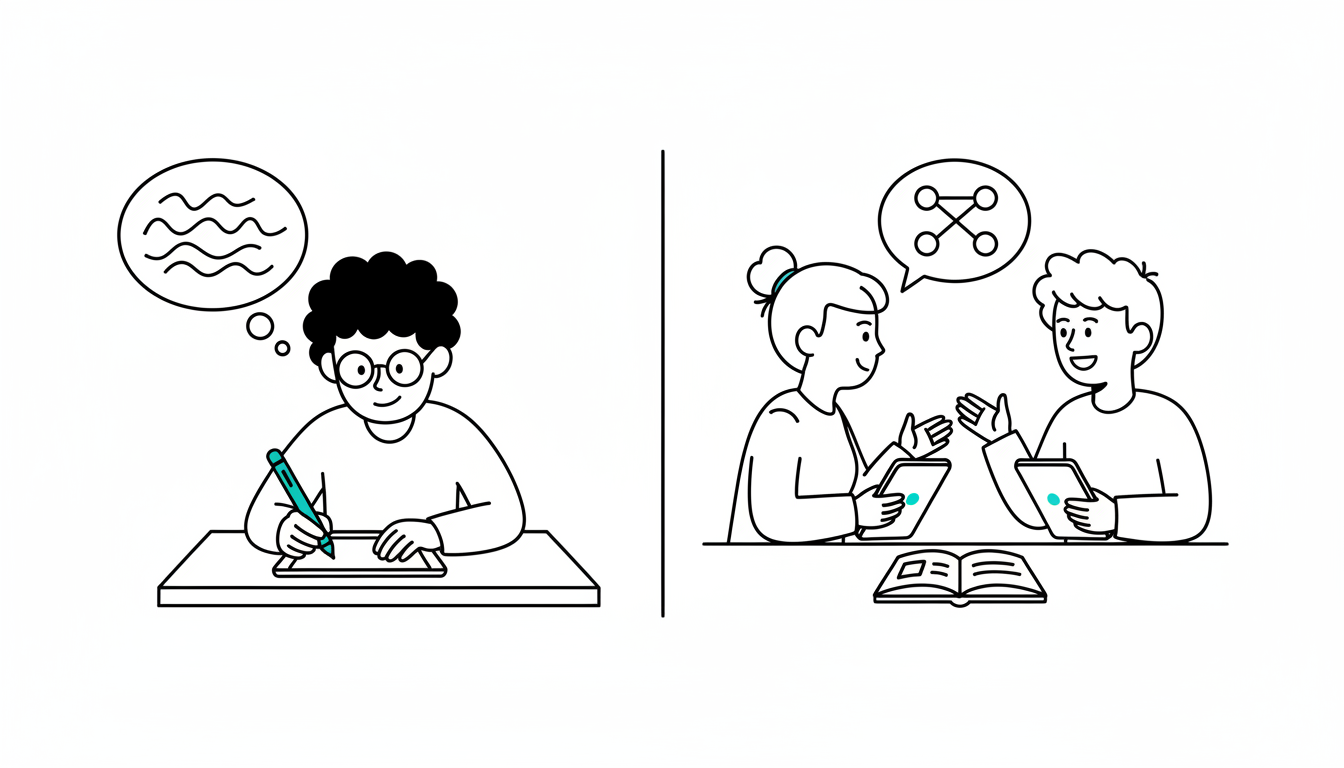
At a Glance
- Time: 4-5 minutes
- Prep: None
- Group: Individual reflection then pair discussion
- Setting: Any classroom
- Subjects: Universal
- Energy: Low
Purpose
Deepen individual reflection and expand perspective-taking by adding a critical written component to traditional Think-Pair-Share, ensuring every student formulates and captures their own thinking in writing before hearing others' ideas, which preserves individual accountability, creates a thinking record, and makes the subsequent discussion richer because students come with prepared, articulated thoughts rather than improvised reactions.
How It Works
- Pose reflection question (15 sec) - "What was the most important idea from today's lesson? Why?"
- Silent individual thinking (60 sec) - Students sit quietly processing the question
- Write (ink) (90-120 sec) - Students write their response—no talking, capturing thoughts in sentences
- Pair share (90 sec) - Partners take turns sharing what they wrote, comparing perspectives
- Optional whole-class share (30 sec) - Sample a few pairs' insights
What to Say
Opening: "We're going to do Think-Ink-Pair-Share. It's like Think-Pair-Share, but with one key difference: you'll WRITE your thinking down before you talk. That 'ink' step is crucial—it captures your thoughts and makes them stick."
Step 1 - Think: "Here's the question: [pose question]. Think silently for one minute. Don't write yet. Just think."
Step 2 - Ink: "Now WRITE your answer. Get your thoughts on paper. You'll share this with a partner, so make it clear. You have 2 minutes."
Step 3 - Pair: "Turn to your partner. Partner A, share what you wrote—don't summarize, READ it or speak from your notes. Partner B, you're listening. Then switch. You have 90 seconds total."
Step 4 - Share: "What did your partner say that made you think differently? Anyone willing to share with the whole class?"
Why It Works
The "ink" component transforms this from a discussion protocol into a metacognitive thinking routine. Writing before speaking forces students to clarify their thinking—vague impressions must become concrete sentences (Langer & Applebee, 1987). This addresses a common problem in pair-share: dominant students speak first while quieter students passively agree. With written commitment, every student HAS a formed opinion before discussion, increasing equity and quality of conversation. Writing also creates an artifact: students can return to their notes later, and teachers can collect them for formative assessment of understanding.
Research Citation: Writing as thinking tool (Langer & Applebee, 1987)
Teacher Tip
Resist the urge to skip the writing step when short on time. The writing IS the learning—that's where individual sense-making happens. If you skip straight to pair-share, you lose the metacognitive benefit and risk having students just echo the first idea they hear from their partner.
Variations
For Different Subjects
- Math/Science: "Write your solution process step-by-step, then compare methods with a partner"
- Humanities: "Write your interpretation of the text, then discuss with partner how your readings differ"
- Universal: "Write what confused you most today, then troubleshoot together with your partner"
For Different Settings
- Large Class (30+): After pair-share, sample 3-4 pairs to share key ideas with whole class
- Small Group (5-15): After pair-share, do full-class go-around where each student shares one key idea from their writing
For Different Ages
- Elementary (K-5): Shorten writing time to 60 seconds; allow drawing + labels instead of full sentences
- Middle/High School (6-12): Standard protocol with 2-minute writing time
- College/Adult: Extend writing to 3-4 minutes for more complex prompts; can assign before class and use class time for pair-share only
Online Adaptation
Tools Needed: Breakout rooms, chat or shared document
Setup: Prepare reflection prompt on slide
Instructions:
- Think (60 sec): Display prompt, students think silently (cameras on, no typing yet)
- Ink (2 min): Students type response in private document or chat draft (don't send yet)
- Pair (90 sec): Assign breakout rooms; students paste their written responses in breakout room chat and discuss
- Share (30 sec): Return to main room; invite volunteers to share from their writing or their partner's insight
Pro Tip: Use Google Doc with comment feature—students write response, partner reads and leaves comment with their perspective.
Troubleshooting
Challenge: Students write one word or one vague sentence to minimize effort Solution: Set minimum expectation: "Your response should be at least 3 sentences. First sentence: answer the question. Second: explain WHY. Third: give an example."
Challenge: During pair-share, students don't actually share what they WROTE—they summarize or improvise Solution: Require students to literally READ their writing to their partner: "Don't summarize—read exactly what you wrote. Your words matter."
Challenge: Pairs finish early and go off-task Solution: Provide extension question for early finishers: "If you're done, discuss: How were your responses similar? How different? Why do you think you focused on different ideas?"
Extension Ideas
- Deepen: "Think-Ink-Pair-Share-Revise"—after discussion, students return to their writing and add one sentence incorporating their partner's perspective
- Connect: Collect written responses periodically as formative assessment; return them to students at end of unit to reflect on how their thinking evolved
- Follow-up: Occasionally do "gallery walk" with written responses posted anonymously around room; students read others' thinking
Related Activities: Think-Pair-Share, Learning Journals, Reflection Rapid Fire