
Turn and Talk
At a Glance
- Time: 1-2 minutes
- Prep: None
- Group: Pairs
- Setting: Any
- Subjects: Universal
- Energy: Medium
Purpose
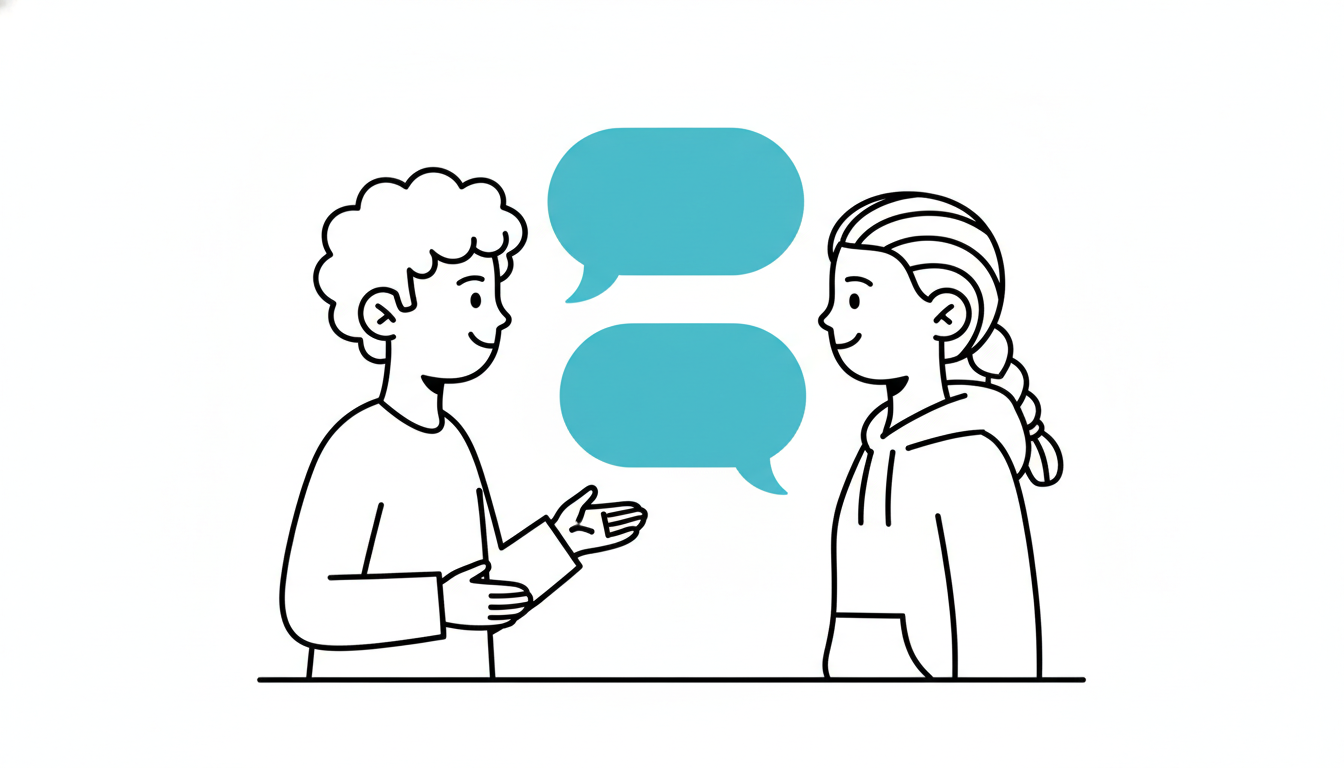
Quickly activate prior knowledge through brief partner conversation. Students turn to someone nearby and talk about what they know or predict about a topic. This low-stakes sharing surfaces knowledge, rehearses ideas, and builds confidence before whole-class discussion.
How It Works
- POSE PROMPT (10 seconds) - Ask a question about the topic
- TURN (5 seconds) - Students physically turn to face a partner
- TALK (60-90 seconds) - Partners share what they know
- OPTIONAL SHARE (30 seconds) - Call on 1-2 pairs to share with whole class
What to Say
"We're about to learn about [topic]. Turn to the person next to you. You have 90 seconds to talk about: What do you already know about this topic? Or, what does this topic make you think of? Go!"
(After 90 seconds) "Thank you! Let's hear from one pair. What did you discuss?"
Example Prompts:
- "Turn and talk: What do you know about the water cycle?"
- "Turn and talk: When you hear 'American Revolution,' what comes to mind?"
- "Turn and talk: How do you think fractions are used in real life?"
Why It Works
Talking to one person is less intimidating than addressing the whole class, so more students participate. Verbalizing knowledge aids retrieval and organization. Hearing a partner's ideas can trigger additional recall ("Oh yeah, I forgot about that!"). The social interaction increases engagement. Turn and Talk also gives the teacher a moment to circulate and listen to student thinking, informing instruction.
Research Citation: Peer discussion enhances learning by activating prior knowledge and facilitating cognitive rehearsal (Webb, 1989).
Teacher Tip
Set a timer! Conversations can drag without a time limit. Also, circulate and listen—you'll gain valuable insight into what students actually know (vs. what you assume they know).
Variations
Prompt Types
Recall: "What do you know about [topic]?" Prediction: "What do you think we'll learn today?" Personal Connection: "Have you ever experienced [related situation]?" Question Generation: "What questions do you have about this topic?"
Content Examples
- Science: "Turn and talk: Explain what you know about gravity to your partner."
- Math: "Turn and talk: How would you solve this problem? Share your strategy."
- Literature: "Turn and talk: What do you predict will happen next in the story?"
- History: "Turn and talk: Why do you think this event happened?"
- Language: "Turn and talk: What cognates (similar words) do you know in English and Spanish?"
Partner Selection
Proximity: Turn to whoever is nearby (quickest) Assigned Partners: Predetermined pairs Clock Partners: Students have pre-assigned partners for different "times" (1 o'clock partner, 3 o'clock partner, etc.) Random: Draw names or use a randomizer
Time Variations
Quick (60 seconds): One brief exchange per person Standard (90 seconds): Each person shares for about 45 seconds Extended (2-3 minutes): Deeper discussion with back-and-forth
For Different Settings
- Large Class: All pairs talk simultaneously; room will be loud
- Small Class: Can do whole-group sharing instead
- Online: Breakout rooms for pairs
- Rows: Students turn to neighbor in front/behind or side-to-side
For Different Ages
- Elementary (K-5): 30-60 seconds; provide sentence stems ("I think... because...")
- Middle/High School (6-12): 60-90 seconds; can handle open-ended prompts
- College/Adult: Can extend to 2-3 minutes for complex topics
Online Adaptation
Excellent for Online:
- Use breakout rooms with pairs
- Set breakout timer for 90 seconds; rooms auto-close
- Return to main room for optional sharing
- Works seamlessly in virtual classrooms
Troubleshooting
Challenge: One partner dominates; other doesn't talk. Solution: Structure it: "Partner A talks for 30 seconds, then Partner B talks for 30 seconds. Make sure both people share!"
Challenge: Students off-task; talking about unrelated topics. Solution: Circulate and redirect: "Remember, you're discussing [topic]!" Or give a more specific prompt.
Challenge: Students finish in 20 seconds and sit silently. Solution: Provide extension: "If you finish, discuss: What questions do you still have?"
Challenge: Odd number of students; one person is alone. Solution: Create one trio, or teacher partners with the solo student, or have that student join a nearby pair.
Challenge: Noise level too high. Solution: Use a noise meter visual or say: "Inside voices—your partner should hear you, but I shouldn't hear everyone!"
Extension Ideas
- Rotating Partners: After first Turn and Talk, find a new partner and discuss again
- Popcorn Share: After pair talk, random students share what their PARTNER said (accountability!)
- Add to Notes: After talking, students write down key ideas discussed
- Turn-Talk-Write: Talk with partner, then individually write a summary
- Gallery Walk: After Turn and Talk, pairs visit other pairs to share and compare ideas
Related Activities: Think-Pair-Share, Speed Meeting, Free Association