
Mirror Movements
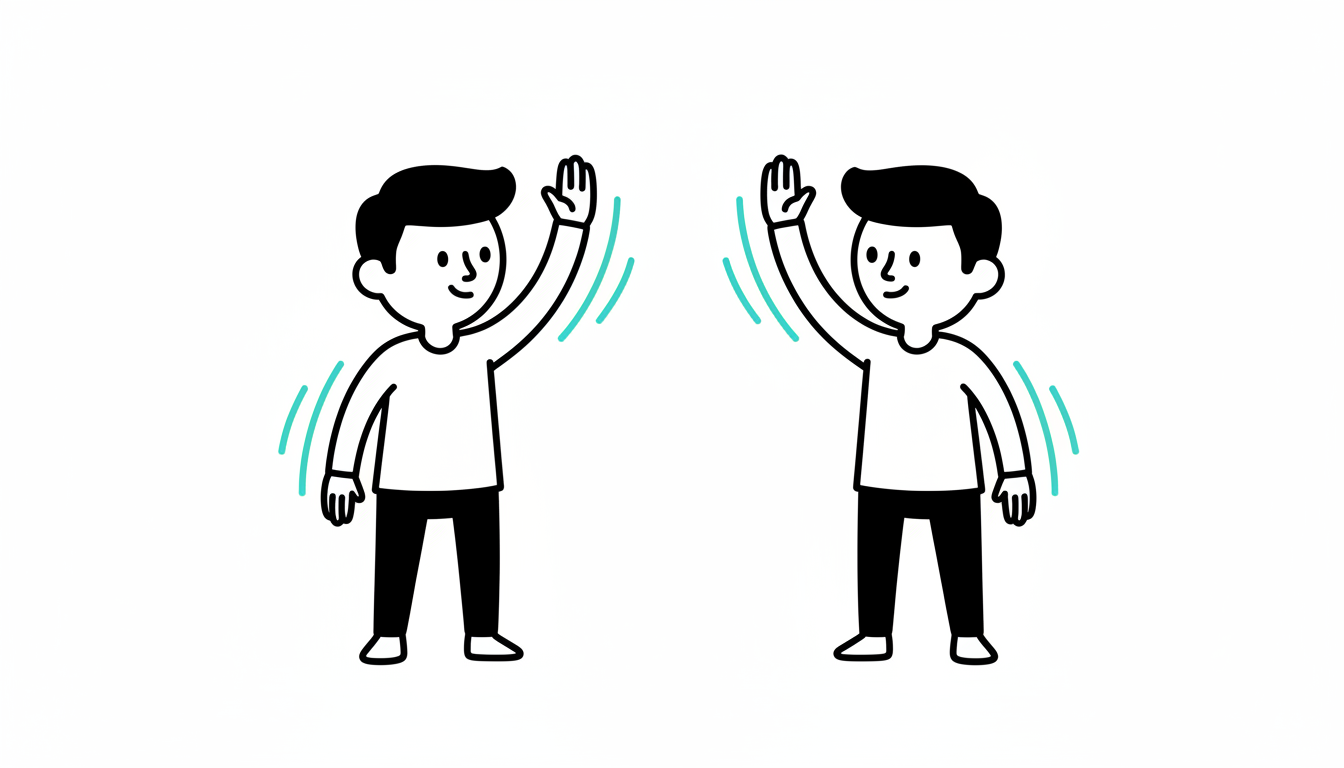
At a Glance
- Time: 3-4 minutes
- Prep: None
- Group: Pairs
- Setting: Any classroom with space for pairs to stand facing each other
- Subjects: Universal - excellent focus reset for any subject
- Energy: Low-Medium
Purpose
Enhance concentration, non-verbal communication, and observational skills through a classic drama exercise where partners mirror each other's slow, deliberate movements, creating a mindful focus break that resets attention before cognitively demanding tasks.
How It Works
- Pair up and face partner (30 sec) - Students find a partner and stand facing each other at arm's length
- Leader's turn (60-90 sec) - One student is designated "leader" and makes slow, deliberate movements (raising arm, tilting head, bending knee); partner mirrors exactly
- Switch roles (60-90 sec) - Roles reverse; the mirror becomes the leader and creates new movements
- Brief reflection (30 sec) - "What did you notice about your focus? What was harder - leading or following?"
What to Say
Opening: "Find a partner and stand facing each other. One of you will be the leader, one will be the mirror. Leader: make slow, smooth movements. Mirror: copy them exactly. No talking - just watch carefully. Partner A, you're the leader first."
During: "Leaders, keep your movements slow and deliberate. Mirrors, stay focused on every detail. Try to move as one person."
After switch: "Partner B, you're now the leader. Create completely new movements. Mirrors, match them perfectly."
Closing: "Freeze. That level of focus you just used? That's exactly what we need for our next activity."
Why It Works
Mirror activities demand sustained visual attention and fine motor coordination, activating the brain's mirror neuron system which is crucial for learning through observation and imitation. The slow, deliberate movements create a meditative state that calms the nervous system while sharpening focus, making this an ideal transition before tasks requiring concentration (Iacoboni, 2009).
Research Citation: Mirror neuron research (Rizzolatti & Craighero, 2004)
Teacher Tip
Emphasize SLOW movements. Students often rush this activity. Remind leaders that the challenge is to move so smoothly that an observer can't tell who's leading and who's following. The slower the movement, the deeper the concentration required, and the more effective the brain break becomes.
Variations
For Different Subjects
- Math/Science: Leader creates geometric shapes in the air; mirror must replicate angles and proportions precisely
- Humanities: Leader embodies emotions or character states through movement; mirror matches the emotional quality
- Universal: Add restriction like "movements must stay above the waist" or "only use hands and arms"
For Different Settings
- Large Class (30+): All pairs work simultaneously; teacher circulates and highlights pairs moving in perfect sync
- Small Group (5-15): Create a "mirror chain" where each person mirrors the person to their right, creating a wave effect
For Different Ages
- Elementary (K-5): Shorter rounds (30-45 seconds each); allow sillier movements; praise specific observations
- Middle/High School (6-12): Standard approach; can add complexity like simultaneous sound effects
- College/Adult: Challenge pairs to eliminate the leader entirely - both try to create movements together organically
Online Adaptation
Tools Needed: Zoom or any video platform with gallery view
Setup: Ensure all students have cameras on and positioned to show upper body
Instructions:
- Assign pairs using breakout rooms or manually ("Partner with the person whose name comes after yours alphabetically")
- Remain in main room; pairs work side-by-side in gallery view
- One student shares video; partner turns off camera and mirrors off-screen
- After 60 seconds, switch - other partner shares video
- Both turn cameras on for reflection
Pro Tip: This works surprisingly well online because the camera frame naturally focuses attention on upper body movements.
Troubleshooting
Challenge: Students move too quickly or make jerky movements Solution: Pause the activity: "Freeze. Let's try that again, but this time pretend you're moving through honey. Every movement should take at least 3 seconds."
Challenge: Pairs start talking or laughing, breaking focus Solution: Frame it as a meditation: "This is a silent activity. Your only job is to watch and move. Talking breaks the concentration we're building."
Challenge: Students feel self-conscious or resist the activity Solution: Do a whole-class round first with you as leader: "Everyone mirror me. Watch my hands." Once they've experienced it as a group, pair work feels less vulnerable.
Extension Ideas
- Deepen: Remove the designated leader - both partners try to create synchronized movements together with no one leading (very challenging!)
- Connect: Extend to "Mirror and Morph" where the mirror gradually transforms the movement into something new, then becomes the leader
- Follow-up: Use this as a metaphor for active listening: "Just like you focused entirely on your partner's movements, focus that same attention on the text we're about to read"
Related Activities: Concept Acting Charades, As-If Transitions, Give and Take