
See-Think-Wonder
At a Glance
- Time: 3-4 minutes
- Prep: Image or object to observe
- Group: Whole class or pairs
- Setting: Any
- Subjects: Universal
- Energy: Low
Purpose
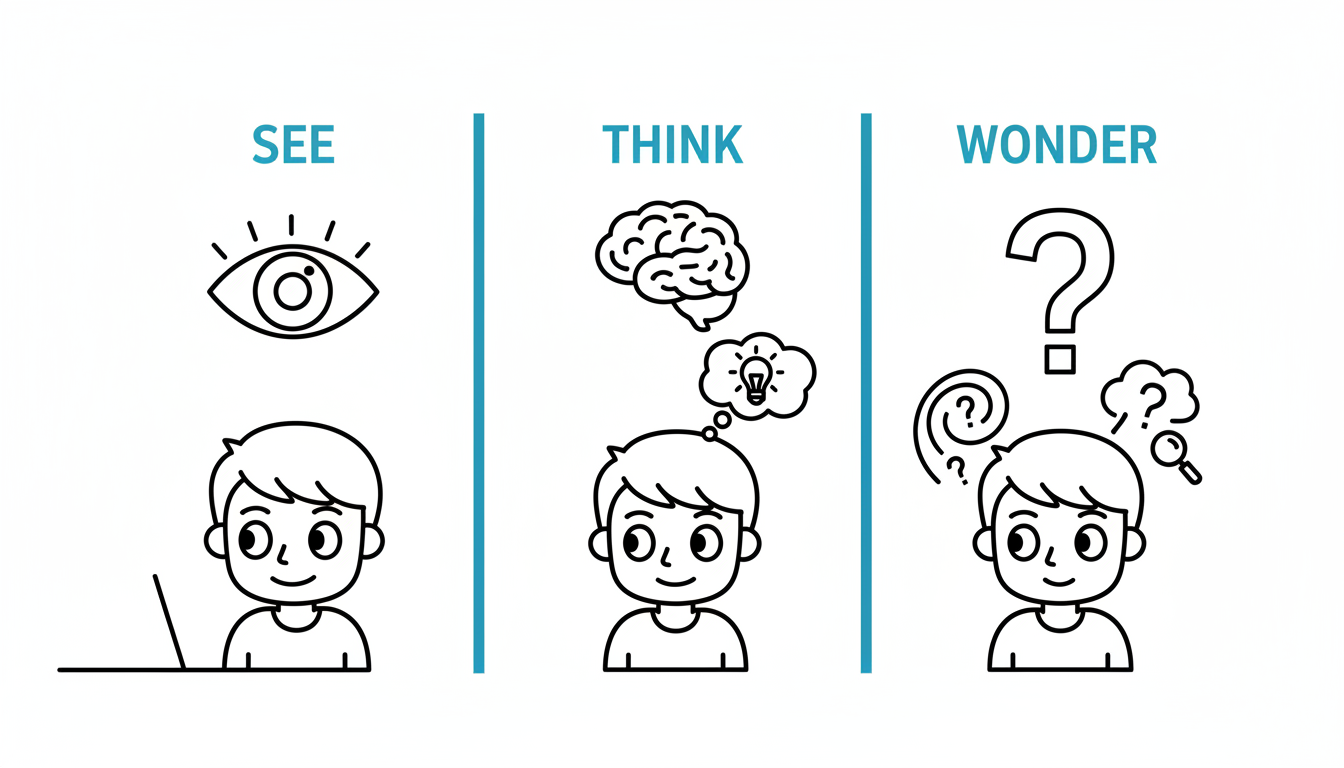
Activate observation, interpretation, and curiosity using Harvard Project Zero's thinking routine. Students observe something (image, object, phenomenon), describe what they see, interpret what they think, and generate wonder questions. This scaffold supports deep thinking while activating prior knowledge.
How It Works
- DISPLAY (10 seconds) - Show an image or object related to the topic
- SEE (60 seconds) - "What do you SEE? Describe objectively."
- THINK (60 seconds) - "What do you THINK is going on? What interpretations do you have?"
- WONDER (60-90 seconds) - "What do you WONDER? What questions does this raise?"
- SHARE - Students share observations, thoughts, and questions
What to Say
"I'm going to show you something related to our topic. We'll use a thinking routine called 'See-Think-Wonder.'
First: What do you SEE? Just describe—what's literally there? You have 30 seconds to observe silently."
(Show image/object)
"Now, what do you THINK? What's going on here? What do you think this shows? Turn to a partner and share. You have 60 seconds."
"Finally, what do you WONDER? What questions does this raise? What are you curious about?"
(After sharing) "You SEE..., you THINK..., and you WONDER... These are great starting points for our learning today."
Why It Works
The three-step structure scaffolds increasingly deep thinking. "See" is accessible—everyone can observe. "Think" requires interpretation, activating prior knowledge to make meaning. "Wonder" generates curiosity and sets purpose for learning. The routine makes thinking visible and teaches that good thinking involves observation, interpretation, AND questioning. This explicitly models inquiry habits.
Research Citation: Visible thinking routines improve metacognition and deepen learning (Ritchhart et al., 2011 - Project Zero).
Teacher Tip
Emphasize the distinction between "See" and "Think." Students often jump to interpretation. Redirect: "That's what you THINK. But what do you literally SEE in the image?" This teaches observation vs. inference—a critical skill.
Variations
What to Display
Images: Historical photos, artwork, scientific diagrams, infographics Objects: Physical specimens, artifacts, models Videos: Short clips (pause at key moment) Data: Charts, graphs, tables Text: Excerpt, quote, poem
Response Formats
Individual Writing: Students write responses in notebooks Think-Pair-Share: Think alone, share with partner, then whole class Chart It: Create three-column chart on board; record class responses Sticky Notes: Students write on sticky notes; post under See/Think/Wonder headings
Content Examples
Science - Cells:
- Show: Microscope image of cells
- See: "Circles, boundaries, some parts are darker"
- Think: "These might be different types of cells"
- Wonder: "Why are some darker? What are the parts inside?"
History - Civil Rights:
- Show: Historical photograph from a protest
- See: "People holding signs, standing together"
- Think: "They're protesting something important to them"
- Wonder: "What were they demanding? Did it work?"
Math - Patterns:
- Show: Visual pattern or sequence
- See: "Shapes arranged in a pattern"
- Think: "It's repeating every 3 shapes"
- Wonder: "What comes next? What's the rule?"
For Different Settings
- Large Class: Whole-class sharing; teacher records on board
- Small Class: Everyone shares all three responses
- Online: Screen share image; chat or breakout rooms for discussion
- Pairs: Partners discuss together before sharing out
For Different Ages
- Elementary (K-5): Use concrete, clear images; provide sentence stems
- Middle/High School (6-12): Abstract images requiring interpretation
- College/Adult: Complex, discipline-specific visuals
Online Adaptation
Excellent for Online:
- Screen share image clearly
- Students type responses in chat (see, think, wonder)
- Or use breakout rooms for discussion
- Can use annotation tools to mark observations
- Works well virtually
Troubleshooting
Challenge: Students confuse "See" and "Think"—they interpret immediately. Solution: Redirect: "That's your interpretation. What do you literally, objectively see? No interpretation yet!"
Challenge: Students can't think of wonders/questions. Solution: Prompt: "What would you like to know more about? What confuses you? What would you ask an expert?"
Challenge: Observations are surface-level ("I see colors"). Solution: Push deeper: "Look more carefully. What specific details do you notice? What's in the background?"
Challenge: Students rush through; don't think deeply. Solution: Set timers for each phase. "You have 60 full seconds for 'Think'—use all the time!"
Challenge: Image is too ambiguous; students are frustrated. Solution: Provide context: "This relates to [topic]. Knowing that, what do you think?"
Extension Ideas
- Compare Two Images: Use See-Think-Wonder for two related images; compare responses
- Return After Learning: Revisit the same image after the lesson. "What do you SEE, THINK, WONDER now?"
- Student-Selected Images: Students bring images related to the topic; class does See-Think-Wonder
- Gallery Walk: Multiple images around room; students rotate and respond to each
- Create Title/Caption: Based on See-Think-Wonder, students create a caption for the image
Related Activities: Image Prompt, Think-Pair-Share, Notice and Wonder