
Mirror, Microscope, Binoculars
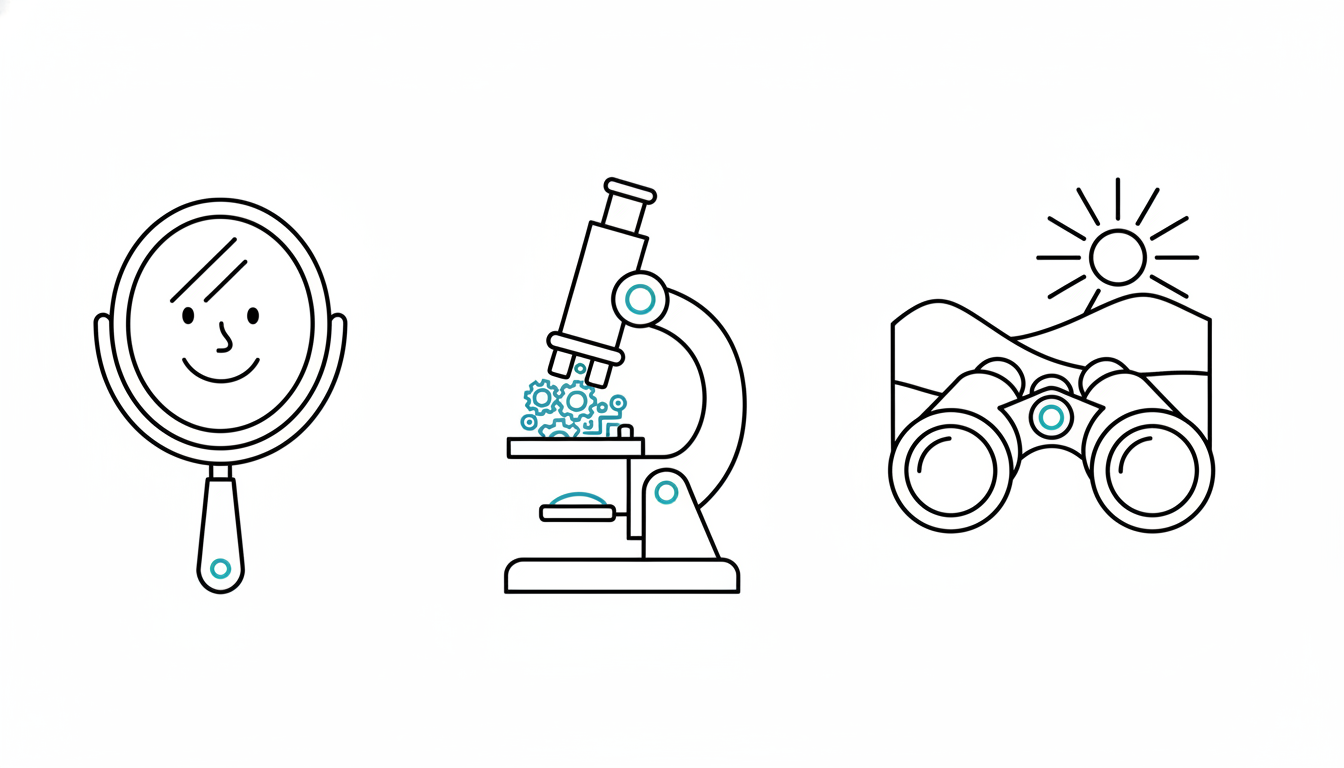
At a Glance
- Time: 3-5 minutes
- Prep: None
- Group: Individual
- Setting: Any
- Subjects: Universal
- Energy: Low
Purpose
Structure deep, multi-faceted reflection through three lenses: Mirror (personal insight), Microscope (detailed analysis), Binoculars (big-picture connection), moving students from self to specifics to synthesis.
How It Works
- Present three prompts (30 sec) - Display the three lenses with prompts
- Respond to each (3-4 min) - Students write 1-2 sentences per lens
- Optional share (1 min) - Few students share one lens
What to Say
Opening: "Three-lens reflection: Mirror—What did I learn about myself? Microscope—What details were most significant? Binoculars—How does this connect to the bigger picture?" During: "Personal insight first... Now zoom in on details... Now zoom out to big picture..." Closing: "This framework works for any experience—three levels of thinking every time you reflect."
Why It Works
Structured reflection framework prevents shallow responses. Three distinct lenses ensure comprehensive thinking: personal (motivation), detailed (comprehension), and connected (transfer).
Research Connection: Structured reflection improves metacognition and transfer (Bransford et al., 2000; Schön, 1983).
Teacher Tip
Post these three lenses permanently in room. Use as ongoing reflection framework—students internalize structure and apply automatically.
Variations
Timing: Quick (1 sentence each) or deep (paragraph each) • Format: Written, verbal pairs, whole-class discussion • Ages: K-5: simplified prompts with sentence starters; 6-12: standard; College: discipline-specific applications
Online
Create digital template (Google Doc). Students fill in three sections. Share in breakout rooms.
Troubleshooting
Students confuse lenses: "Mirror=YOU, Microscope=DETAILS, Binoculars=BIG PICTURE. Three different angles."
Extension
Use as regular journal framework—students build portfolio of multi-lens reflections across semester.
Related: I Used to Think, Reflection Moments