
Opinion Continuum
At a Glance
- Time: 2-3 minutes
- Prep: None
- Group: Whole class
- Setting: Space to move along a line
- Subjects: Universal
- Energy: High
Purpose
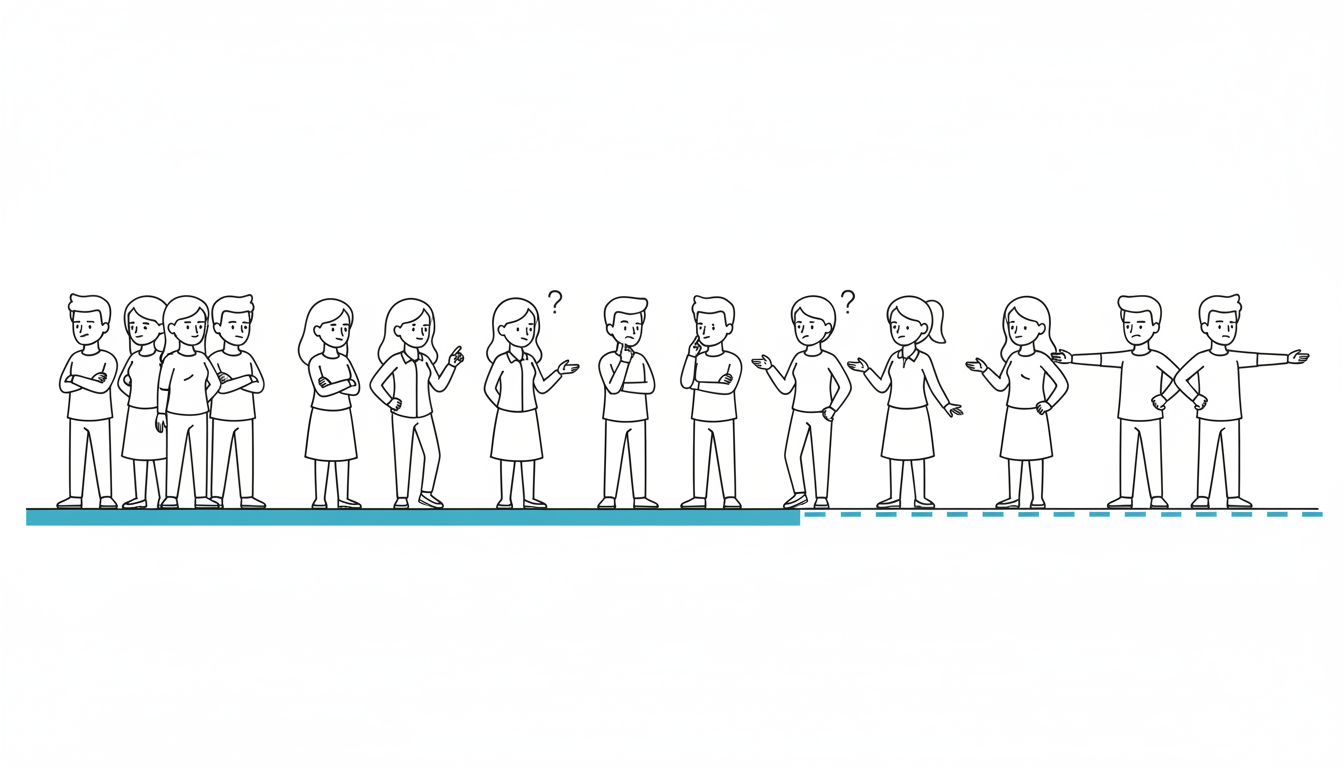
Activate prior beliefs and opinions by having students physically position themselves along a continuum from "Strongly Agree" to "Strongly Disagree." This reveals the spectrum of thinking in the room and creates curiosity about why people hold different beliefs.
How It Works
- ESTABLISH LINE (15 seconds) - Designate one end as "Strongly Agree," other end as "Strongly Disagree," middle as "Neutral/Unsure"
- POSE STATEMENT (10 seconds) - Read a statement related to the topic
- POSITION (30-45 seconds) - Students move to their spot on the continuum
- SHARE (60-90 seconds) - Ask people from different positions to explain their reasoning
- TRANSITION - "Interesting range of opinions! Today's lesson will help us explore this."
What to Say
"Stand up. This side of the room (point) is 'Strongly Agree.' This side (point to opposite) is 'Strongly Disagree.' The middle is 'Unsure' or 'Neutral.' I'm going to read a statement. Move to the spot that represents your opinion. Ready?
Statement: [Read opinion statement about the topic]
Move to your position now!"
(After students position) "Let's hear from different spots. Someone near 'Strongly Agree'—why are you there?"
(Take 2-3 responses from different positions)
"Fascinating! We have a range of opinions. Today's lesson will give us evidence to refine our thinking."
Example Statements:
- "Technology makes our lives better." (before a unit on technology's impact)
- "All animals should be protected, even if they're dangerous." (before ecology unit)
- "The government should make all major decisions for the country." (before government unit)
Why It Works
Physical positioning makes abstract opinions concrete and visible. Students see that they're not alone in their thinking AND that diversity of opinion exists. Movement activates the brain and increases engagement. Hearing reasoning from different positions exposes students to multiple perspectives. This activity explicitly teaches that complex topics involve nuance—not binary right/wrong answers.
Research Citation: Kinesthetic learning and visible positioning improve engagement and perspective-taking (Beilock & Goldin-Meadow, 2010).
Teacher Tip
Choose statements that are genuinely debatable—not obvious facts. The goal is to activate diverse thinking, not to test knowledge. Also, emphasize: "There's no right answer right now. We're exploring our initial beliefs."
Variations
Statement Types
Opinion-Based: "Homework should be banned." Belief-Based: "Climate change is the most urgent issue we face." Value-Based: "Individual freedom is more important than community rules." Prediction-Based: "In 20 years, most jobs will be done by robots."
Continuum Labels
Agree-Disagree: Classic format True-False: For statements that can be verified Important-Unimportant: For priority setting Likely-Unlikely: For predictions Always-Never: For frequency statements
Content Examples
Science:
- "Humans and apes share a common ancestor." (evolution)
- "We should genetically modify crops to end world hunger." (bioethics)
Math:
- "Math is more about memorizing than understanding."
- "You're either a 'math person' or you're not."
Literature:
- "The author's intent is the most important thing to understand."
- "A book is only good if it has a happy ending."
History:
- "Wars are sometimes necessary."
- "History is told by the winners, so we can't fully trust it."
For Different Settings
- Large Class: Use full room; create clear visual markers
- Small Class: Can be a shorter line; still effective
- Online: Not ideal—use polling with scale instead
- Limited Space: Point to different corners instead of a line
For Different Ages
- Elementary (K-5): Use simpler, concrete statements
- Middle/High School (6-12): Can handle abstract, complex statements
- College/Adult: Philosophical, disciplinary statements
Online Adaptation
Not Ideal for Online:
- Physical positioning is core to the activity
- Alternative: Use a Likert scale poll (1-5: Strongly Disagree to Strongly Agree)
- Or use virtual line with name positioning in a shared doc
Troubleshooting
Challenge: Everyone clumps in the middle (neutral). Solution: "It's okay to have an opinion! Pick a side, even tentatively." Or: "If you're neutral, you can stay there, but tell us why you're unsure."
Challenge: Students position based on friends, not true beliefs. Solution: "Close your eyes and think about YOUR belief. Then open and move—don't watch where others go!"
Challenge: Awkward silence when asking for reasoning. Solution: Call on specific people: "You, in the middle there—what are you thinking?" Or use turn-and-talk first.
Challenge: Debate gets heated or personal. Solution: Redirect: "We're exploring ideas, not judging people. What's the REASONING, not who's right or wrong."
Challenge: Students refuse to move from their seats. Solution: Motivate: "This only works if we move! Everyone up!" Or use seated version: hold up fingers (1-5 scale).
Extension Ideas
- Multiple Rounds: Pose 2-3 statements; students move for each
- Reasoning Pairs: Students turn to someone near them and explain their position
- Revisit After Learning: Repeat the same statement after the lesson; see if anyone moves
- Debate: Choose representatives from each end to formally present their reasoning
- Written Reflection: "Why did you stand where you did? What would change your mind?"
Related Activities: Human Barometer, Four Corners, Anticipation Guide