The X Activity
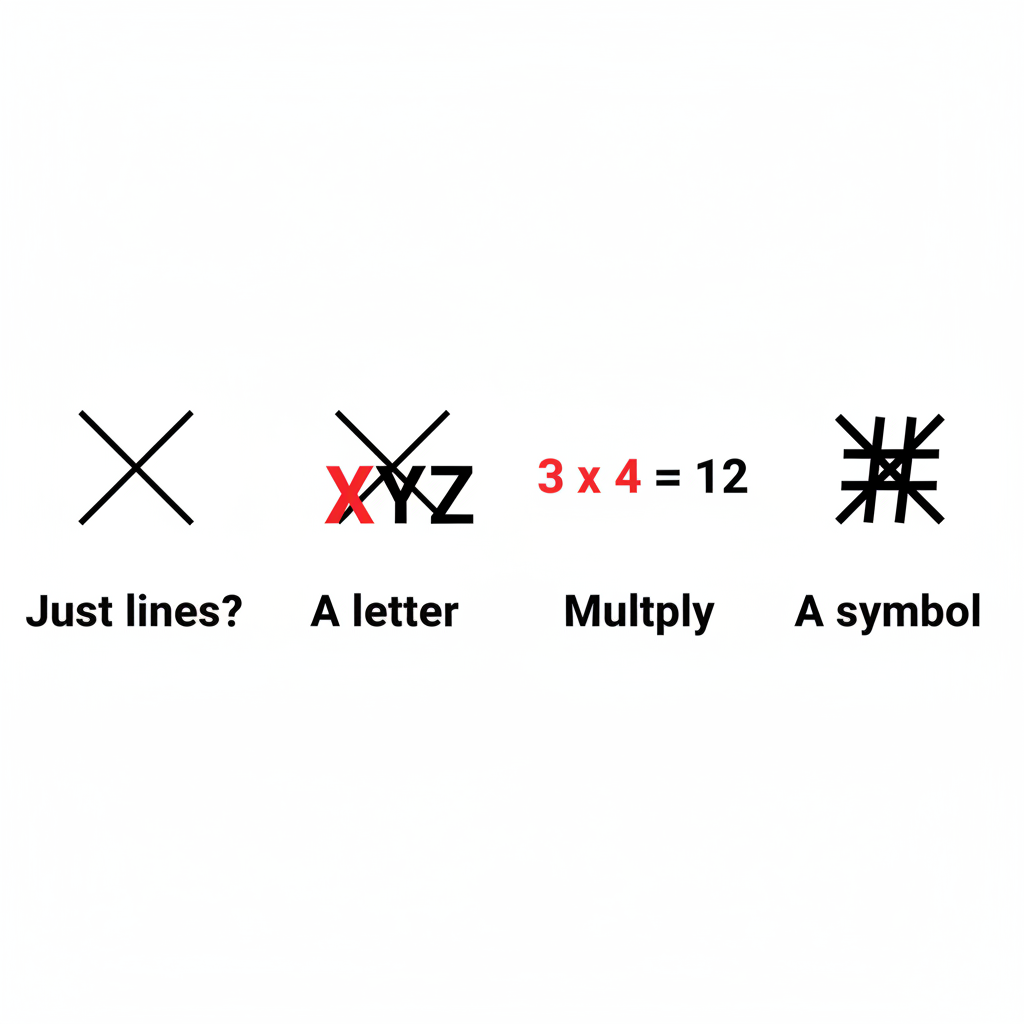
The same symbol means completely different things depending on context:
At a Glance
- Time: 3-4 minutes
- Prep: Minimal (whiteboard or slide with two crossing lines)
- Group: Whole class (call-and-response)
- Setting: In-person, hybrid, or online (any setting with a visible drawing surface)
- Subjects: Universal (especially effective for AI education, language arts, math, philosophy)
- Energy: Medium
Purpose
Demonstrate that context changes everything — including the meaning of the simplest symbol. This activity engages every person in the room through rapid call-and-response, creates escalating surprise through progressive revelation, and establishes a powerful teaching point: without context, even two crossing lines are meaningless. With context, they become specific, precise, and unambiguous. This principle applies directly to how we prompt AI, interpret data, read text, and communicate across cultures.
How It Works
Step-by-step instructions:
- DRAW (5 seconds) — Draw two simple crossing lines on the board or slide. Just an X shape. Nothing else.
- ASK (30 seconds) — Point to the X and ask: "What does this mean?" Students will shout answers:
- "The letter X!"
- "A multiplication sign!"
- "A wrong answer mark!"
- "A stop sign / crossbones!"
- "Roman numeral 10!"
- "A kiss (in texting)!"
- To each answer, say "No." and wait for the next guess.
- ADD CONTEXT — Round 1 (30 seconds) — After one of the crossing lines, write Y and Z. Now ask: "What does this mean now?" The room immediately says "The letter X!" because XYZ makes it unambiguously alphabetical.
- ADD CONTEXT — Round 2 (30 seconds) — Erase the Y and Z. Before one of the crossing lines, write 1. After it, write 2. Below, write = 2. So it reads: 1 × 2 = 2. Ask: "What does this mean now?" Everyone says "multiplication." The same crossing lines — completely different meaning.
- ADD CONTEXT — Round 3 (30 seconds) — Erase the numbers. Draw two horizontal bars through one of the crossing lines. Ask: "What about now?" Some will recognize the British pound symbol (£). Others might see a different currency or notation.
- THE REVEAL (30 seconds) — Step back and say: "These are the same two crossing lines I drew 3 minutes ago. Nothing changed about the lines. What changed?" Pause. "The context changed. And context changed everything."
What to Say
Opening: "I'm going to draw something on the board. Tell me what it means." (Draw two crossing lines.) "What is this?"
During (after each guess): "No." (Wait.) "No." (Wait.) "No." (Let the tension build. Every 'no' increases engagement.)
After adding Y, Z: "Okay, what about NOW? Did the lines change? No. But something changed. What?"
After adding 1 × 2 = 2: "Same lines again. Completely different meaning. What happened?"
Closing: "Here's the lesson: these two crossing lines are meaningless by themselves. They could be anything — a letter, a math operation, a Roman numeral, a currency symbol, a rejection mark. The CONTEXT you add around them determines their meaning entirely. Nothing about the symbol changed. Everything about the context changed. And that changes everything."
Why It Works
This activity leverages semiotic ambiguity — the principle that symbols have no inherent meaning; meaning is assigned by context. The two crossing lines are a "floating signifier" until context anchors them.
The call-and-response format ensures universal participation: even students who don't shout answers are mentally generating guesses. Each "No" creates cognitive tension (the brain needs to resolve ambiguity), and each progressive revelation creates a schema shift that physically feels like surprise.
The activity also levels the playing field: PhDs and first-year students all guess "the letter X" first. Nobody gets it "right" because there IS no right answer without context. This shared experience of productive confusion creates psychological safety.
Research basis: Saussure's theory of signs (1916), Wittgenstein's language games, and modern cognitive linguistics all support the principle that meaning is context-dependent.
Teacher Tip
The power is in the "No." Every time you say "No," the engagement increases. Don't rush through the guesses — let each one land, let the room feel the tension of being wrong. The longer the ambiguity persists, the more powerful the revelation. Resist the urge to explain too early. Let them sit in the productive confusion.
Variations
For Different Subjects
- Language Arts: After the activity, discuss how the same word changes meaning in different sentences ("I left my left shoe"). Connect to context clues in reading comprehension.
- Math: Show how the × symbol, the · symbol, and parentheses all mean multiplication — different symbols, same meaning. Then show how parentheses can also mean function application: f(x). Context changes the same symbol.
- Science: Draw H₂O. Cover the ₂ and O — now it's just "H" (hydrogen). Context (subscripts, other elements) changes an element into a molecule.
- History: Show the swastika symbol — ancient Buddhist/Hindu auspiciousness symbol vs. 20th century Nazi appropriation. Same symbol, opposite meanings. Context is everything.
- AI Education: "When you type a prompt into ChatGPT, the AI has no context about your classroom, your students, or your goals. The same prompt — 'give me a lesson plan' — produces wildly different results depending on what context you provide. Context is the difference between generic AI output and useful AI output."
For Different Settings
- Large Audience (50+): Works perfectly — call-and-response scales to any size. Use a microphone and large slide.
- Small Class (5-15): Go around the room — each student offers one guess before you say "No."
- Workshop/PD: After the reveal, pair participants and ask them to design their own "X Activity" using a different ambiguous symbol (a circle, a line, a dot).
For Different Ages
- Elementary (K-5): Use simpler context additions. "X" → "X marks the spot" (add a treasure map). "X" → "hugs and kisses" (add XOXO). Keep it playful.
- Middle/High School (6-12): Full version works perfectly. Add the AI education connection.
- College/Adult: Full version plus deeper debrief on semiotics, communication theory, or AI prompting. Ask: "In your field, what are the 'crossing lines' that change meaning depending on context?"
Online Adaptation
Tools Needed: Screen share with any drawing tool (whiteboard app, Google Slides, even MS Paint)
Setup: Share your screen showing a blank slide or whiteboard.
Instructions:
- Draw the X on screen. Use the chat: "Type in chat what you think this means."
- Read responses aloud. Say "No" to each one.
- Add context step by step — students watch the meaning shift in real time.
- Use the poll feature: "What does this mean NOW?" after each context addition.
Pro Tip: The chat actually makes this MORE engaging online — you can see EVERY person's guess simultaneously, not just the loudest voices in the room.
Troubleshooting
Challenge: Students immediately guess the "right" answer for each context. Solution: That's fine — the point isn't to stump them forever. The point is that the SAME lines meant something different each time. Ask: "What changed between your first guess and your last guess? The lines didn't change. You did."
Challenge: Students are shy and won't shout answers. Solution: Use think-pair-share. "Turn to your neighbor — what do you think this is?" Then ask pairs to share. Or use a digital polling tool.
Challenge: Someone says "It depends on the context" immediately. Solution: Smile and say: "Exactly. But let me show you HOW MUCH it depends on context." Then proceed with the progressive revelation. Their correct answer becomes the setup for the demonstration.
Extension Ideas
- Deepen: After the activity, show three ChatGPT prompts — one with no context, one with some context, one with rich context — and compare the outputs. "See how the same 'crossing lines' (the prompt) produced completely different results depending on context?"
- Connect: Assign students to find three examples of context-dependent meaning in their daily lives (emojis, road signs, slang, gestures). Share the next day.
- Follow-up: Create a class "Context Wall" — a physical or digital space where students post examples of symbols, words, or images that change meaning depending on context.
Related Activities: Stroop Effect, Duck-Rabbit, Paris in the Spring