
The Word That Is Everything — BANK
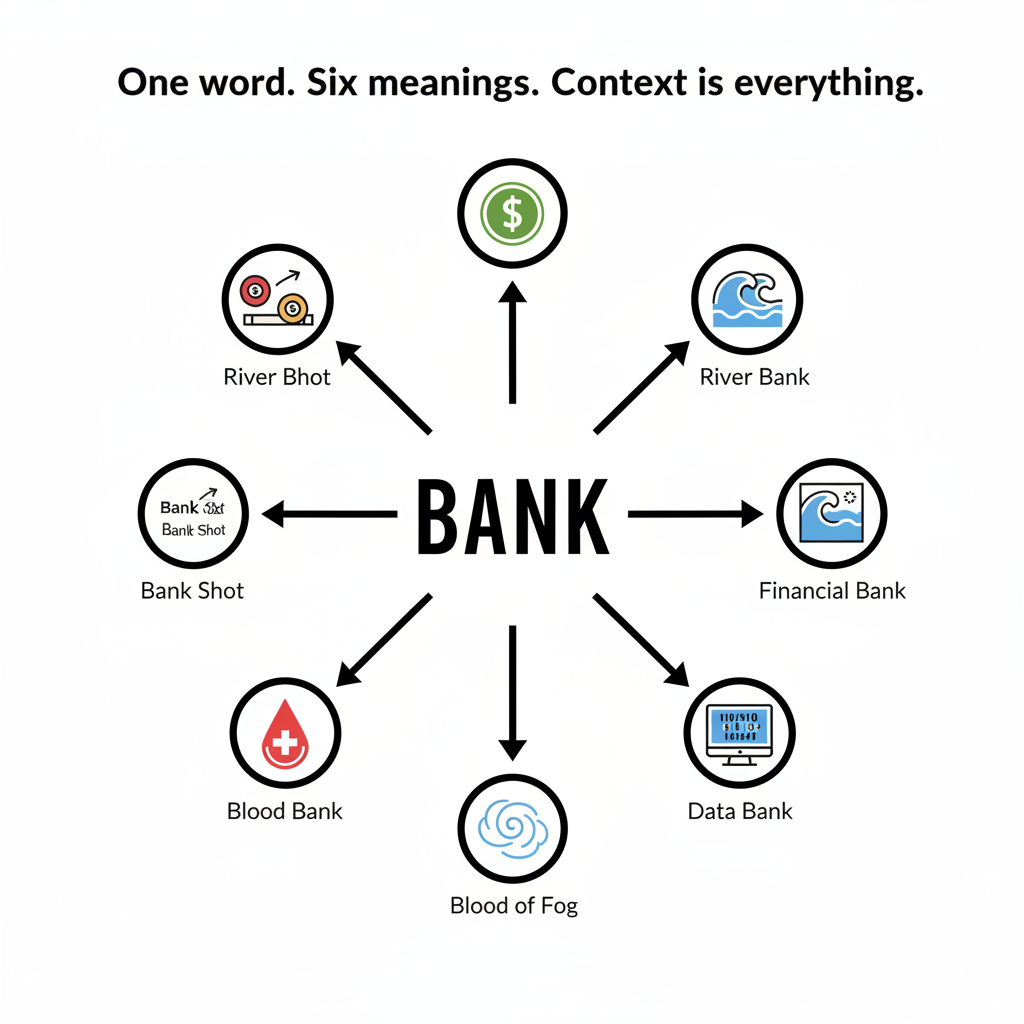
At a Glance
- Time: 2-3 minutes
- Prep: None (whiteboard or slide)
- Group: Whole class (brainstorm + reveal)
- Setting: In-person, hybrid, or online
- Subjects: Universal (especially effective for linguistics, AI education, communication)
- Energy: Medium
Purpose
Demonstrate that a single word — something that feels like the most basic unit of clear communication — can carry completely unrelated meanings depending on context. When you write BANK and ask what it means, the meaning that surfaces first reveals which cognitive schema the reader activated, shaped entirely by their profession, recent experiences, and cultural background. Two people reading the same word are not reading the same thing.
How It Works
Step-by-step instructions:
- WRITE THE WORD (5 seconds) — Write in large letters: BANK. Ask: "What does this mean?"
- COLLECT ANSWERS (30 seconds) — Take answers from around the room. Write each one on the board.
- PROGRESSIVE REVEAL (60 seconds) — Add context phrases one at a time:
- river bank — land beside water
- blood bank — medical storage facility
- bank shot — billiards rebound
- bank on it — to rely on something
- memory bank — computing storage
- broke the bank — financial ruin
- bank angle — aircraft tilt in aviation
- THE QUESTION (15 seconds) — "When I first wrote BANK, which of these did you think of? Why that one?" Let a few people share.
- THE LESSON (30 seconds) — "The word BANK has at least seven completely unrelated meanings. The one you thought of first was determined not by the word itself, but by YOUR context — your profession, your recent conversations, your cultural background. Words are not containers of meaning. They are triggers that activate whatever schema you bring to them."
What to Say
Opening: (Write BANK.) "Simple question. What does this word mean?"
During collection: "Financial institution — sure. River bank — yes. What else? (Keep pushing for more.) Blood bank? Bank shot? Banking an airplane?"
The lesson: "You all read the same four letters. But a nurse thought 'blood bank,' a pilot thought 'bank angle,' a gamer thought 'bank shot,' and an accountant thought 'savings account.' The word didn't change. Your brains activated different encyclopedias."
AI connection: "When AI processes the word 'bank,' it uses surrounding words to disambiguate — just like you do. But if the context is thin or ambiguous, AI picks the most statistically common meaning. In NLP, this is called 'word sense disambiguation,' and it fails regularly. Humans fail at it too — we just don't notice because our brain picks so fast."
Why It Works
This exercise demonstrates polysemy — the linguistic phenomenon where a single word form carries multiple related or unrelated meanings. Swiss linguist Ferdinand de Saussure argued that the relationship between a signifier (the word) and the signified (the meaning) is arbitrary and entirely dependent on social convention and context.
The word that surfaces first in a person's mind is determined by priming — the most recently or frequently activated meaning takes priority. This is not conscious choice; it's automatic activation of neural pathways. A person who just visited a hospital will think "blood bank" before "river bank."
Research basis: Saussure, F. de (1916). Course in General Linguistics. | Swinney, D.A. (1979). Lexical access during sentence comprehension. Journal of Verbal Learning and Verbal Behavior, 18(6), 645-659.
Teacher Tip
Ask "Why that one?" after collecting first answers. The meta-reflection — "Oh, I thought of the financial meaning because I just paid my bills" — is where the real learning happens. The exercise isn't about listing definitions; it's about discovering that your context filters meaning before you're aware of it.
Variations
Alternative Words
| Word | Sample Meanings | Best For |
|---|---|---|
| SET | Tennis set, TV set, set the table, mathematical set, mindset, sunset | Math, sports, philosophy |
| RUN | Run a program, run a marathon, run a company, a run in stockings, a run of bad luck | Business, computing, PE |
| LIGHT | Light switch, lightweight, light color, light reading, light of my life | Science, literature, philosophy |
| CRANE | Bird, construction machine, to crane your neck | Science, engineering, anatomy |
| BAT | Animal, cricket bat, Batman, batting average | Biology, sports, culture |
For Different Ages
- Elementary (K-5): Use "BAT" — kids love the animal/sports dual meaning. Draw both. "Same word, totally different picture!"
- College/Adult: Use "SET" — it holds the Guinness record for most definitions in the English language (over 430 in the OED). The sheer number makes the point about context overwhelming.
Online Adaptation
Display BANK on screen. "Type your FIRST interpretation in chat — the very first thing that came to mind. Don't overthink it." The chat becomes a live survey of the room's diverse priming. Categorize the responses together.
Extension Ideas
- Deepen: Show how AI language models handle polysemy. Give ChatGPT a sentence with "bank" in an unusual context and show how it disambiguates (or fails to). "AI needs context to resolve meaning — just like you do."
- Connect: Pair with The B or 13 (009) — one shows visual category switching, the other shows linguistic meaning switching. Same principle, different modalities.
Related Activities: The B or 13, The X Activity, Sentence Without Punctuation