
The Number Without Context — 37
At a Glance
- Time: 2-3 minutes
- Prep: None (whiteboard or slide)
- Group: Whole class (brainstorm + progressive reveal)
- Setting: In-person, hybrid, or online
- Subjects: Universal (especially effective for math, science, data literacy, policy)
- Energy: Medium
Purpose
Demonstrate that numbers — often treated as the most "objective" form of communication — are just as meaningless without context as two crossing lines. A bare number requires a unit, a domain, and a reference system to mean anything. This activity challenges the common assumption that data is inherently objective and unambiguous.
How It Works
Step-by-step instructions:
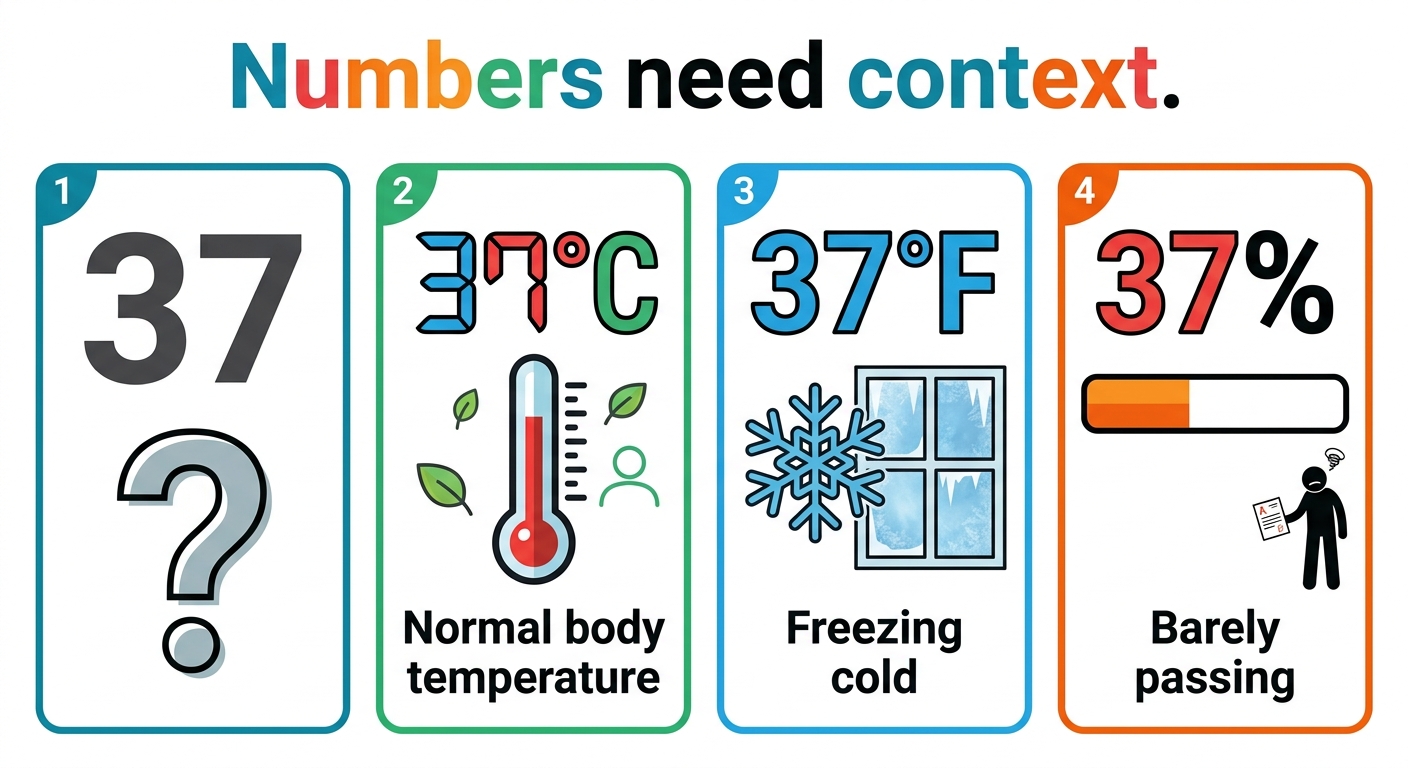
- WRITE THE NUMBER (5 seconds) — Write: 37. Ask: "What is this?"
- COLLECT ANSWERS (20 seconds) — Answers: a number, someone's age, a jersey number, a temperature, a bus route, a score, a chapter number.
- ADD CONTEXT IN LAYERS (90 seconds):
- 37°C — normal human body temperature. "Is this good or bad?" Neutral — it's healthy.
- 37°F — near freezing. "Good or bad?" Depends — great for skiing, terrible for your garden.
- 37th parallel — the geographic line dividing North and South Korea. "Same number. Now it's geopolitics."
- Article 37 — a legal clause (pick any relevant one for your audience).
- 37% — "Is this a good test score? A good approval rating? A good survival rate?" The answer changes completely depending on the denominator and domain.
- THE LESSON (30 seconds) — "The number 37 is just squiggles on a page until you add a unit, a domain, and a reference point. The same is true for every number you encounter in a headline, a report, or an AI-generated analysis. A number without context is not data — it's decoration."
What to Say
Opening: (Write 37.) "What is this? Shout it out."
During progressive reveal: "37 degrees Celsius — you're healthy. 37 degrees Fahrenheit — you're freezing. Same number. Completely opposite situations. What changed? Not the number. The unit."
AI connection: "When AI gives you a number — '87% of users prefer option A' — what's your first instinct? To believe it. But 87% of HOW MANY users? Surveyed HOW? Compared to WHAT baseline? Without context, that 87% is as meaningless as writing '37' on a whiteboard."
Why It Works
This activity challenges naive realism about data — the widespread belief that numbers are objective and self-interpreting. In reality, every number requires at least three pieces of context to mean anything: a unit (degrees, percent, dollars), a domain (temperature, approval, survival), and a reference point (normal body temp, class average, industry benchmark).
Behavioral economists and data literacy researchers consistently show that people anchor on numbers without evaluating their context, leading to systematic misinterpretation of statistics, research findings, and AI-generated data.
Teacher Tip
Pick a number that resonates with your audience. If teaching medical professionals, 37°C is perfect. If teaching educators, use a test score: "Is 37 a good score? On what?" If teaching business leaders, use 37% market share. The closer to their domain, the harder the lesson hits.
Variations
For Different Subjects
- Science: "Is a pH of 7 acidic or basic? Trick question — it's neutral. But a pH of 7 in stomach acid (normally 1.5-3.5) would mean something is very wrong. Context."
- Economics: "The economy grew 2.3%. Is that good? Compared to last year? Compared to other countries? Compared to inflation?"
- Math: "37 is prime. But is that fact useful? Only if you're factoring, generating keys, or solving a number theory problem. Mathematical properties need context too."
For Different Ages
- Elementary (K-5): "I scored 10. Is that good?" (10 out of 10? Amazing. 10 out of 100? Not great. 10 goals in soccer? Incredible.)
- College/Adult: Use real headline statistics and strip the context. "This number appeared in a major newspaper. Is it alarming or reassuring?" Then reveal the full context.
Online Adaptation
Display just "37" on screen. "Type in chat: what does this number mean? First thing that comes to mind." Then reveal each context layer as new slides. The chat shows the diversity of initial interpretations.
Extension Ideas
- Deepen: Show three real headlines that use decontextualized numbers. Add the missing context and show how the meaning changes. "Every number in every headline is missing context. Your job is to find it."
- Connect: Pair with Graph Without Axes (014) — one strips context from numbers, the other strips it from visual data. Together they build comprehensive data literacy.
Related Activities: Graph Without Axes, The X Activity, The B or 13