
Count the F's — Attention Blindness
Display this sentence and ask: "How many F's can you count?"
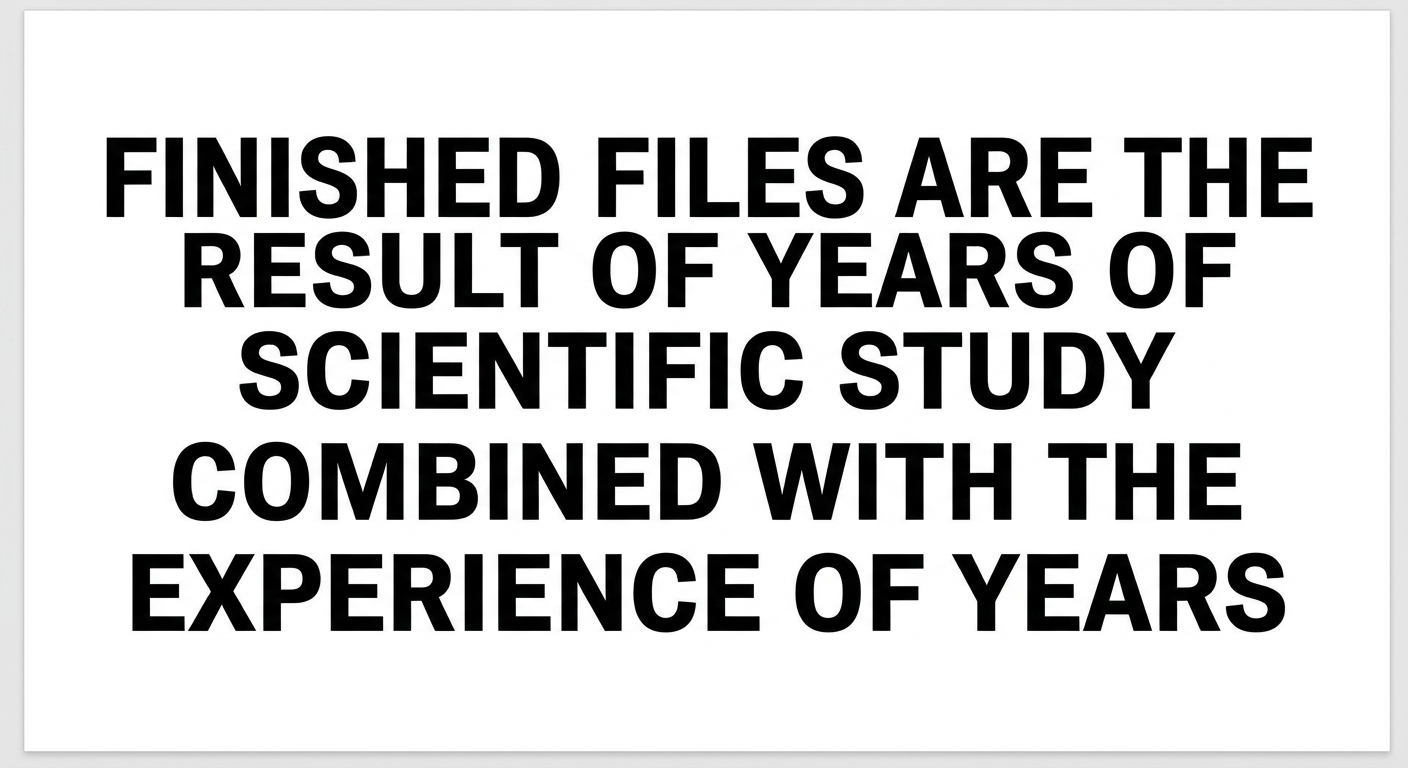
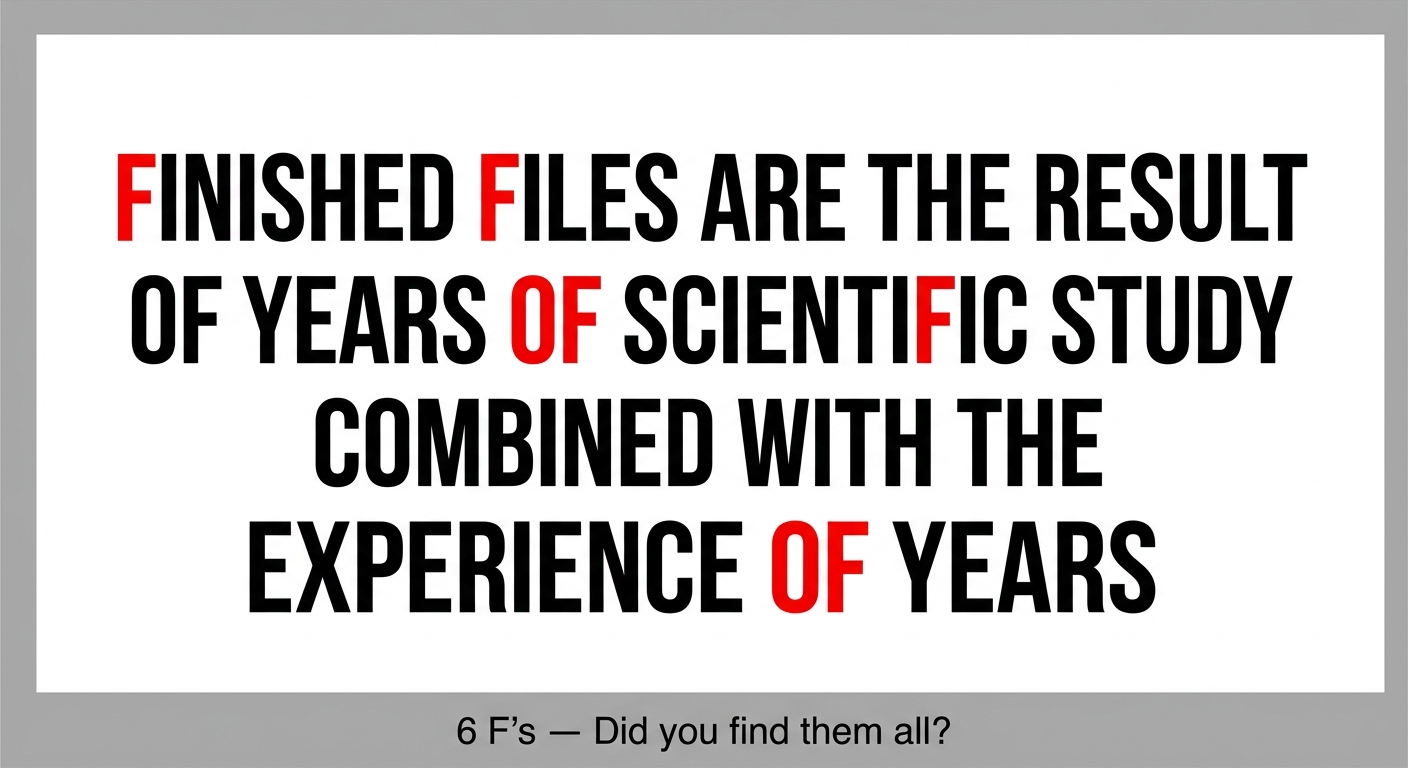
The answer is 6 — most people only count 3, missing the F's in "OF":
At a Glance
- Time: 2-3 minutes
- Prep: Minimal (one slide with the sentence)
- Group: Whole class (individual count, then group reveal)
- Setting: In-person, hybrid, or online (requires projected or shared text)
- Subjects: Universal (especially effective for language arts, AI education, research methods)
- Energy: Medium
Purpose
Demonstrate that our brains skip what's familiar — and that this invisible shortcut is dangerous when evaluating AI output, proofreading, or analyzing data. Most people miss half the F's in a simple sentence because the brain processes common words phonetically rather than letter-by-letter. The gap between how many F's people THINK they found and how many actually exist creates a powerful "aha" moment about the limits of human attention.
How It Works
Step-by-step instructions:
-
DISPLAY THE SENTENCE (5 seconds) — Show this sentence in LARGE, clear font on your slide:
FINISHED FILES ARE THE RESULT OF YEARS OF SCIENTIFIC STUDY COMBINED WITH THE EXPERIENCE OF YEARS
-
THE TASK (15 seconds) — Say: "Count every letter F in this sentence. Silently. Don't shout out. You have 15 seconds." Start a silent countdown.
-
THE SURVEY (30 seconds) — "Time's up. How many F's? Raise your hand if you got 3." (Most hands go up.) "4?" (A few.) "5?" (Fewer.) "6?" (Almost nobody.) "7 or more?" (Maybe one person.)
-
PROGRESSIVE REVELATION (45 seconds) — Now highlight each F one at a time on the slide:
- FINISHED — "One."
- FILES — "Two."
- RESULT OF — "Three. This is where most people stopped."
- SCIENTIFIC — "Four."
- OF — "Five. Did you catch this one?"
- OF — "Six. How about this one?"
The answer is 6. Most people miss the F's in "OF" because the brain processes the word "of" phonetically (it sounds like "ov"), essentially skipping over the F entirely.
-
THE LESSON (30 seconds) — "You literally looked at the word 'OF' three times — and didn't see the F in it. Your brain auto-corrected reality to match what it expected. Now imagine: when you read an AI-generated essay that LOOKS right, what are you skipping over?"
What to Say
Opening: "I have a simple challenge. Count every letter F in this sentence. Silently — don't shout out your answer. You have 15 seconds. Ready? Go."
After counting: "Okay, pencils down. How many? (Survey the room.) Most of you said 3. Some said 4. A few brave souls said 5 or 6. Let's find out."
During the reveal: (Highlight each F with deliberate drama. Pause after each one.) "One... two... three — this is where most of you stopped. But wait... four... five... SIX. The answer is six."
The lesson: "Here's what's fascinating: the F's you missed were all in the word 'OF.' You looked at that word THREE TIMES and didn't see the F. Why? Because your brain doesn't read 'of' letter by letter — it processes the whole word phonetically. 'Of' sounds like 'ov,' so your brain essentially deleted the F. You saw what you EXPECTED to see, not what was actually there."
AI connection: "When AI writes something that LOOKS right — fluent sentences, proper grammar, confident tone — your brain does the same thing. It auto-accepts the familiar patterns and skips the errors hiding in plain sight. Critical reading means going against your brain's natural shortcuts."
Why It Works
This activity demonstrates inattentional blindness at the letter level — the brain's tendency to skip over familiar elements in favor of holistic pattern processing. Skilled readers process common function words (of, the, a, in) as whole units, not letter-by-letter. This efficiency is normally an advantage, but it becomes a vulnerability when accuracy requires detailed attention.
The progressive reveal creates escalating surprise: each additional F that was "hiding in plain sight" compounds the realization that our perception is less reliable than we believe.
The activity also creates a leveling effect: advanced readers are actually MORE likely to miss the F's because their reading automation is stronger. This means teachers, professors, and editors — the people most responsible for evaluating text quality — are the most susceptible to this exact blind spot.
Research basis: Healy, A.F. (1976). Detection errors on the word 'the': Evidence for reading units larger than letters. Journal of Experimental Psychology: Human Perception and Performance, 2(2), 235-242.
Teacher Tip
Resist the urge to give hints or tell them to "look carefully." The power of this activity is the genuine surprise. If you telegraph that they'll miss some, they'll look harder and the effect is diminished. Let them count naturally, then let the reveal do the teaching.
Variations
For Different Subjects
- Language Arts: Connect to proofreading and editing. "This is why you can't proofread your own work effectively — your brain auto-corrects your own writing because it knows what you MEANT to say."
- Science: "When analyzing data, you see what you expect to see. Unexpected results in 'familiar' datasets get auto-corrected by your brain. This is why peer review exists."
- Math: "In long calculations, we skip over familiar numbers and operations the same way we skip the F in 'of.' This is why showing your work matters — it forces letter-by-letter processing instead of whole-pattern scanning."
- AI Education: "When AI writes something that LOOKS right, our brain auto-accepts it. We must train ourselves to see the 'OFs' — the errors hiding inside familiar-sounding text."
- Research Methods: "This is why double-blind studies matter. When researchers expect a result, they literally cannot see contradicting evidence — just like you couldn't see the F."
For Different Settings
- Large Audience (50+): Works perfectly. The hand-raising survey creates a dramatic visual of how many people were wrong.
- Small Class (5-15): Have each student write their count on a sticky note before the reveal. Post them on the board. The visual spread of wrong answers is powerful.
- Workshop/PD: After the reveal, give participants a paragraph of AI-generated text with three subtle errors. Time them: "You have 60 seconds. Find ALL the errors." Most miss at least one.
For Different Ages
- Elementary (K-5): Simplify: "How many times does the letter E appear in this sentence: 'EVERY EVENING ELEVEN ELVES EAT EGGS.'" Still demonstrates the skip-over effect with repeated patterns.
- Middle/High School (6-12): Full version works perfectly.
- College/Adult: Full version plus deeper debrief on cognitive load theory, attention allocation, and professional implications.
Online Adaptation
Tools Needed: Screen share with text slide, chat for responses
Setup: Display the sentence via screen share.
Instructions:
- Show the sentence. "Type your count in chat — but don't send it yet!"
- Say "Send!" — watch the chat fill with 3s, 4s, and a few 5s.
- Highlight each F using an annotation tool or pre-prepared reveal animation.
- The chat explodes with reactions when they see the answer is 6.
Pro Tip: Take a screenshot of the chat before the reveal showing everyone's wrong answers. Post it afterward. The documented evidence of collective error is powerful.
Troubleshooting
Challenge: Someone gets 6 immediately. Solution: Congratulate them, then ask: "How? What did you do differently?" Usually they'll say they went word by word or letter by letter — which is the exact strategy you want to teach. "Most people read sentences, not letters. You read letters. That's the skill we need for evaluating AI output."
Challenge: Students argue about whether there are 6 or 7 F's. Solution: Count them together, pointing to each one. There are exactly 6: Finished, Files, oF, scientiFic, oF, oF. If someone sees 7, they may be counting the same "of" twice.
Challenge: English-language learners find more F's than native speakers. Solution: Highlight this! "You found more because your brain doesn't auto-process English words as whole units yet. Native speakers are WORSE at this task because their reading is more automatic. Expertise created a blind spot." This beautifully connects to the Stroop Effect activity.
Extension Ideas
- Deepen: Give students an AI-generated paragraph with 3 factual errors embedded in fluent prose. Challenge them to find all 3. Track how many they miss. "See? The AI's fluency is like the familiar word 'of' — it makes you skip over the errors."
- Connect: Have students keep a "things I missed" journal for one week — moments where they auto-corrected reality (misread a sign, heard wrong lyrics, assumed an email said something it didn't). Share findings.
- Follow-up: Teach a "slow reading" technique: read AI output backward, sentence by sentence. This disrupts automatic pattern processing and forces letter-by-letter attention. Practice it.
Related Activities: Stroop Effect, Paris in the Spring, Invisible Gorilla