
Paris in the Spring — The Brain's Auto-Correct
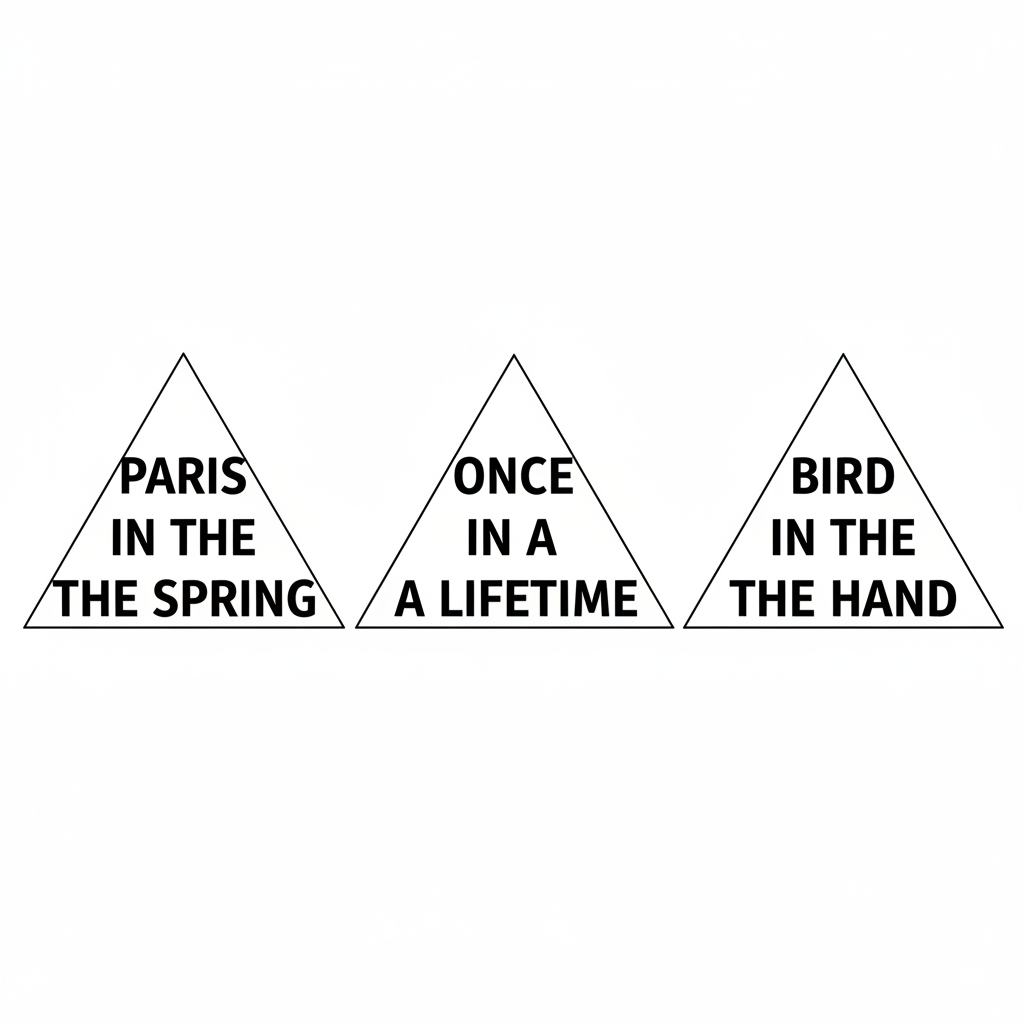
Display this image and ask everyone to read each triangle aloud:
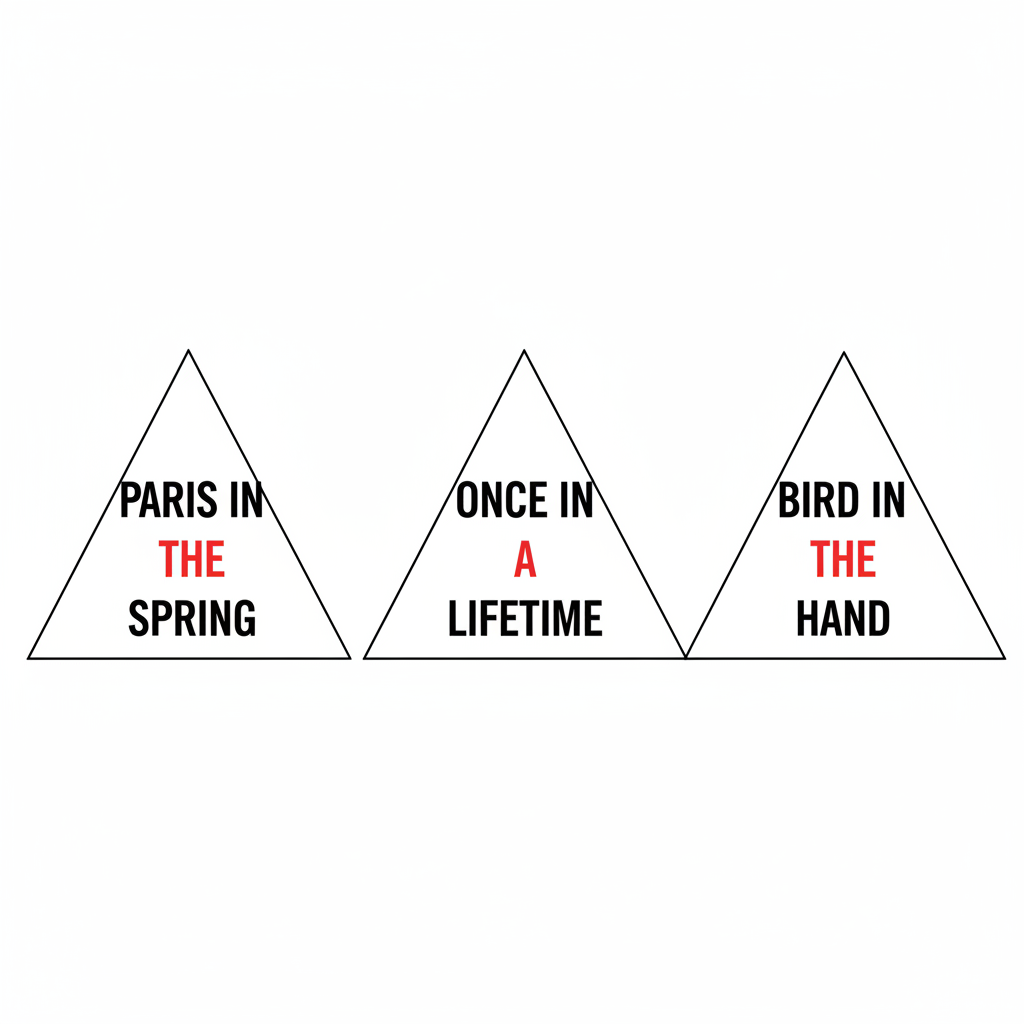
Then reveal the hidden duplicates:
At a Glance
- Time: 2-3 minutes
- Prep: Minimal (one slide with three triangle phrases)
- Group: Whole class (read aloud, then re-read)
- Setting: In-person, hybrid, or online (requires projected or shared image)
- Subjects: Universal (especially effective for language arts, AI education, editing)
- Energy: Medium
Purpose
Demonstrate that the brain sees what it EXPECTS to see, not what's actually there. When familiar phrases contain a subtle error (a repeated word), the brain literally deletes the duplicate to match its stored expectation. This is the same mechanism that makes AI-generated text dangerous: it sounds familiar and fluent, so we auto-accept it without checking whether it's actually accurate. Experiencing your own brain deleting reality is unforgettable.
How It Works
Step-by-step instructions:
-
SHOW THE TRIANGLES (10 seconds) — Display three triangles on your slide, each containing a familiar phrase written across two or three lines inside the triangle:
- Triangle 1: PARIS / IN THE / THE SPRING
- Triangle 2: ONCE / IN A / A LIFETIME
- Triangle 3: BIRD / IN THE / THE HAND
The line break should fall between the repeated words so the duplicate is split across lines (e.g., "THE" at the end of line 2 and "THE" at the start of line 3).
-
READ ALOUD (15 seconds) — Say: "Read these three phrases out loud together. Go!" The whole room will confidently read: "Paris in the spring," "Once in a lifetime," "Bird in the hand." Nobody hesitates.
-
THE TRAP SPRINGS (20 seconds) — Say: "Good. Now read them again. Slowly. Word. By. Word." Watch the room go quiet as people start spotting the repeated words. Gasps, laughter, disbelief.
-
PROGRESSIVE REVELATION (30 seconds) — Highlight the duplicate word in each triangle one at a time:
- "PARIS IN THE THE SPRING" — gasp
- "ONCE IN A A LIFETIME" — bigger gasp
- "BIRD IN THE THE HAND" — laughter
-
THE LESSON (30 seconds) — "Your brain is so familiar with these phrases that it literally DELETED a word to match its expectations. You didn't misread it — your brain re-wrote reality. Now think: when a student submits an AI-generated assignment that SOUNDS right, what is YOUR brain deleting?"
What to Say
Opening: "Read these three phrases out loud. Together. Nice and loud. Go!"
After the first read: "Perfect. You all read them correctly. Or did you? (Pause for effect.) Read them again. Slowly this time. Word... by... word."
As they discover the errors: (Let the gasps happen naturally. Don't point them out — let the discovery be theirs.)
After the reveal: "Every phrase has a duplicated word — 'the the,' 'a a,' 'the the.' You read right past them. Your brain was so confident it knew what these phrases said that it literally rewrote what was on the screen. It deleted a word from reality."
AI connection: "This is exactly what happens with AI-generated content. It sounds familiar. It flows naturally. The grammar is perfect. So your brain auto-accepts it — and deletes the errors. Fluency is not the same as accuracy. Familiar is not the same as correct."
Why It Works
This activity demonstrates top-down processing — the brain's tendency to use prior knowledge and expectations to interpret sensory input, sometimes overriding what's actually there. The familiar phrases ("Paris in the spring") are so deeply encoded in memory that the brain's prediction engine fills in the "correct" version, suppressing the actual input.
The triangle format is crucial: the line break splits the repeated word across two lines, making it even harder to detect because the brain processes each line as a unit and doesn't compare across line boundaries.
This is a profoundly humbling experience. The audience literally LOOKED at the duplicate word, processed it, and failed to see it. This is not a failure of intelligence — it's a feature of how human cognition works. And it's the exact same feature that makes AI-generated misinformation dangerous.
Research basis: Top-down processing theory (Gregory, 1970). The "Paris in the the spring" illusion has been widely used in cognitive psychology demonstrations since the 1970s.
Teacher Tip
The line break placement is critical. Put the first "THE" at the end of one line and the second "THE" at the beginning of the next line inside the triangle. This makes the duplicate nearly invisible. If both instances are on the same line, the illusion is much weaker. Also: use a clear, large font. The effect works BECAUSE people can read it easily — not despite it.
Variations
For Different Subjects
- Language Arts: "This is why editing is so hard. Your brain predicts what should be there and shows you the prediction instead of the text. Professional editors read backwards, sentence by sentence, to defeat this bias."
- Science: "When you expect an experimental result, you literally see confirming data more clearly than disconfirming data. This is why we need controlled experiments and peer review."
- Math: Create a math version: show "2 + 2 = 4" but write "2 + 2 = = 4" with the double equals. Most people won't notice the extra equals sign.
- AI Education: "AI-generated text sounds fluent and familiar — that's exactly WHY it's dangerous. Fluency creates the same kind of brain auto-correct. The text looks right, so your brain decides it IS right. Slow, deliberate reading is a skill that must be taught and practiced."
- Journalism / Media Literacy: "Headlines are designed to match your expectations. When they do, you don't read critically. When something SOUNDS right, that's exactly when you need to read most carefully."
For Different Settings
- Large Audience (50+): Maximum impact — having the entire room read aloud and then go silent as they discover the errors is dramatic.
- Small Class (5-15): Write each phrase on a separate card. Hand one card to each student. Ask them to read it aloud. Then ask them to read it word by word to their neighbor. Watch the discovery spread.
- Workshop/PD: After the reveal, give participants an AI-generated paragraph. Say: "There are 3 errors in this paragraph. Your brain will try to auto-correct them. Can you find all 3?"
For Different Ages
- Elementary (K-5): Use simpler phrases: "A A CAT / SAT ON / THE MAT" — works the same way. The discovery is just as surprising.
- Middle/High School (6-12): Full triangle version works perfectly.
- College/Adult: Full version plus deeper discussion of confirmation bias, editorial processes, and the neuroscience of prediction.
Online Adaptation
Tools Needed: Screen share with slides
Setup: Display the three triangles via screen share.
Instructions:
- Show the triangles. "Read these aloud. Unmute everyone."
- After the group read: "Now type in chat, word by word, EXACTLY what you see in Triangle 1."
- Watch the chat — most people will type the corrected version without the duplicate. When someone types the duplicate, the chat erupts.
- Highlight the duplicates on screen.
Pro Tip: Ask participants to screenshot the chat showing everyone's "corrected" versions vs. the actual text. This documented evidence of mass brain auto-correction is powerful reference material.
Troubleshooting
Challenge: Someone spots the duplicate immediately. Solution: Ask them to stay quiet. Say: "If you see something unusual, keep it to yourself for a moment." After the group read, ask: "Did anyone notice anything different?" Let the spotter share, then highlight for the rest. The spotter's early detection actually reinforces the lesson: "Most of the room missed what one person caught. That's why diverse perspectives matter."
Challenge: Students think you made a typo. Solution: "That's exactly what your brain told you — 'it must be a mistake.' But it was intentional. And your brain's first instinct was to assume error rather than look carefully. That's the bias."
Challenge: The effect doesn't work well if the text is too small. Solution: Use the largest font possible. Each triangle should take up about a third of the slide. The text must be easily readable from the back of the room — the illusion works BECAUSE reading is effortless.
Extension Ideas
- Deepen: Introduce the concept of "proofreading blindness" — why authors cannot effectively edit their own work. "Your brain wrote it, so your brain 'knows' what it says, and shows you the expected version instead of the actual version. This is why peer editing is essential."
- Connect: Have students write a paragraph, then introduce one subtle repeated word. Exchange paragraphs with a partner and try to find the duplicate. Track success rate — it's lower than they expect.
- Follow-up: Teach a practical anti-auto-correct technique: when evaluating AI text, change the font, print it out, or read it aloud. Changing the visual format disrupts the brain's auto-correct predictions.
Related Activities: Count the F's, Stroop Effect, Confirmation Bias Trap