
Best Wrong Answer
At a Glance
- Time: 3-4 minutes
- Prep: Minimal (slide with three wrong answers)
- Group: Whole class (evaluate + fix)
- Setting: In-person, hybrid, or online
- Subjects: Universal (especially effective for math, science, statistics, exam review)
- Energy: Medium
Purpose
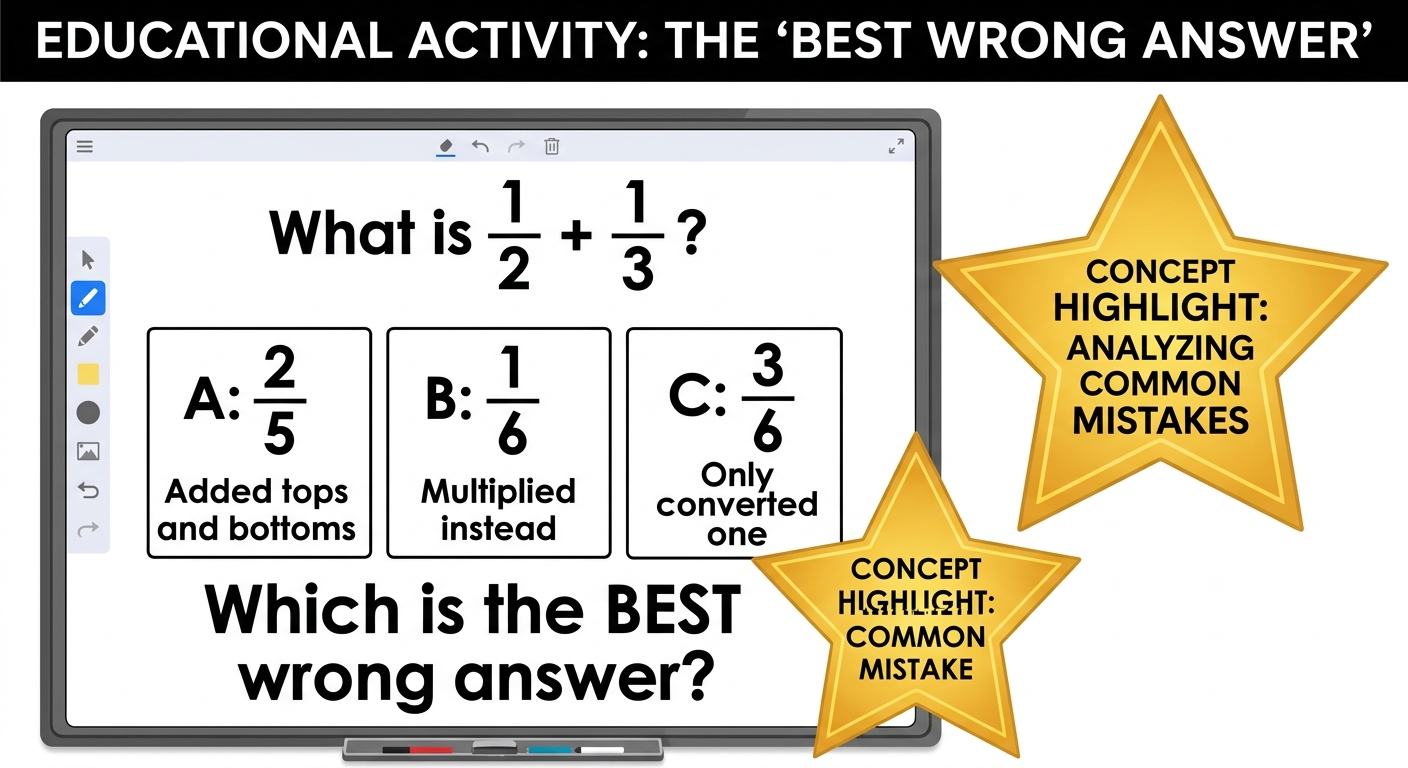
Show three wrong answers that come from three different lines of reasoning. Ask: "Which is the most tempting? What truth is hiding inside it? What one small fix makes it right?" This transforms errors from failures to discard into reasoning to analyze. Wrong answers become data about HOW students think — and the most "tempting" wrong answer is often the most instructive one.
How It Works
Step-by-step instructions:
- SHOW THE QUESTION AND THREE WRONG ANSWERS (15 seconds) — Present a question with three incorrect answers, each arising from a different reasoning error:
- Answer A: Wrong because of a common misconception
- Answer B: Wrong because of a calculation/procedural error
- Answer C: Wrong because of an incomplete understanding
- ASK THREE QUESTIONS (90 seconds):
- "Which wrong answer is the most TEMPTING? Which one would trick the most people?"
- "What TRUTH is hiding inside that wrong answer? Where does the reasoning go right before it goes wrong?"
- "What ONE SMALL FIX would make it correct?"
- THE LESSON (30 seconds) — "Wrong answers aren't failures. They're windows into reasoning. The 'best' wrong answer reveals the most about how we think. If we just mark it wrong and move on, we miss the learning."
What to Say
Opening: "Three wrong answers. All of them wrong. But one of them is the BEST wrong answer — the most instructive, the most tempting, the most revealing about how we think. Which one?"
During analysis: "You picked Answer B? Why is it tempting? (Let them explain.) Good — the person who wrote B understood the concept but made one procedural step wrong. That's a completely different error than Answer A, where the concept itself was misunderstood. Different errors need different corrections."
AI connection: "When AI gives a wrong answer, it's almost always the 'best' kind of wrong — it sounds right, it follows a logical structure, and it contains real truth mixed with error. Evaluating AI output requires the same skill: find the truth hiding inside the error, then fix the one broken piece."
Why It Works
Research on learning from errors (Metcalfe, 2016) shows that errors help learning when learners identify, explain, compare, correct, and get feedback — not when errors are simply marked wrong and discarded. The "best wrong answer" format structures exactly this process: identification, explanation, analysis, and correction.
This routine is especially effective with intellectual audiences because it RESPECTS the wrong answer. It treats an error as a serious piece of reasoning with one broken hinge, not as ignorance to be corrected. This shifts the classroom culture from "don't be wrong" to "be productively wrong."
Research basis: Metcalfe, J. (2017). Learning from Errors. Annual Review of Psychology, 68, 465-489.
Teacher Tip
Design the three wrong answers carefully. Each should arise from a DIFFERENT type of error: conceptual, procedural, and incomplete. If all three are wrong for the same reason, the activity loses its analytical power. The best prompts make it genuinely difficult to choose which wrong answer is "best."
Variations
Example Prompts
| Subject | Question | Answer A (Misconception) | Answer B (Procedural) | Answer C (Incomplete) |
|---|---|---|---|---|
| Math | "Simplify: 2(x+3)" | "2x+3" (forgot to distribute) | "2x+6" (correct, actually!) | "4x+6" (doubled everything) |
| Science | "Why do we see lightning before thunder?" | "Light is louder" (conceptual error) | "Light is faster" (correct!) | "We're closer to the lightning" (incomplete) |
| Statistics | "Correlation implies..." | "Causation" (classic misconception) | "Association" (correct!) | "Nothing" (over-correction) |
Note: Include the correct answer among the options to keep students honest — they should evaluate ALL answers, not assume they're all wrong.
For Different Subjects
- Math: Show common student errors on a worked problem. "Where did the reasoning break?"
- Science: Show three explanations for a phenomenon, each with a different flaw.
- Ethics: Show three moral arguments for a position, each with a different weakness. "Which is most convincing? Which is most dangerous?"
- AI Education: Show three AI-generated answers to the same question. "Which is most dangerously wrong — the one that's closest to right but still wrong?"
For Different Ages
- Elementary (K-5): Use simple math errors. "3 + 4 = 9, 3 + 4 = 6, 3 + 4 = 34. Which is the best wrong answer?" (34 is interesting — the student concatenated instead of adding.)
- College/Adult: Use field-specific examples where the "best wrong answer" is a common professional error.
Online Adaptation
Display the three wrong answers. Use a poll: "Which is the best wrong answer? A, B, or C?" Then discuss in chat: "Why did you pick that one? What truth is inside it?"
Extension Ideas
- Deepen: Have students write "best wrong answer" explanations for concepts they're learning. This requires deeply understanding both the correct reasoning AND the common pitfalls.
- Connect: "Which wrong answer would do the most damage OUTSIDE class?" — this shifts from academic to practical, connecting to AI safety and real-world consequences of confident-but-wrong reasoning.
Related Activities: Confirmation Bias Trap, Precision Ladder, Half a Case