
Read This Aloud — The Stroop Effect
The Stroop Test Slides
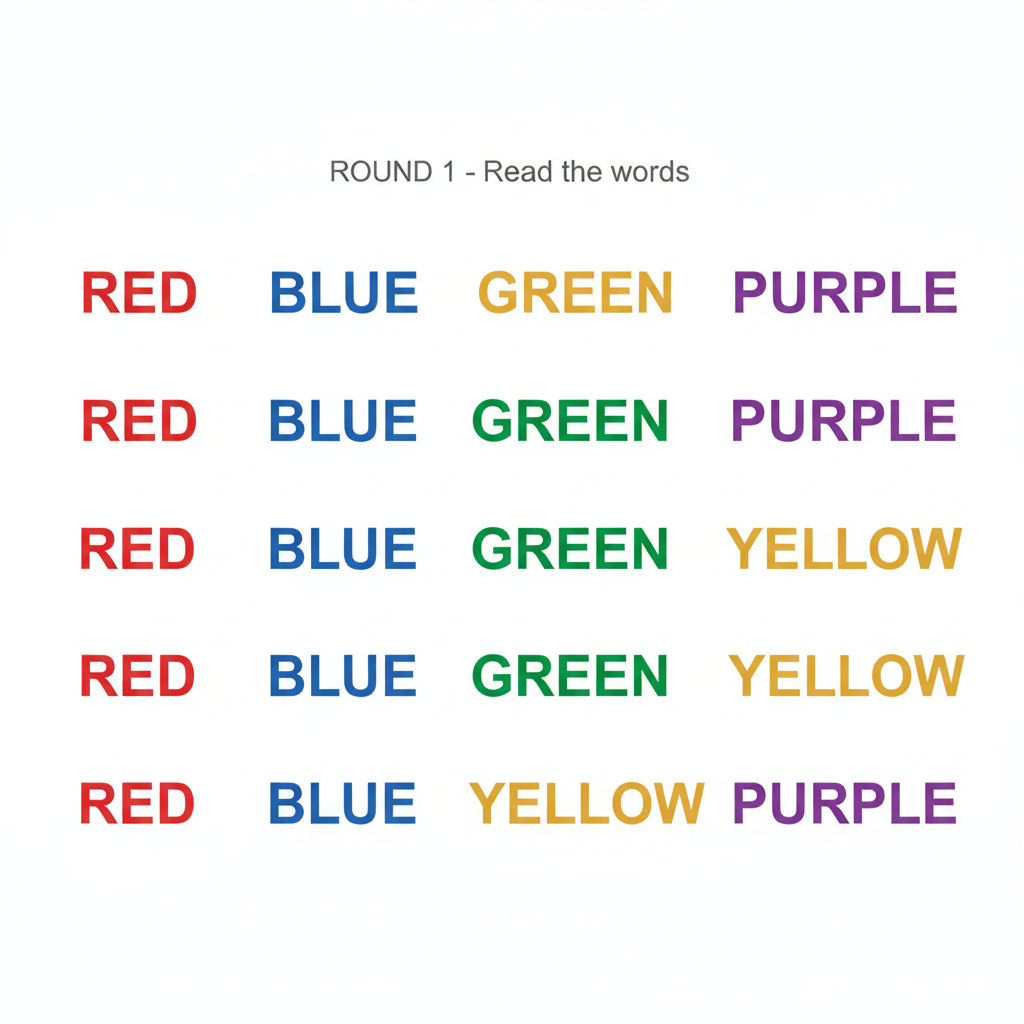
Use these two slides directly in your classroom. Show Round 1 first (easy), then switch to Round 2 (the trap):
Round 1 — Matching Colors (Easy):
Round 2 — Mismatched Colors (The Trap):
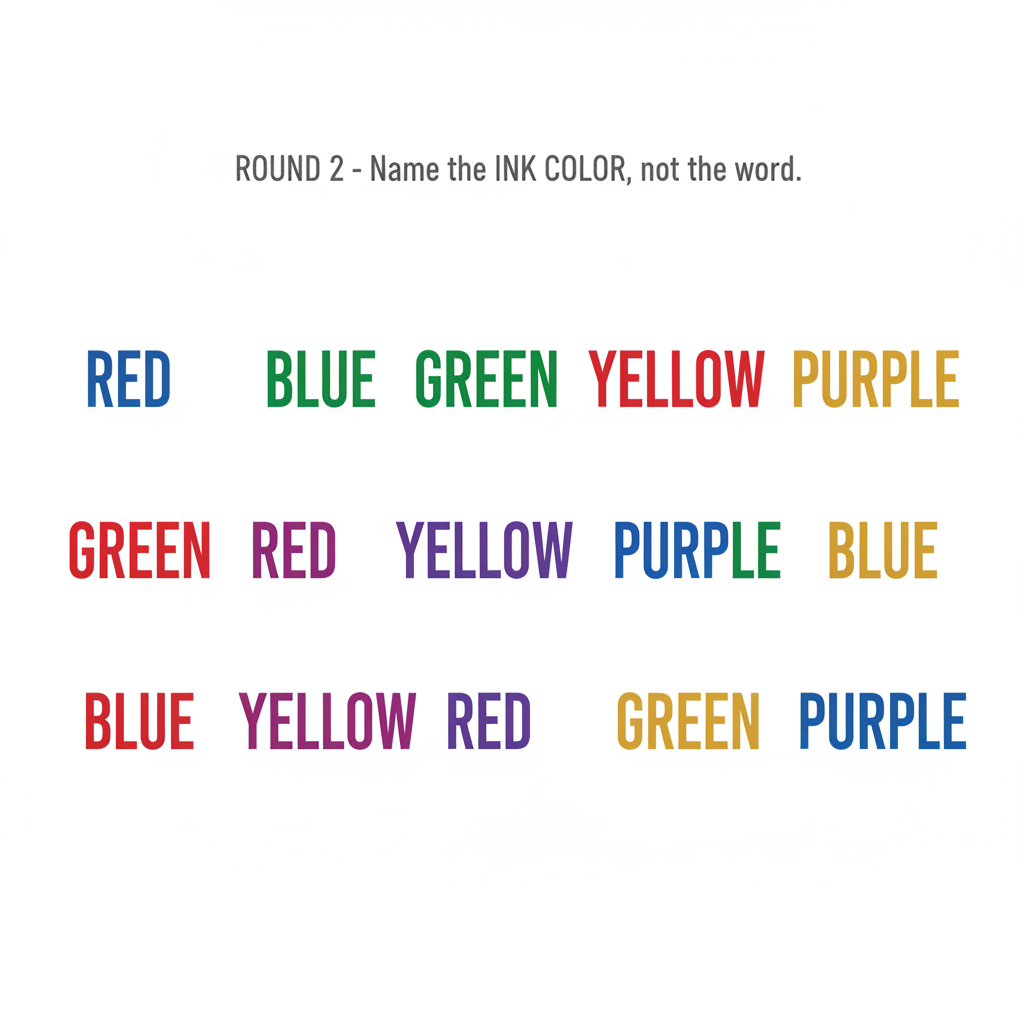
Tip: Project these images full-screen for maximum impact. The larger the text, the stronger the interference effect.
At a Glance
- Time: 3-4 minutes
- Prep: Minimal (two slides — one with matching colors, one with mismatched colors)
- Group: Whole class (read aloud together)
- Setting: In-person or hybrid (requires projected slides or shared screen)
- Subjects: Universal (especially effective for AI education, psychology, neuroscience)
- Energy: High (the room erupts in laughter when they stumble)
Purpose
Demonstrate that automatic processing (System 1 thinking) can override deliberate thinking — and that this is exactly what happens when students auto-accept AI-generated output without critical evaluation. The Stroop Effect is one of the most replicated findings in psychology, and experiencing it firsthand is unforgettable. Every person in the room — regardless of age, expertise, or intelligence — will stumble. That shared experience of cognitive failure creates the perfect teaching moment.
How It Works
Step-by-step instructions:
- EASY ROUND (30 seconds) — Show a slide with color words printed in MATCHING ink colors: the word "RED" in red ink, "BLUE" in blue ink, "GREEN" in green ink, "YELLOW" in yellow ink, "PURPLE" in purple ink. Arrange 10-15 words in rows. Say: "Read these words aloud together. Go!" The room breezes through confidently.
- THE TRAP (10 seconds) — Show the next slide with the SAME words but in MISMATCHED colors: "RED" printed in blue ink, "GREEN" printed in red ink, "BLUE" printed in yellow ink, "YELLOW" printed in green ink. Say: "Now read the COLOR of the ink, not the word. Go!"
- WATCH THE CHAOS (30 seconds) — The entire room — including PhDs, school principals, and the most confident speakers — will stumble, slow down, laugh, and make mistakes. It's involuntary. Even knowing the trick, they can't stop the interference.
- PROGRESSIVE DEBRIEF (60 seconds) — Ask: "Why was that hard?" Let them articulate it. Then reveal: "Your brain reads the WORD automatically — it's been doing it for 20+ years. Naming the COLOR requires deliberate effort. When automatic processing conflicts with deliberate thinking, automatic usually wins. Unless you slow down."
What to Say
Opening (before easy round): "I'm going to show you some words. Read them aloud together, nice and loud. Easy. Ready? Go!"
Transition: "Great. You're all excellent readers. Now here's the challenge." (Switch to mismatched slide.) "This time, DON'T read the words. Tell me the COLOR of the ink. Not the word — the color. Ready? Go!"
During the chaos: (Smile. Let them struggle. Don't help. The struggle IS the lesson.)
Debrief: "What happened? Why was that so hard? (Let them explain.) Here's what's going on: your brain has been reading words automatically for decades. It's System 1 — fast, effortless, unconscious. But naming the color requires System 2 — slow, deliberate, effortful. When these two systems conflict, the automatic one almost always wins. You literally could NOT stop yourself from reading the word, even when you knew you shouldn't."
AI connection: "This is exactly what happens with AI. When ChatGPT produces fluent, well-structured text, your brain's System 1 says 'this sounds right.' Evaluating whether it IS right requires System 2 — the harder, slower, deliberate process. And just like the Stroop test, the automatic response wins unless you intentionally override it."
Why It Works
The Stroop Effect was first described by John Ridley Stroop in 1935 and has been replicated thousands of times across cultures, ages, and languages. It demonstrates automaticity — when a skill (like reading) becomes so practiced that it operates without conscious control, it can interfere with tasks that require deliberate processing.
The effect is involuntary. Even when participants KNOW the trick, they cannot eliminate the interference. This makes it a uniquely powerful teaching tool: the demonstration is self-evident. Nobody can deny it happened to them.
The laughter that erupts when the room stumbles creates a moment of shared vulnerability that builds psychological safety and makes the subsequent teaching point memorable.
Research Citation: Stroop, J.R. (1935). Studies of interference in serial verbal reactions. Journal of Experimental Psychology, 18(6), 643-662. | MacLeod, C.M. (1991). Half a century of research on the Stroop Effect: An integrative review.
Teacher Tip
Make the mismatched slide HARD. Use at least 15 words with aggressively conflicting colors. The more interference, the more dramatic the effect. Also: do it WITH the audience. Your own stumbling makes the demonstration more powerful and builds trust. If you breeze through it perfectly, they'll think it's a performance, not a genuine cognitive phenomenon.
Variations
For Different Subjects
- Psychology: Full debrief on dual-process theory, cognitive load, and automaticity. This is a gateway to Kahneman's System 1/System 2 framework.
- Language Arts: Connect to reading fluency. "Your reading is so automatic that it interferes with other tasks. That's the POWER of fluency — and its limitation."
- Math: Create a "Math Stroop" — show equations like "3 + 4 = 12" and ask students to say whether the answer is correct or incorrect. The automatic calculation (7) conflicts with reading the displayed answer (12). Fast judgments reveal interference.
- AI Education: "This is exactly what happens when students copy-paste from ChatGPT without thinking — the automation wins. AI is like reading the word. Critical thinking is like naming the color. We must train the harder skill."
- Bias Training: "Our biases are automatic. Overriding them requires deliberate, effortful practice — just like naming the color instead of reading the word."
For Different Settings
- Large Audience (50+): Maximum impact — the collective stumbling is louder and funnier.
- Small Class (5-15): Go one at a time. Each person reads a row of mismatched words. The individual struggle is more visible.
- Workshop/PD: After the demonstration, have groups design their own "Stroop-like" interference tasks related to their subject area.
For Different Ages
- Elementary (K-5): Use a shape-color Stroop: show shapes (circle, square, triangle) drawn inside OTHER shapes (circle drawn inside a square). Ask them to name the OUTER shape. Same principle, no reading required.
- Middle/High School (6-12): Full word-color Stroop works perfectly.
- College/Adult: Full version plus deeper discussion of automaticity in professional contexts. "What do you do on autopilot that might benefit from deliberate attention?"
Online Adaptation
Tools Needed: Screen share with pre-made slides
Setup: Share your slide deck. Ensure colors display accurately on screen (test beforehand).
Instructions:
- Show matching slide. "Everyone unmute and read these aloud. Go!"
- Show mismatched slide. "Now name the COLORS, not the words. Unmute. Go!"
- The cacophony of errors through speakers is hilarious and unmistakable.
Alternative (cameras): Ask participants to hold up fingers for each color: 1 = red, 2 = blue, 3 = green, etc. Watch them struggle to match the number to the ink color.
Pro Tip: Record the audio of the mismatched round and replay it. The collective stumbling is comedy gold — and a powerful anchor for the teaching point.
Troubleshooting
Challenge: The colors don't display well on the projector or screen. Solution: Use high-contrast, saturated colors. Test beforehand. Avoid yellow-on-white or light colors. Red, blue, green, and purple on a white background work best.
Challenge: Some students speak another language and don't experience the effect as strongly. Solution: This actually reinforces the point! "The effect is WEAKER for you because reading English isn't fully automatic yet. The more automatic a process, the harder it is to override. That's the lesson."
Challenge: A student claims they didn't struggle at all. Solution: "Interesting! You probably slowed down significantly compared to the matching round — that slowdown IS the effect. Even if you didn't make errors, your processing speed decreased. That's interference."
Extension Ideas
- Deepen: Introduce Kahneman's System 1 / System 2 framework. "The Stroop Effect is System 1 and System 2 fighting for control. When do you want System 1 to win? When do you want System 2?"
- Connect: Ask students to identify three situations in their lives where automatic processing helps them (driving, typing, reading) and three where it hurts them (jumping to conclusions, believing headlines, accepting AI output).
- Follow-up: Create a "Slow Thinking Challenge" — for one week, students practice deliberately pausing before accepting information at face value. Journal about what they notice.
Related Activities: The X Activity, Count the F's, Paris in the Spring