
Which One Doesn't Belong?
Display this image — every shape can be the odd one out for a different reason:
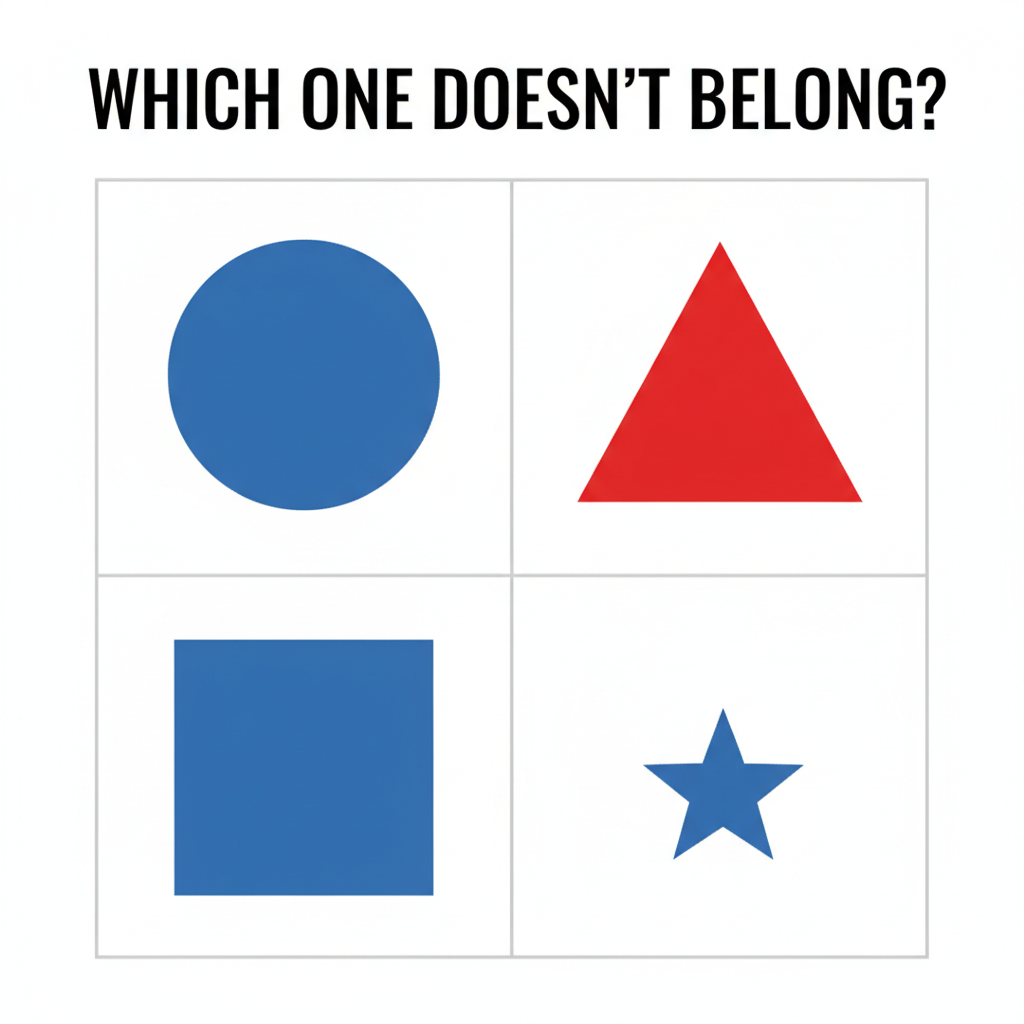
At a Glance
- Time: 3-4 minutes
- Prep: Minimal (slide with four items)
- Group: Whole class (silent pick, pair talk, whole-room harvest)
- Setting: In-person, hybrid, or online
- Subjects: Universal (works across all disciplines)
- Energy: Medium
Purpose
Demonstrate that category boundaries depend on the criteria you choose — and that there is ALWAYS more than one rigorous answer. Four items are displayed, each excludable for a different reason. This forces flexible thinking, disciplinary vocabulary, and the realization that "the odd one out" depends entirely on the lens you apply. The activity directly challenges the single-right-answer mindset that limits critical thinking.
How It Works
Step-by-step instructions:
- DISPLAY FOUR ITEMS (10 seconds) — Show four items on a slide: images, words, equations, quotes, or concepts. The secret: each item CAN be the odd one out for a different, defensible reason.
- SILENT PICK (20 seconds) — "Which one doesn't belong? Pick one silently. Be ready to explain WHY."
- PAIR TALK (30 seconds) — "Turn to your neighbor. Share your choice and your reasoning."
- WHOLE-ROOM HARVEST (60 seconds) — Collect answers. "Who picked item A? Why? Who picked item B? Why?" Map the different criteria on the board.
- THE SECOND CRITERION (30 seconds) — "Now give me a reason for a DIFFERENT item. Can you find a valid reason for EVERY item?" The room discovers that all four can be the odd one out.
- THE LESSON (20 seconds) — "There wasn't one right answer. There were four right answers with four different criteria. The question wasn't testing your knowledge — it was testing your ability to see the same set through different lenses."
What to Say
Opening: "Four items. Which one doesn't belong? No trick — but there IS more than one defensible answer."
During harvest: "Maya says item C because it's the only one that [criteria]. Interesting. James says item A because [different criteria]. Both are logically valid. Anyone have a third option?"
The lesson: "Every item was the odd one out depending on the criterion. The first answer gets participation. The SECOND answer gets thinking. And asking for a reason for EVERY item? That's where mastery lives."
Why It Works
This routine builds cognitive flexibility — the ability to switch between different classification criteria fluently. Research on categorization shows that novices tend to classify by surface features while experts classify by deep structure. Asking for multiple criteria pushes everyone toward deeper analysis.
The format also creates low social risk: because there's no single right answer, nobody can be wrong. This psychological safety increases participation and encourages risk-taking.
Research basis: QCAA (Queensland Curriculum & Assessment Authority) guidelines; widely used in math education and visible thinking routines.
Teacher Tip
The key to a great prompt is that EVERY item must be excludable for a defensible reason. If three items share an obvious feature, the activity becomes trivial. Test your prompts: can you articulate a valid exclusion for each item? If not, redesign.
Variations
Example Prompts
| Domain | Four Items | Possible Exclusions |
|---|---|---|
| Math | 16, 25, 36, 43 | 43 (not a perfect square), 25 (only odd), 16 (only 4th power), 36 (only divisible by 6) |
| History | WWI, WWII, Cold War, Vietnam War | Cold War (not "hot"), WWI (pre-nuclear), WWII (most global), Vietnam (not European) |
| Literature | Hamlet, Romeo & Juliet, Macbeth, Othello | Romeo (only comedy-inflected love story), Hamlet (longest), Othello (non-royal protagonist), Macbeth (only one in Scotland) |
| Classroom Policies | No phones, Late = detention, Growth mindset, Pop quizzes | Growth mindset (only one that's encouraging vs. punitive) |
For Different Ages
- Elementary (K-5): Use shapes (circle, triangle, square, heart) or animals.
- College/Adult: Use disciplinary concepts, research papers, or policies. The more sophisticated the audience, the more nuanced the criteria should be.
Expert Version
Require the room to give one valid reason for EVERY item — proving that all four can be excluded. This forces exhaustive analysis.
Online Adaptation
Display four items. "Type in chat: which one and WHY." The chat creates a beautiful diversity of reasoning. Then ask: "Who can find a reason for a DIFFERENT item?"
Extension Ideas
- Deepen: Have students create their own "Which One Doesn't Belong" prompts for their subject area. Designing the prompt requires deeper understanding than solving it.
- Connect: Pair with Four Voices (025) — both present multiple valid perspectives. WODB uses objects; Four Voices uses arguments.
Related Activities: Four Voices, Hidden Rule, Duck-Rabbit