
Object Transformation — Breaking Functional Fixedness
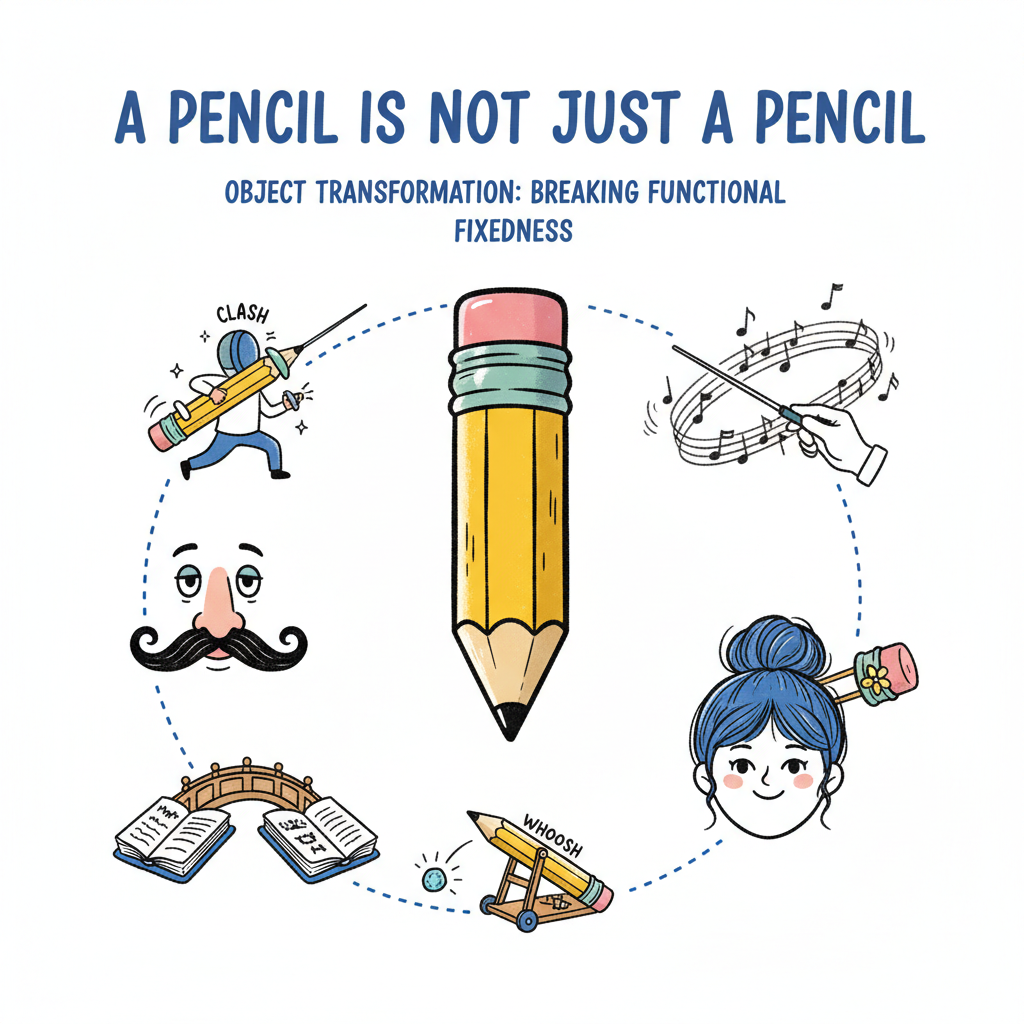
At a Glance
- Time: 3-5 minutes
- Prep: Minimal (one mundane physical object: pencil, tape roll, stapler)
- Group: Whole class (pantomime + guess)
- Setting: In-person (requires physical interaction with object)
- Subjects: Universal (especially effective for design thinking, innovation, creativity, entrepreneurship)
- Energy: High (physical pantomime generates laughter and energy)
Purpose
Demonstrate that objects — like symbols, words, and numbers — have no inherent purpose beyond what context assigns them. By banning an object's intended use and forcing participants to invent completely new functions through pantomime, the exercise breaks functional fixedness — the cognitive bias that limits us to using things only as they were designed to be used. This is The X Activity applied to physical objects: same crossing lines (the pencil), different context (the pantomime), completely different meaning.
How It Works
Step-by-step instructions:
- PRESENT THE OBJECT (10 seconds) — Hold up a mundane object: a pencil, a roll of tape, a heavy stapler. State the rule: "This is no longer a pencil. It cannot be used for writing, erasing, or anything related to its intended purpose."
- DEMONSTRATE (15 seconds) — Pantomime a completely new use. Hold the pencil horizontally to your lips and press an imaginary button on the side — a spy's hidden communicator. Or hold it over your upper lip as a fake mustache. Or wave it dramatically as a conductor's baton.
- PASS AND INVENT (90 seconds) — Pass the object to a volunteer (or ask the front row). Each person must instantly invent a new function: a magic wand, a tiny sword, a toothpick for a giant, an antenna, a chopstick. No repeats. Move fast.
- THE LESSON (30 seconds) — "A pencil is only a pencil when it interacts with paper. In a conductor's hands, it's a baton. In a spy movie, it's a weapon. The object didn't change — your CONTEXT for it did. This is functional fixedness: the brain locks an object to its manufactured purpose. Breaking that lock is the first step in innovation."
What to Say
Opening: (Hold up pencil.) "This is not a pencil. It hasn't been a pencil for years. It is something else entirely. Watch."
During the demonstration: (Pantomime with full commitment. The more seriously you do it, the funnier it is.)
During pass-and-invent: "Your turn. What is this object? Show us — don't tell us. (Audience guesses the new function.)"
The lesson: "You just generated 15 different identities for a pencil in 90 seconds. In your work, when someone says 'we've always done it this way,' they're treating the pencil as only a pencil. Innovation begins when you ask: what ELSE could this be?"
AI connection: "AI is a tool — like a pencil. Right now, most people use AI for one function: 'write my essay' or 'answer my question.' That's functional fixedness applied to AI. What are the other 14 uses nobody has tried yet? The creative users aren't the ones who use AI better — they're the ones who use it DIFFERENTLY."
Why It Works
Functional fixedness is a well-documented cognitive bias first described by Karl Duncker (1945). In his famous candle problem, participants struggle to attach a candle to a wall when the tacks are presented INSIDE a box — because they see the box as "a container" rather than "a shelf." When tacks are presented NEXT TO the box, the solution (pin the box to the wall as a shelf) becomes obvious.
The exercise leverages embodied cognition — by physically manipulating the object in new ways, neural pathways associated with the original function are inhibited and new associations are formed. This is why pantomime works better than just TALKING about alternative uses.
Stanford d.school design thinking workshops use similar exercises to break fixed thinking patterns before ideation sessions.
Research basis: Duncker, K. (1945). On problem-solving. Psychological Monographs, 58(5). | Adamson, R.E. (1952). Functional fixedness as related to problem solving. Journal of Experimental Psychology, 44(4), 288-291.
Teacher Tip
Commit to the pantomime. If you half-heartedly wave the pencil, the room stays passive. But if you dramatically hold it to your ear like a phone, speak into it urgently in a fake language, and then slam it down — the room erupts, and everyone wants a turn. Your energy sets the ceiling for theirs.
Variations
Stanford "Make Up a Story" Version
For intellectual audiences: bring an obscure, unrecognizable object (a vintage kitchen gadget, an antique medical tool, an unusual piece of hardware). Participants pair up and must invent a plausible, confident, elaborate story: what it is, who uses it, where, and why it's valuable. Then reveal the actual purpose. The gap between imagined and real function IS the lesson.
For Different Subjects
- Entrepreneurship: "Every successful startup found a new use for existing technology. Slack was a game company's internal tool. Play-Doh was wallpaper cleaner. Innovation is functional UN-fixedness."
- Science: "Scientific breakthroughs often come from using a tool in a way it wasn't designed for. PCR was adapted from bacterial enzymes. CRISPR was repurposed from bacterial immune systems."
- AI Education: "AI is being used as a search engine, a calculator, and a writing assistant. What are the functions nobody has invented yet?"
For Different Ages
- Elementary (K-5): Kids are naturally brilliant at this because they haven't fully developed functional fixedness yet. A stick is already a sword, a wand, a fishing rod, and a horse in a single afternoon.
- College/Adult: The Stanford "obscure object" variation works best — adults need more intellectual framing to feel comfortable being silly.
Online Adaptation
Each participant grabs a random object from their desk. "Hold it up to camera. You have 10 seconds to show us a completely new use for it — pantomime only, no talking." Take turns. The constraint of using whatever's at hand adds spontaneity.
Extension Ideas
- Deepen: After the activity, apply the same thinking to a real problem: "What existing resource in your classroom/organization is currently being used for only ONE purpose? What else could it do?"
- Connect: Pair with Droodles (017) — both require radical reframing. Droodles reframe visual geometry through captions. Object Transformation reframes physical objects through action. Same cognitive muscle, different modality.
Related Activities: Droodles, The X Activity, Which One Doesn't Belong