
The Tapping Experiment — Curse of Knowledge
At a Glance
- Time: 3-5 minutes
- Prep: None (just a table or desk surface)
- Group: Pairs or one volunteer + audience
- Setting: In-person (requires table tapping)
- Subjects: Universal (especially effective for leadership, teaching, communication, PD)
- Energy: High (funny and humbling)
Purpose
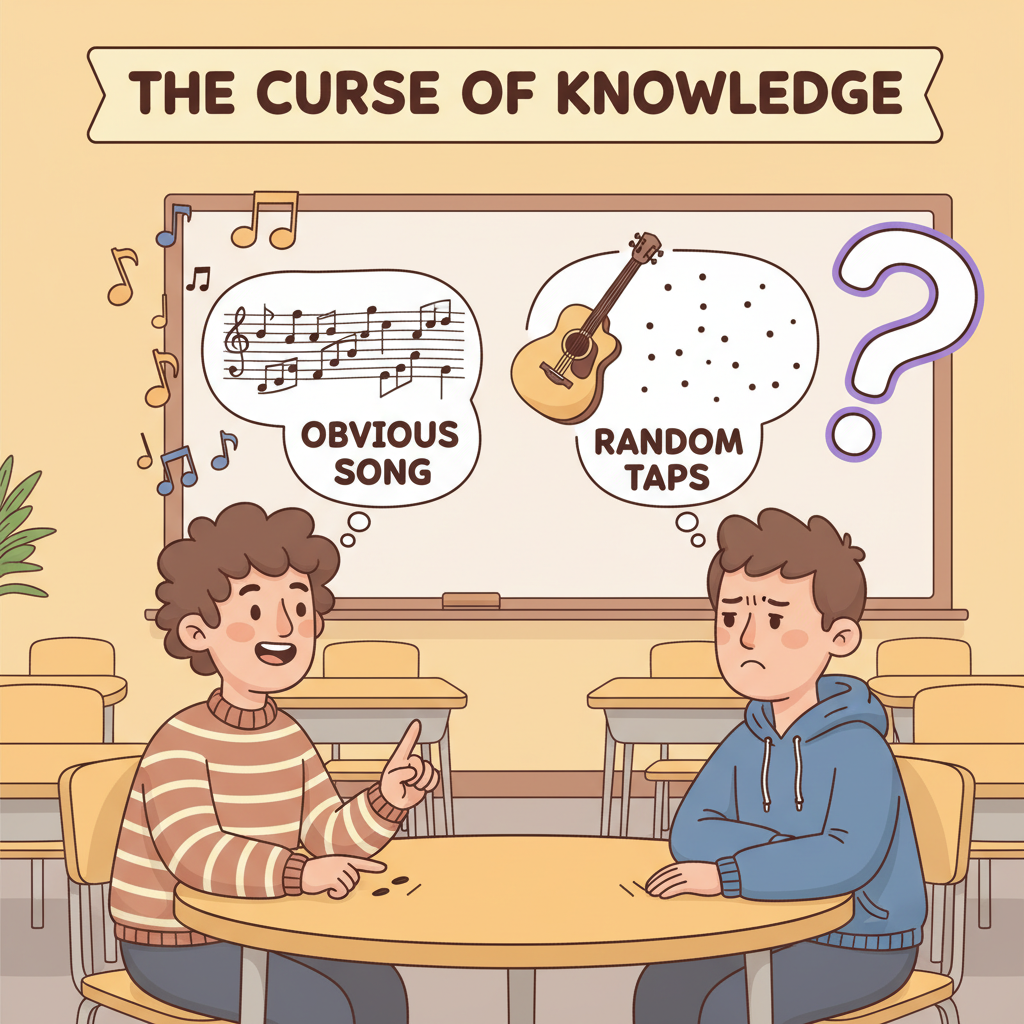
Demonstrate the "Curse of Knowledge" — once you know something, you cannot imagine what it's like NOT to know it. A tapper who hears the full melody in their head while knocking on a table predicts that 50% of listeners will guess the song. The actual success rate is 2.5%. The catastrophic gap between predicted and actual comprehension vividly illustrates why experts give terrible instructions, why managers think their strategy is obvious, and why teachers assume students understood.
How It Works
Step-by-step instructions:
- SETUP (30 seconds) — Select a confident volunteer (the Tapper). Show them — and ONLY them — the name of a universally known song: "Happy Birthday," "Jingle Bells," or your national anthem. The audience (Listeners) must not see the song title.
- THE PREDICTION (15 seconds) — Before tapping, ask the Tapper publicly: "What percentage of the audience do you think will guess this song?" They will predict 40-50% or more. Write this prediction on the board.
- THE TAPPING (30 seconds) — The Tapper taps the rhythm of the song on a table, desk, or podium using their knuckles. No humming, no lip-moving, no head-bobbing. Just taps.
- THE GUESS (30 seconds) — Ask the audience: "Who thinks they know what song that was?" A few tentative hands. Take guesses. Almost nobody gets it right.
- THE REVEAL (15 seconds) — Reveal the song. Ask the Tapper: "While you were tapping, could you hear the full song in your head?" They'll say yes emphatically. Ask the Listeners: "Did it sound like that song?" They'll say it sounded like random noise.
- THE LESSON (30 seconds) — "The Tapper predicted 50%. The actual rate was near 0%. That gap is the Curse of Knowledge. When you know something, it's neurologically impossible to fully un-know it. You hear the melody; your audience hears random taps. This is why brilliant experts can be terrible communicators."
What to Say
Opening: "I need a volunteer. Someone confident. (Select tapper. Show song title privately.) Before you tap — how many people in this room do you think will recognize the song? Give me a percentage."
After tapping: "Alright, audience — any guesses? What song was that? (Take 3-4 guesses.) The song was... 'Happy Birthday.' (To the tapper:) Could you hear it? (Yes.) (To the audience:) Could you? (Definitely not.)"
The lesson: "The tapper HEARD 'Happy Birthday' perfectly. The audience heard disconnected knocks on a table. That's the Curse of Knowledge. The tapper couldn't stop hearing the melody — it played automatically in their head. They couldn't imagine what it sounds like WITHOUT the melody. This exact phenomenon happens every time an expert explains something to a novice, every time a leader announces a strategy to the team, every time a teacher teaches a concept that seems 'obvious.'"
AI connection: "When you understand a topic deeply and ask AI to explain it, the AI's explanation might seem perfectly clear to YOU — because you already know the answer. But to a novice, it might be random taps. You can't evaluate whether AI's explanation is clear for your students because YOU hear the melody."
Why It Works
This activity replicates Elizabeth Newton's famous 1990 Stanford experiment. Newton found that tappers predicted a 50% success rate while the actual rate was 2.5% — a 20x gap. The discrepancy illustrates the Curse of Knowledge (also called Hindsight Bias in some contexts): once information is known, people cannot accurately reconstruct the state of mind of someone who lacks that knowledge.
The mechanism is neurological: when you tap a rhythm while knowing the song, your brain automatically fills in melody, lyrics, instrumentation, and emotional associations. This internal "soundtrack" is so vivid that tappers genuinely cannot understand why listeners don't hear it. The tap-to-listener gap is a physical analog of every communication failure between expert and novice.
Research Citation: Newton, E.L. (1990). The rocky road from actions to intentions (Doctoral dissertation, Stanford University). As popularized by Heath, C. & Heath, D. (2007). Made to Stick.
Teacher Tip
Run this with pairs if you have time — every tapper in the room experiencing the prediction gap simultaneously is more powerful than watching one volunteer. Have everyone pair up, privately assign songs (different songs for each pair), predict, tap, and guess. The universal failure rate makes the lesson inescapable.
Variations
For Different Subjects
- Leadership/PD: "Every time you roll out a new initiative and wonder why the team 'doesn't get it,' you're tapping. You hear the full strategy — the reasoning, the data, the vision. They hear disconnected directives. Start with the melody (the Why), not the rhythm (the What)."
- Teaching: "When you say 'photosynthesis is just plants making food from sunlight' and think it's simple, you're tapping 'Happy Birthday.' Your student hears random knocks. What melody are you assuming they hear?"
- Parenting: "When your teenager says 'you don't understand,' they might be right — you can't un-know what you know."
For Different Settings
- Large Audience (50+): Use one volunteer. The large audience makes the prediction gap more dramatic — 50% of 200 people = 100 correct guesses expected, reality = 2 or 3.
- Small Class (5-15): Everyone pairs up. More intimate, more personal.
- Workshop/PD: After the activity, have participants identify a concept in their field where they're "tapping" — where they assume clarity that doesn't exist for their audience.
For Different Ages
- Elementary (K-5): Use very simple songs (Twinkle Twinkle). Kids love tapping and guessing. The lesson: "When you explain something to a friend and they don't get it, it's not because they're not listening. It's because YOU know something they don't."
- College/Adult: Full version with the Newton research context. Discuss implications for teaching, mentoring, and cross-disciplinary communication.
Online Adaptation
Tools Needed: Microphone
Instructions:
- DM the tapper a song title via private message.
- Tapper unmutes and taps on their desk/table near the microphone.
- Audience types guesses in chat.
- The chat log (mostly wrong guesses) is powerful evidence.
Limitation: Audio quality through speakers may degrade the tapping sound. In-person is significantly better for this activity.
Troubleshooting
Challenge: Someone guesses the song immediately. Solution: Rare, but possible. Congratulate them and ask: "How? What cue did you use?" Then note: "One person out of the whole room got it. The tapper predicted HALF the room would. That gap is the lesson."
Challenge: The tapper is a terrible rhythm-keeper. Solution: That actually reinforces the lesson: "Even when the tapper tapped poorly, THEY still heard the perfect melody in their head. The quality of the communication doesn't matter — the curse operates regardless."
Extension Ideas
- Deepen: After the activity, have each participant identify one concept they teach or explain regularly. Ask: "What's the 'melody' you hear that your audience might not? How can you make the melody explicit rather than assumed?"
- Connect: Pair with The Laundry Paragraph (015) — one demonstrates the curse of knowledge through sound (tapping), the other through text (the paragraph is incomprehensible without context). Both prove: context must be provided BEFORE content.
Related Activities: Laundry Paragraph, Dot Exercise, The X Activity