
The Dot Exercise — Draw What I Describe
At a Glance
- Time: 4-5 minutes
- Prep: Minimal (a hidden simple image; participants need paper and pen)
- Group: Whole class (drawing simultaneously)
- Setting: In-person (requires drawing)
- Subjects: Universal (especially effective for leadership, communication, project management)
- Energy: High (the comparison of drawings creates laughter)
Purpose
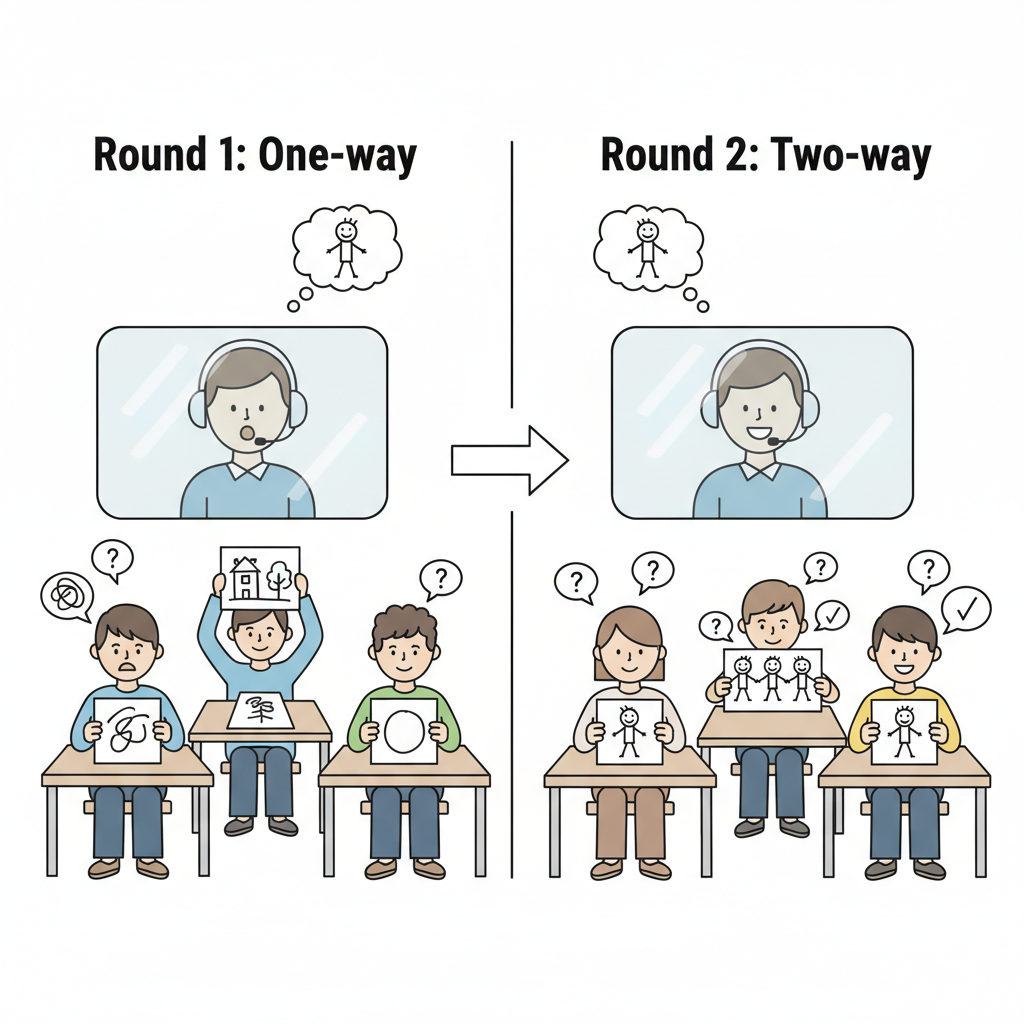
Demonstrate that one-way communication is unreliable even when the speaker is perfectly clear. The instructor describes a hidden image using only geometric instructions while the audience draws it. Without the ability to ask questions, the resulting drawings diverge wildly. In Round 2, with questions allowed, accuracy improves dramatically. The lesson: feedback loops transform communication accuracy, and the gap between "I said it" and "they understood it" is always larger than you think.
How It Works
Step-by-step instructions:
- ROUND 1 — NO QUESTIONS (90 seconds) — Have a simple image hidden (a stick figure, a house, a basic diagram). Describe it to the audience step by step using only geometric instructions: "Draw a vertical line in the center of your page. At the top, draw a circle. From the middle of the vertical line, draw two lines angling downward to the left and right..." Do NOT tell them what the final picture is. Do NOT accept questions. Just give instructions.
- THE COMPARISON (30 seconds) — Ask 3-4 volunteers to hold up their drawings. They will look wildly different from each other and from the original. Reveal your hidden image. Laughter ensues.
- ROUND 2 — QUESTIONS ALLOWED (90 seconds) — Use a different simple image. This time, describe it the same way but allow the audience to ask yes/no questions: "Is the circle touching the line?" "Should the lines angle at 45 degrees or steeper?" The results will be dramatically more accurate.
- THE LESSON (30 seconds) — "Same speaker. Same type of instructions. Same audience. The only difference: feedback. The ability to ask questions transformed random noise into coherent communication. One-way communication is broadcasting. Two-way communication is connecting."
What to Say
Opening: "Everyone grab a piece of paper and a pen. I'm going to describe a picture. Draw exactly what I say. You may NOT ask questions. Ready?"
During Round 1: (Give precise geometric instructions. Speak clearly. Do not answer questions.)
After Round 1: "Hold up your drawings! (Laughter.) Now here's what I was describing. (Reveal image.) How many got it exactly right? (Almost nobody.) I was perfectly clear. What happened?"
After Round 2: "Look at the difference. Same exercise. Same type of instructions. But this time you could ask questions. Every question was a course correction. Every answer was a calibration. That's the power of a feedback loop."
AI connection: "When you give AI a prompt, it's Round 1 — one-way communication with no feedback. That's why iterative prompting works: each follow-up question is a feedback loop that calibrates the output. Don't expect perfection from a single prompt. Expect it from a conversation."
Why It Works
This exercise demonstrates the profound difference between one-way and two-way communication — a finding consistently replicated in organizational communication research. Harold Leavitt's early work on communication networks showed that one-way communication is faster but dramatically less accurate than two-way communication.
The exercise also reveals the illusion of transparency — the speaker's belief that their intended meaning was clearly transmitted. The instructor feels perfectly clear; the audience's drawings prove otherwise. This mirrors the Tapping Experiment's curse of knowledge, but in a visual-spatial domain rather than an auditory one.
Teacher Tip
Use genuinely simple images — a stick figure, a house with a chimney, a smiley face. If the image is too complex, Round 1 becomes frustrating rather than instructive. The point isn't to draw something hard; it's to see how even SIMPLE communication fails without feedback.
Variations
For Different Subjects
- Leadership: "Every email you send without inviting a response is Round 1. Every all-hands meeting without Q&A is Round 1. If you want your team to draw the right picture, you need to let them ask questions."
- Project Management: "Requirements documents are Round 1. Sprint reviews with stakeholder feedback are Round 2. Which produces better software?"
- Teaching: "A lecture is Round 1. A class discussion with checks for understanding is Round 2."
For Different Ages
- Elementary (K-5): Use very simple shapes (circle, square, triangle). Kids love drawing and comparing.
- College/Adult: Use slightly more complex images. The professional implications hit harder with more sophisticated audiences.
Online Adaptation
Works well online. Describe the image via audio while participants draw on physical paper. Have them hold up drawings to camera. Or use an online whiteboard where everyone draws simultaneously — the visual divergence is immediately apparent.
Extension Ideas
- Deepen: Run Round 3: show the original image to everyone FIRST, then have one person describe it to a partner who didn't see it (also with questions allowed). Compare accuracy across all three rounds. Context + feedback = highest accuracy.
- Connect: Pair with The Tapping Experiment (019) — both demonstrate the gap between the communicator's internal experience and the receiver's actual understanding. Tapping is auditory; the Dot Exercise is visual. Same principle, different modality.
Related Activities: Tapping Experiment, Laundry Paragraph, Statement Stress