
Visual Thinking Strategies (VTS)
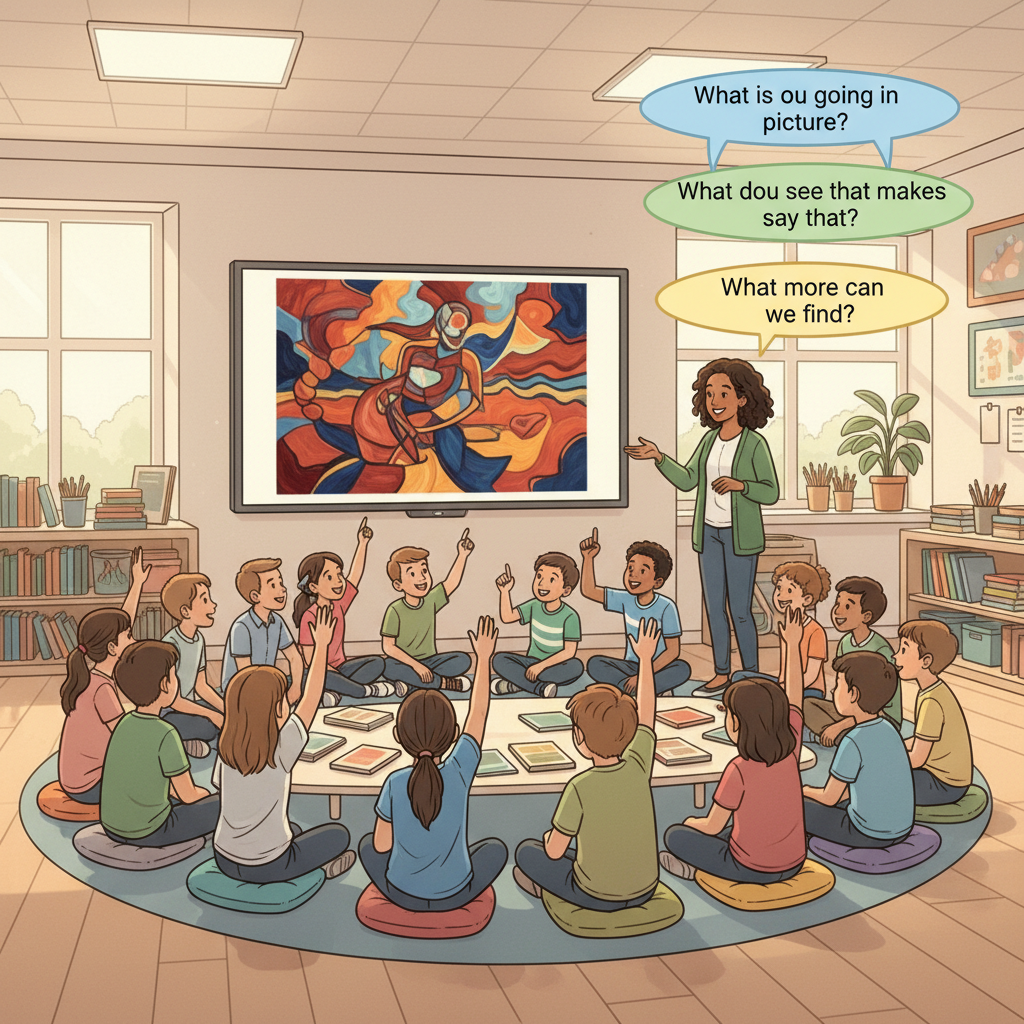
At a Glance
- Time: 4-5 minutes
- Prep: Minimal (one complex, ambiguous image on a slide)
- Group: Whole class (facilitated discussion)
- Setting: In-person, hybrid, or online
- Subjects: Universal (especially effective for science, leadership, medicine, research)
- Energy: Medium
Purpose
Force a rigorous separation between OBSERVATION and INFERENCE. Using a complex, ambiguous image and a strict three-question protocol, VTS demands that participants justify every claim with visual evidence. There is deliberately no "correct answer" — which forces high-achieving audiences to practice dwelling in ambiguity and building evidence-based arguments without the safety net of a verifiable right answer.
How It Works
Step-by-step instructions:
- DISPLAY THE IMAGE (10 seconds) — Project a complex, narrative-rich, but ambiguous image. A candid photograph, a painting, or a photojournalism image with its caption removed works best.
- SILENT LOOKING (60 seconds) — Demand complete silence for 60 seconds. "Just look. Don't talk yet. Really examine the details." This prevents the quickest thinker from anchoring the group's perception.
- QUESTION 1 — "What's going on in this picture?" This demands narrative construction, not object identification. Take 3-4 responses.
- QUESTION 2 (after each response) — "What do you see that makes you say that?" This forces the speaker to tether their subjective inference back to specific visual evidence.
- NEUTRAL PARAPHRASE — Mirror the response: "So you're noticing the blurred motion in the background, which suggests to you that people are moving quickly." Don't validate or correct — just reflect.
- QUESTION 3 — "What more can we find?" This prevents premature closure and insists the analysis isn't complete yet. Repeat 3-4 cycles.
- THE LESSON (30 seconds) — "Notice what we just did. Every claim had to be backed by evidence. No one was told they were right or wrong. And collectively, we built a richer understanding than any individual had alone."
What to Say
Opening: "I'm going to show you an image. I want 60 seconds of complete silence first — just look. No talking."
Facilitating:
- "What's going on in this picture?"
- (After a response:) "Interesting. What do you see that makes you say that?"
- (Paraphrase:) "So Maria is noting that the figures are leaning forward, which suggests to her urgency or determination."
- "What more can we find?"
Closing: "We just built a collaborative interpretation without any single 'expert' answer. Each person noticed different details. Together, we saw more than any individual could alone. This is the value of diverse perspectives — not as a platitude, but as a cognitive fact."
AI connection: "When AI analyzes an image or generates a description, it gives you ONE interpretation. VTS trains you to ask: what else is going on? What did the AI miss? What evidence contradicts its reading?"
Why It Works
Developed by cognitive psychologist Abigail Housen and museum educator Philip Yenawine, VTS uses three carefully constructed questions to separate observation from inference — a distinction that highly educated people routinely collapse. The protocol has been adopted by medical schools (to improve diagnostic observation), corporate teams (to improve collaborative analysis), and K-12 classrooms.
The deliberate withholding of the "correct" interpretation forces participants to build tolerance for ambiguity — a critical skill in complex environments where definitive answers don't exist.
Research basis: Yenawine, P. (2013). Visual Thinking Strategies: Using Art to Deepen Learning Across School Disciplines. Harvard Education Press.
Teacher Tip
The hardest part is NOT inserting your own interpretation. As the facilitator, your job is to reflect, connect, and expand — never to confirm or deny. The moment you say "Exactly right!" or "Not quite," the exercise collapses into guess-what-the-teacher-thinks. Stay neutral. The ambiguity IS the learning.
Variations
For Different Subjects
- Medical Education: Show ambiguous diagnostic images. "What do you observe? What makes you say that?" Trains diagnostic reasoning.
- History: Show historical photographs with captions removed. Let students build interpretations from visual evidence before revealing context.
- Science: Show microscopy images, satellite data, or experimental results without labels. "What patterns do you notice?"
- Leadership: "In your next meeting, try these three questions instead of telling people what you think. Watch what happens."
For Different Ages
- Elementary (K-5): Use simple, colorful paintings. Kids are naturally brilliant at VTS because they haven't yet learned to fear being wrong.
- College/Adult: Use more complex, ambiguous images. The sophistication of the audience should be matched by the ambiguity of the image.
Online Adaptation
Display the image via screen share. Use the timer feature for 60 seconds of silent looking. Then open the floor: "Type your observation in chat, then I'll ask you to explain it." The chat format actually works well because multiple observations appear simultaneously, creating a rich collaborative canvas.
Extension Ideas
- Deepen: After a VTS round, reveal the image's actual context (the journalistic backstory, the historical moment). Ask: "How close were we? What did we miss? What did we get right that we wouldn't have predicted?"
- Connect: Pair with the Invisible Gorilla (008) — VTS trains the OPPOSITE of selective attention. It trains comprehensive observation.
Related Activities: Droodles, Duck-Rabbit, Four Voices