
Precision Ladder — One Word Changes Everything
At a Glance
- Time: 3-4 minutes
- Prep: None (whiteboard or slide)
- Group: Whole class (read, compare, discuss)
- Setting: In-person, hybrid, or online
- Subjects: Universal (especially effective for research, writing, law, policy, science)
- Energy: Medium
Purpose
Start with a bold claim and change one word, one quantifier, one hedge, or one qualifier at a time. Each modification shifts certainty, scope, and risk. This is the closest cousin to The X Activity — instead of adding context around crossing lines, you're adding precision around a statement. It turns precision into something the room can physically FEEL changing with each step.
How It Works
Step-by-step instructions:
-
START WITH A BOLD CLAIM (10 seconds) — Write on the board:
"Homework improves learning."
-
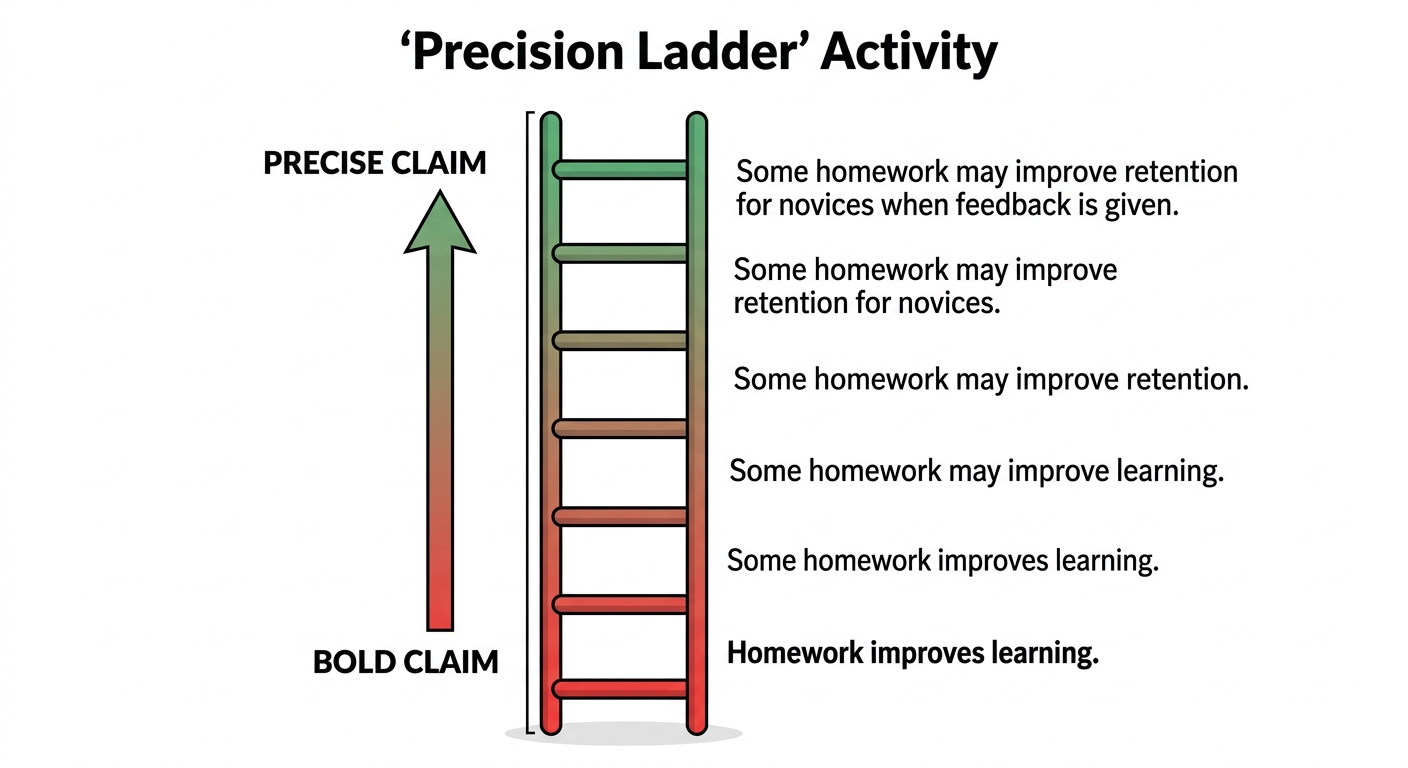
CLIMB THE PRECISION LADDER (90 seconds) — Change one element at a time. After each change, ask: "What risk did that one word remove?"
- "Homework improves learning."
- "Some homework improves learning." (What changed? We removed the universal claim.)
- "Some homework may improve learning." (What changed? We removed certainty.)
- "Some homework may improve retention." (What changed? We specified the outcome.)
- "Some homework may improve retention for novices." (What changed? We specified the population.)
- "Some homework may improve retention for novices when feedback is given." (What changed? We specified the condition.)
-
COMPARE FIRST AND LAST (20 seconds) — Show both versions side by side:
- "Homework improves learning."
- "Some homework may improve retention for novices when feedback is given." Ask: "Same sentence? Same claim?"
-
THE LESSON (30 seconds) — "Every word we added made the claim MORE precise and LESS risky. The first version sounds confident but is probably wrong. The last version sounds cautious but is probably right. Precision costs confidence. But imprecision costs truth."
What to Say
Opening: "'Homework improves learning.' True or false?"
After each step: "What did that one word remove? What risk disappeared?" (Let the room articulate: universal → some; definite → possible; vague outcome → specific outcome.)
The comparison: "The first version fits on a bumper sticker. The last version fits in a research paper. Which one is more likely to be true? Which one would you base policy on? Which one would AI generate if you asked 'Does homework help?'"
AI connection: "When you ask AI a broad question, you get a broad answer — the bumper sticker version. When you add qualifiers to your prompt ('for which students? under what conditions? measuring what outcome?'), you get the precise version. Precision in prompting produces precision in output."
Why It Works
This exercise demonstrates how hedges, quantifiers, and scope limitations transform vague claims into precise, testable propositions. Research on examples and non-examples (Deans for Impact) supports the core move: tiny contrasts help learners notice where a concept starts, stops, weakens, or becomes more precise.
The exercise is particularly powerful for audiences who deal with language professionally: researchers, lawyers, policy makers, journalists, and educators. It shows that the difference between a defensible claim and a dangerous oversimplification is often just one or two words.
Teacher Tip
After each word change, always ask: "What risk did that word remove?" This forces the audience to articulate the specific function of each qualifier. "Some" removes the risk of universality. "May" removes the risk of certainty. "For novices" removes the risk of over-generalization. Naming the risk makes the precision tangible.
Variations
Alternative Chains
| Starting Claim | Precision Added | Domain |
|---|---|---|
| "Technology improves education" | → "Some technology, when well-implemented, may improve specific learning outcomes for certain populations" | Ed-tech policy |
| "AI will replace teachers" | → "AI may automate some instructional tasks for teachers in content delivery, freeing them for mentoring" | AI education |
| "Exercise is good for you" | → "Regular moderate exercise may reduce cardiovascular risk for sedentary adults" | Health science |
| "The defendant is guilty" | → "The evidence suggests the defendant may have been present" | Legal reasoning |
For Different Subjects
- Science: Transform a hypothesis from vague to testable. "Plants need light" → "Arabidopsis thaliana seedlings show increased chlorophyll-a concentration under 14-hour photoperiods compared to 8-hour controls."
- Law: Show how one word changes legal liability. "The company knew" vs. "The company should have known" vs. "The company may have known."
- Statistics: "Correlation implies causation" → "This correlation, controlling for X and Y, suggests a possible association." Show how each qualifier maps to a statistical concept.
For Different Ages
- Elementary (K-5): "Dogs are the best pets" → "Some dogs are good pets for families with yards." Simpler but same principle.
- College/Adult: Use discipline-specific claims. The precision ladder mirrors the revision process in academic writing.
Online Adaptation
Display the claim and add one word at a time via animated slides. After each addition, ask in chat: "What risk did that word remove?" The chat-based format works well because participants must articulate the change explicitly.
Extension Ideas
- Deepen: Give students an AI-generated claim and ask them to "climb the precision ladder" — adding qualifiers until the claim is defensible. Track how many qualifiers are needed. "If the claim needed 5 qualifiers to become true, how much was the original claim worth?"
- Connect: Pair with Statement Stress (011) — one shows how emphasis changes meaning, the other shows how qualifiers change truth. Together: words are astonishingly powerful tools, and every single one matters.
Related Activities: Statement Stress, Hidden Rule, Best Wrong Answer