
The Invisible Gorilla — Selective Attention
At a Glance
- Time: 3-4 minutes
- Prep: Minimal (the Selective Attention Test video queued up)
- Group: Whole class (watch together, then discuss)
- Setting: In-person or hybrid (requires video playback)
- Subjects: Universal (especially effective for psychology, AI education, research methods)
- Energy: High (disbelief and laughter when the gorilla is revealed)
Purpose
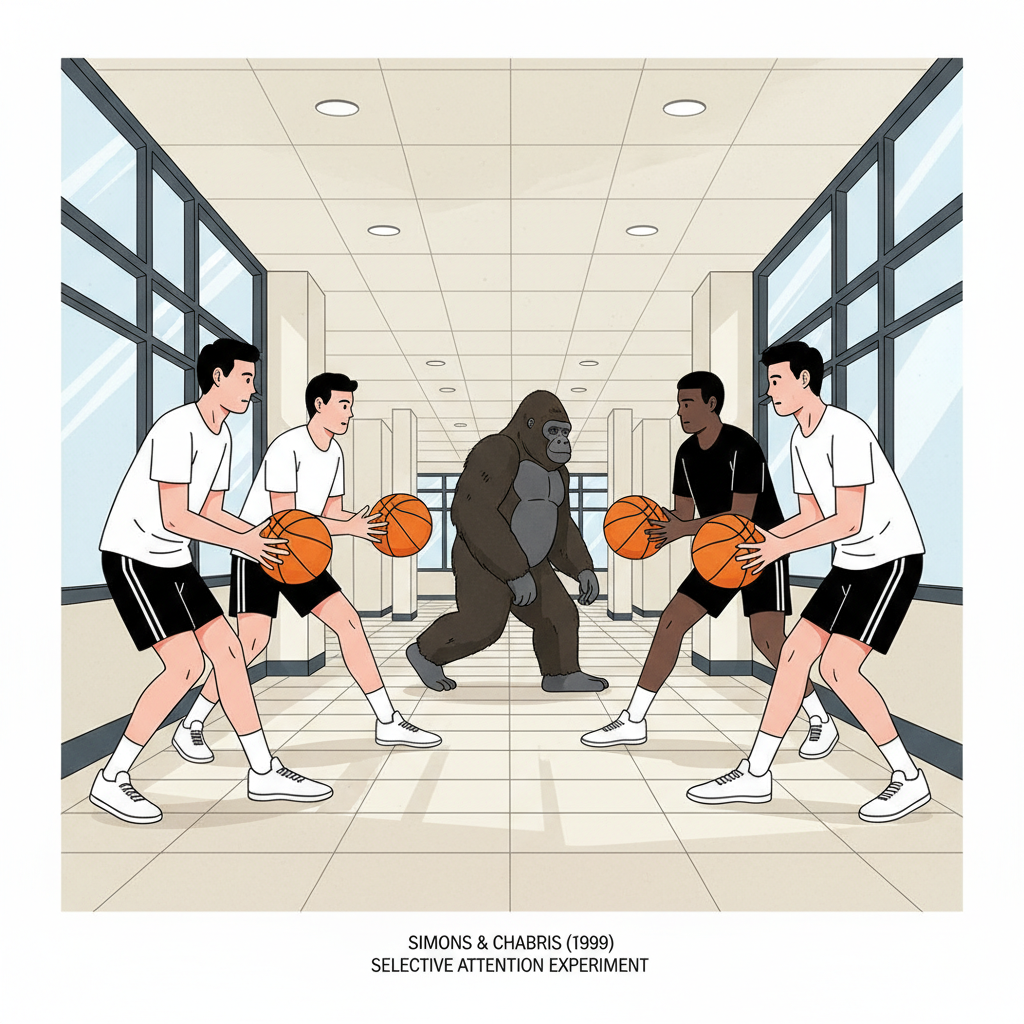
Demonstrate that when we focus narrowly on one task, we can completely miss obvious things happening right in front of us — even a person in a gorilla suit walking through the scene. Based on the famous Daniel Simons and Christopher Chabris experiment at Harvard (1999), this is one of the most cited and replicated findings in psychology. The lesson applies directly to education and AI: when students focus only on "getting the assignment done," they miss the learning. When we focus only on "covering the curriculum," we miss the gorilla.
How It Works
Step-by-step instructions:
- SET UP THE TASK (15 seconds) — Tell the audience: "I'm going to show you a short video. Two teams — one in white shirts, one in black shirts — are passing basketballs. Your job: count EXACTLY how many times the team in WHITE passes the ball. Focus carefully — it's tricky."
- PLAY THE VIDEO (90 seconds) — Play the Selective Attention Test video. The audience concentrates intensely on counting passes, tracking the ball through a complex scene of moving bodies.
- THE COUNT (20 seconds) — "How many passes did the white team make? Raise your hand: 13? 14? 15? 16?" Let them debate the exact number. The correct answer is 15 (or 16, depending on the version).
- THE QUESTION (10 seconds) — Then ask, casually: "Did anyone see the gorilla?"
- THE REVEAL (60 seconds) — About 50% of the audience will NOT have seen a person in a full gorilla suit walk directly into the middle of the scene, face the camera, beat their chest, and walk away. When you tell them this, they will insist you're lying. Play the video again. The gorilla is unmissable on the second viewing. The room erupts in disbelief and laughter.
- THE LESSON (30 seconds) — "When I gave you ONE task to focus on — counting passes — your brain literally deleted a gorilla from reality. Not from memory — from PERCEPTION. You didn't see it, forget it, or ignore it. Your brain prevented you from seeing it in the first place. Now think about your students: when they're focused on 'getting the assignment done,' what gorilla are they missing?"
What to Say
Opening: "I'm going to show you a short video. Pay close attention. Two teams are passing basketballs — one team wears white, one wears black. Count how many times the WHITE team passes the ball. It's harder than it sounds. Ready?"
After the video: "How many passes? (Let them debate. Take a few answers.) The answer is about 15. Good job."
The reveal (deliver casually): "By the way... did anyone see the gorilla?" (Pause. Watch the confusion.) "No? Let me show you again."
After the replay: "A person in a gorilla suit walked into the middle of the scene, turned to face you, beat their chest for 5 seconds, and walked away. And half of you didn't see it. Not because you weren't paying attention — because you were paying TOO MUCH attention. To the wrong thing."
AI connection: "Focus creates blindness. When students focus only on getting AI to give them the answer, they miss the learning. When WE focus only on covering the curriculum, what gorilla are we missing? Attention is not just a skill — it's a superpower. And like all superpowers, it has a weakness: it makes you blind to everything outside its beam."
Why It Works
The Invisible Gorilla experiment (Simons & Chabris, 1999) is one of the most famous demonstrations of inattentional blindness — the failure to notice a fully visible but unexpected object when attention is engaged on another task. The original study found that approximately 50% of participants failed to see the gorilla.
What makes this so powerful as a teaching tool:
-
It's unforgettable. Once you experience missing the gorilla, you never forget it. The emotional impact creates a permanent anchor for the teaching point.
-
It's involuntary. Even after being warned about inattentional blindness, people still miss unexpected objects in similar tasks. Knowing about the bias doesn't automatically fix it.
-
It's universal. Intelligence, expertise, and attention span don't protect against inattentional blindness. PhDs miss the gorilla at the same rate as undergraduates.
-
It's demonstrable. Unlike most cognitive biases that require statistical analysis to prove, this one is experienced directly and personally.
Research Citation: Simons, D.J., & Chabris, C.F. (1999). Gorillas in our midst: Sustained inattentional blindness for dynamic events. Perception, 28(9), 1059-1074.
Teacher Tip
The KEY to this activity is the setup: you must make the counting task genuinely engaging. If students aren't really trying to count, they'll see the gorilla easily. Say: "I'll ask you the exact number afterward, so count carefully." The harder they focus on counting, the more likely they are to miss the gorilla. Also: NEVER reveal the gorilla before showing the video. Once someone knows to look for it, the effect is ruined.
Variations
For Different Subjects
- Psychology: Full debrief on inattentional blindness, change blindness, and attentional capacity. This is a gateway to an entire unit on perception and attention.
- Science: "In lab work, when you focus on the expected result, you miss the anomalous data — the gorilla — that might lead to a breakthrough. Many scientific discoveries were 'gorillas' that someone finally noticed."
- Literature: "When you read a novel looking only for plot (counting passes), you miss the symbolism, the foreshadowing, the thematic gorillas walking through every chapter."
- AI Education: "When students focus only on whether AI gives them a usable answer, they miss the learning process. The gorilla isn't the answer — it's the understanding of HOW and WHY."
- Safety / Quality: "In quality control and safety audits, focused attention on one metric can blind you to other critical failures. This is why checklists cover multiple categories, not just the obvious ones."
For Different Settings
- Large Audience (50+): Maximum impact. The collective gasp when the gorilla is revealed to 200 people is extraordinary.
- Small Class (5-15): Works well. The intimate setting makes the individual reactions more visible.
- Workshop/PD: After the reveal, ask: "In your school / organization / team — what's the gorilla? What are we all so focused on that we're missing something obvious?"
Alternative Videos
If students have already seen the original gorilla video (it went viral), use one of these alternatives:
- The Monkey Business Illusion (Simons, 2010) — An updated version with additional unexpected changes beyond the gorilla (curtain color change, player leaving). Even people who see the gorilla miss the other changes.
- The Door Study — A researcher asks a stranger for directions. During the conversation, two people carrying a door walk between them, and the researcher is secretly replaced by a different person. 50% of people don't notice they're now talking to someone else.
For Different Ages
- Elementary (K-5): Use a simplified version: show a "spot the difference" image where an obvious change happens while they're focused on counting specific objects. Or use the video but frame it as: "Count the balls! ... Did you see something surprising?"
- Middle/High School (6-12): Full video version works perfectly.
- College/Adult: Full version plus deeper discussion of attentional blindness in professional contexts. "Radiologists miss tumors at the same rate if they're focused on a different type of anomaly. Airline pilots miss runway incursions when focused on instruments."
Online Adaptation
Tools Needed: Screen share with video playback and audio
Setup: Queue the Selective Attention Test video. Ensure audio is shared through screen share.
Instructions:
- Share screen. "You're about to see a video. Count the passes by the white team. Type your count in the chat when the video ends — but don't send until I say 'send.'"
- Play the video.
- "Type your count. Don't send yet... SEND!"
- After counts appear: "Great. Now — did anyone see the gorilla?" Type this in chat.
- Replay the video. The chat will explode.
Pro Tip: Record a few reaction shots (with permission) during the replay via a gallery view screenshot. The facial expressions of people seeing the gorilla for the first time are priceless — and make great discussion starters.
Troubleshooting
Challenge: Most students have already seen the gorilla video (it's famous). Solution: Use The Monkey Business Illusion (2010 version) instead — it has additional changes beyond the gorilla that even people who know about the gorilla will miss. Or use the lesson meta-cognitively: "You came in knowing about the gorilla. But there were THREE other changes in the video. Did you catch those?"
Challenge: A student says they saw the gorilla. Solution: "Great! How many passes did the white team make?" If they don't know: "You saw the gorilla because you weren't fully focused on counting. The people who missed the gorilla were the ones doing the task most diligently. Both strategies have trade-offs. What does that tell us about attention?"
Challenge: The video quality is poor or audio doesn't work. Solution: The video works without audio — just the visual counting task is sufficient. If video playback is unreliable, describe the experiment and its results instead. The storytelling version is less dramatic but still teaches the concept effectively.
Extension Ideas
- Deepen: Introduce the concept of "attentional bandwidth." "Your brain can only process a limited amount of information at once. When you allocate bandwidth to one task, less is available for everything else. This is why multitasking is a myth — you're not doing two things at once; you're switching between them and losing information both ways."
- Connect: Challenge students to identify their "gorilla" in a current assignment or project. "What are you so focused on that you might be missing something important? What would stepping back and looking at the whole picture reveal?"
- Follow-up: Create a class practice: before submitting any assignment, each student writes a "gorilla check" — one thing they might have missed because they were focused on something else. This builds metacognitive awareness over time.
Related Activities: Count the F's, Stroop Effect, Confirmation Bias Trap