
Hidden Assumption in the Question
At a Glance
- Time: 2-3 minutes
- Prep: None
- Group: Whole class (call-and-response)
- Setting: In-person, hybrid, or online
- Subjects: Universal (especially effective for logic, law, research, journalism, AI education)
- Energy: High (the discomfort is immediate and memorable)
Purpose
Demonstrate that questions are not neutral — every question smuggles in assumptions that determine the range of possible answers. A loaded question makes the respondent guilty regardless of their answer. Recognizing hidden assumptions is a fundamental skill in critical thinking, research design, legal cross-examination, journalism, survey construction, and evaluating AI-generated questions.
How It Works
Step-by-step instructions:
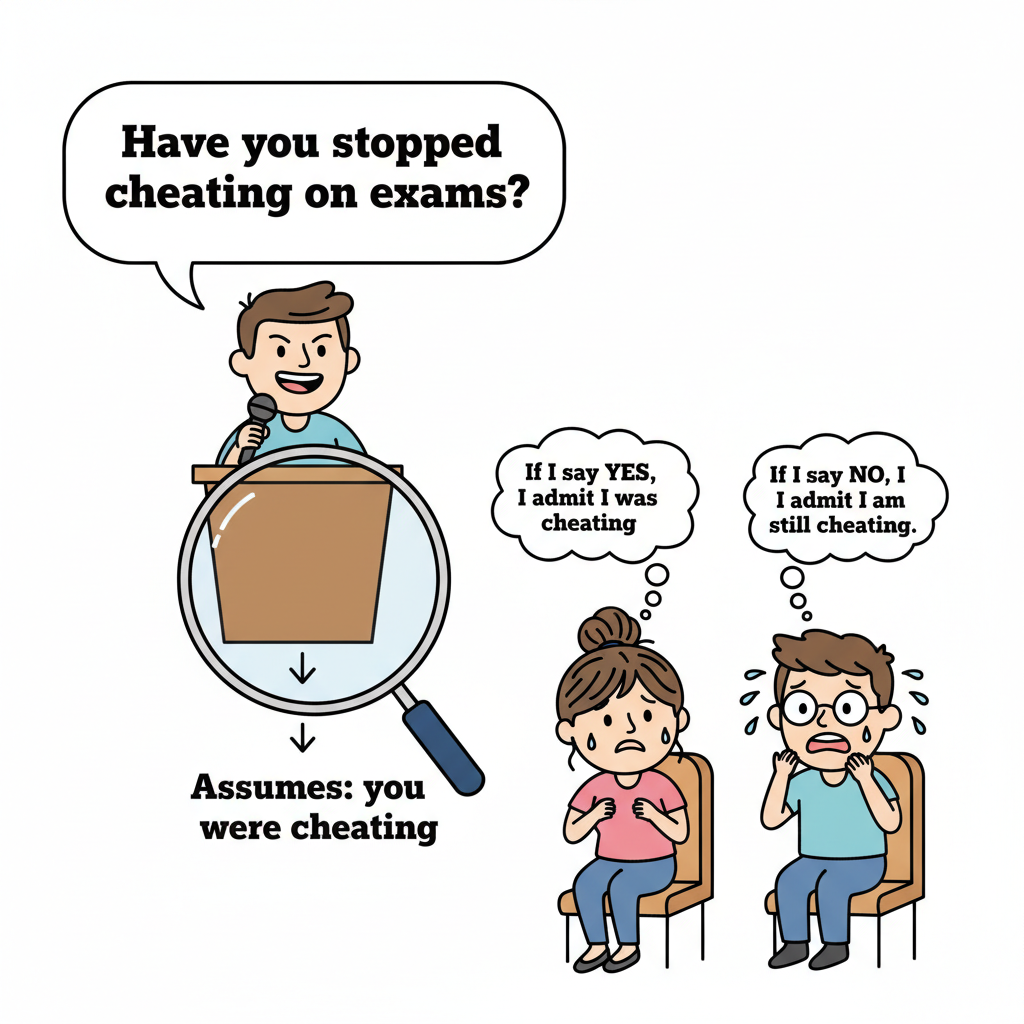
- THE LOADED QUESTION (15 seconds) — Ask the audience, seriously: "Have you stopped cheating on your exams?" Wait. Watch the discomfort. Both "yes" and "no" are problematic. "Yes" implies you used to cheat. "No" implies you still are.
- UNPACK IT (20 seconds) — "What's wrong with this question?" Let them articulate: the question ASSUMES you cheated. It encodes guilt regardless of the answer. There is no honest way to answer if you never cheated.
- ANOTHER EXAMPLE (15 seconds) — Write: "Which of these two candidates do you support?" Ask: "What does this question assume?" It assumes only two options exist. It excludes supporting neither, both, or a third option. It assumes a binary world.
- THE CLASSIC (15 seconds) — "When did you stop beating your wife?" — another loaded question that makes the respondent guilty regardless of answer.
- THE LESSON (30 seconds) — "Every question encodes assumptions. The framing of a question determines the range of possible answers — and therefore the range of possible THINKING. If you can't recognize a loaded question, you can be manipulated by anyone who asks one — a politician, a journalist, a survey, or an AI."
What to Say
Opening: "I have a question for you. And I'd like an honest answer." (Pause for effect.) "Have you stopped cheating on your exams?"
After the discomfort: "Notice what just happened. You felt uncomfortable — and not because you cheated. You felt uncomfortable because the question ASSUMED you cheated. Both 'yes' and 'no' trap you. This is called a loaded question."
AI connection: "When AI generates quiz questions, survey questions, or discussion prompts, it can accidentally embed assumptions. 'Why is solar energy the best solution?' assumes solar IS the best — the question doesn't allow for disagreement. Teaching students to spot loaded questions in AI output is a critical AI literacy skill."
Why It Works
Loaded questions exploit presupposition — the implicit assumptions embedded in the structure of a question. When someone accepts the question's framing and tries to answer, they've already accepted the hidden assumption. This is the mechanism behind leading questions in courtrooms, push polls in politics, and loaded survey instruments in poorly designed research.
The Socratic method — historically used not to provide answers but to reveal the assumptions embedded in the questioner's own thinking — is built on exactly this principle.
Research basis: Classical logic and argumentation theory. See also: Walton, D. (2008). Informal Logic: A Pragmatic Approach. Cambridge University Press.
Teacher Tip
Deliver the loaded question with a straight face. The more seriously you ask "Have you stopped cheating?", the more powerful the moment when they realize it's a trap. If you telegraph that it's a trick, the exercise loses its punch.
Variations
More Loaded Questions to Use
| Question | Hidden Assumption |
|---|---|
| "Why do students hate math?" | Students hate math (assumes universal dislike) |
| "How bad was the damage?" | There was damage, and it was bad |
| "Don't you think we should...?" | The speaker's position is the reasonable one |
| "Why is AI dangerous?" | AI is dangerous (assumes conclusion) |
| "What's the best programming language?" | One language is objectively best (assumes hierarchy) |
For Different Subjects
- Research Methods: "Every research question encodes assumptions. 'Does homework improve grades?' assumes homework exists, grades are the metric, and improvement is linear. A better question starts by examining these assumptions."
- Law: "Leading questions are literally prohibited in direct examination. Why? Because the question's framing can determine the answer."
- Journalism: "Interview questions that start with 'Don't you think...' or 'Isn't it true that...' are not neutral. They're arguments disguised as questions."
- AI Education: "When you prompt AI with a loaded question, AI answers within the frame you provided. 'Explain why homework is bad' produces anti-homework arguments. 'Explain the effects of homework' produces balanced analysis. The question determines the answer."
For Different Ages
- Elementary (K-5): "Would you rather have a boring pizza or exciting broccoli?" — the adjectives hide an assumption about which food is interesting.
- College/Adult: Use real examples from political debates, legal cases, or research instruments.
Online Adaptation
Type the loaded question in chat: "Quick poll: Have you stopped cheating on your exams? Yes or No." Watch the chat freeze. Then explain. The documented discomfort and subsequent discussion work well in text format.
Extension Ideas
- Deepen: Give students a survey (real or AI-generated) and ask them to identify every loaded question. Rewrite each one to remove the hidden assumption. Compare the original and rewritten versions — the differences reveal the survey's bias.
- Connect: Pair with Confirmation Bias Trap (006) — loaded questions are a tool of confirmation bias. They frame the inquiry to produce the answer the questioner already believes.
Related Activities: Confirmation Bias Trap, Sound of Silence, Four Voices