
Statement Stress — Seven Meanings in Seven Words
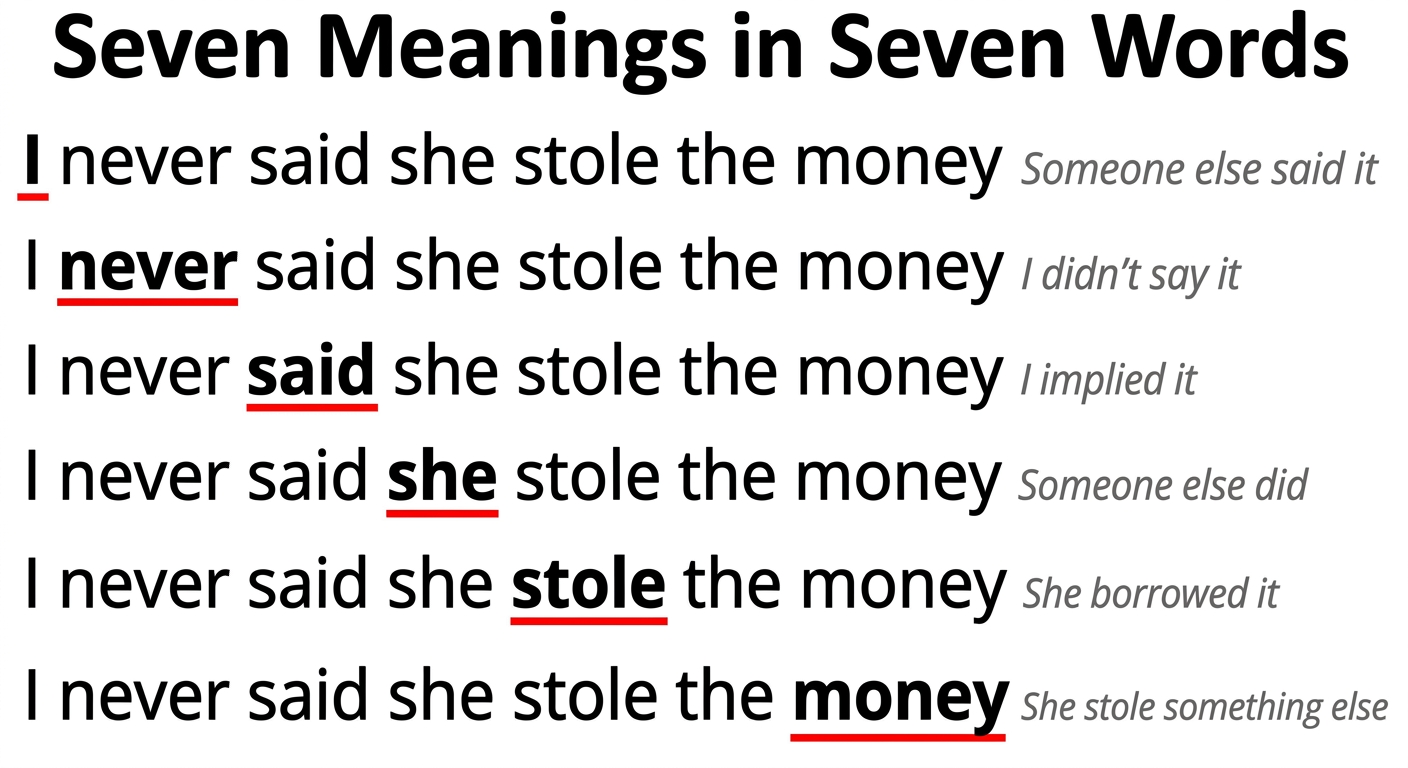
Stress a different word each time and the meaning changes completely:
At a Glance
- Time: 3-4 minutes
- Prep: None
- Group: Whole class (read aloud together)
- Setting: In-person or hybrid (works best with voice)
- Subjects: Universal (especially effective for communication, law, literature, leadership)
- Energy: High (the room gets louder with each iteration)
Purpose
Demonstrate that one sentence has at least seven completely different meanings depending on which word you stress — without changing a single word. This is the spoken-language equivalent of The X Activity: same raw material, different emphasis, different meaning. It reveals that in every conversation, argument, or negotiation, what was "said" and what was "heard" may be entirely different things.
How It Works
Step-by-step instructions:
-
DISPLAY THE SENTENCE (10 seconds) — Write on the board:
I never said she stole the money.
Ask: "What does this sentence mean?" Take one or two answers. Most people read it as a simple denial.
-
SEVEN READINGS (2 minutes) — Read the sentence seven times. Each time, stress ONE word. After each reading, ask: "What changed?"
- I never said she stole the money. (Someone else said it.)
- I never said she stole the money. (I absolutely deny it.)
- I never said she stole the money. (I implied it, or wrote it, but didn't say it.)
- I never said she stole the money. (Someone else stole it.)
- I never said she stole the money. (She borrowed it, or found it.)
- I never said she stole the money. (She stole some money, not that specific money.)
- I never said she stole the money. (She stole something else entirely.)
-
THE LESSON (30 seconds) — "Seven words. Seven meanings. Same sentence. The only thing that changed was which word I leaned on. In written text, you don't hear the emphasis — so you supply your OWN. And what you supply depends on what you already believe."
What to Say
Opening: "I'm going to say one sentence seven times. Each time, listen for what changes."
After each version: "What did I just say? What's different?" (Let the room articulate each shift.)
Closing: "Here's the problem: when you read this sentence in an email, in a report, in an AI-generated text — you can't hear the emphasis. So YOUR brain picks which word to stress based on your assumptions, your mood, and your relationship with the writer. Two people read the same email and walk away with opposite interpretations. Not because the email was unclear — because emphasis is invisible in writing."
AI connection: "AI generates text without any intended emphasis. When you read AI output, YOUR brain adds the stress pattern. You hear what you expect to hear — which means AI can accidentally confirm your existing beliefs simply because you read its flat text through your own biased emphasis."
Why It Works
This exercise demonstrates prosodic ambiguity — the phenomenon where stress, intonation, and rhythm carry meaning independent of the words themselves. In spoken language, prosody disambiguates sentences that are structurally identical. In written language, this layer of meaning is absent, creating systematic ambiguity.
Research in pragmatics and discourse analysis shows that listeners don't just process words — they process the emphasis pattern and use it to infer the speaker's focus, presupposition, and implicature. When emphasis is absent (as in all written communication), the reader's existing beliefs fill the gap.
This is directly relevant to miscommunication in email, text messages, AI output, and any written medium where tone and emphasis are invisible.
Teacher Tip
Exaggerate the stress dramatically. Each reading should sound obviously different. Have the audience read along with you — when 50 people stress "SHE" simultaneously, the meaning shift is palpable. Also: after the seven readings, ask the audience which version they heard when they first read the sentence silently. Their answer reveals their default assumption.
Variations
For Different Subjects
- Law: "In courtroom testimony, the emphasis a witness places on a word can change the jury's interpretation entirely. 'I never said she stole the money' is the same words as 'I never said SHE stole the money' — but one is a denial and the other is an accusation of someone else."
- Literature: "When you read dialogue in a novel, you're choosing the emphasis. Two readers can interpret the same character completely differently based on how they 'hear' the lines."
- Leadership: "When you send a company-wide email, every employee reads it with their own stress pattern. The anxious employee stresses the threatening word. The confident employee stresses the reassuring word. Same email, different organizations."
For Different Ages
- Elementary (K-5): Use a simpler sentence: "I didn't take your cookie." Stress each word for different meanings. Kids find this hilarious.
- Middle/High School (6-12): Full version works perfectly. Great for rhetoric, debate, and media literacy units.
- College/Adult: Add the pragmatics framework. Discuss how email miscommunication often stems from absent prosody.
Online Adaptation
Tools Needed: Microphone (everyone unmuted for group reading)
Instructions:
- Display the sentence. Ask everyone to unmute and read it aloud together.
- Then say: "Now read it again, but stress the word I highlight." Bold or highlight one word at a time.
- Use chat: "Which version did you hear when you first read it? Type the number (1-7)."
Troubleshooting
Challenge: The audience doesn't hear the difference between versions. Solution: Exaggerate more. Or add a visual cue: bold, underline, or enlarge the stressed word on the slide for each reading.
Challenge: Someone says "This is just semantics." Solution: "Exactly. It IS semantics — and semantics is the study of meaning. The fact that a single stress shift changes meaning is not trivial. It's the mechanism behind every miscommunication you've ever had."
Extension Ideas
- Deepen: Give pairs an ambiguous email (real or AI-generated) and ask each person to mark which words they'd stress. Compare. The differences reveal the assumptions each reader brought to the text.
- Connect: Pair with Sentence Without Punctuation (010) — one shows how written marks change meaning, the other shows how spoken emphasis changes meaning. Together, they prove that meaning lives in the space between the words.
Related Activities: Sentence Without Punctuation, Sound of Silence, Hidden Assumption