
Droodles — Minimalist Abstraction
Show this image and ask: "What are these?"
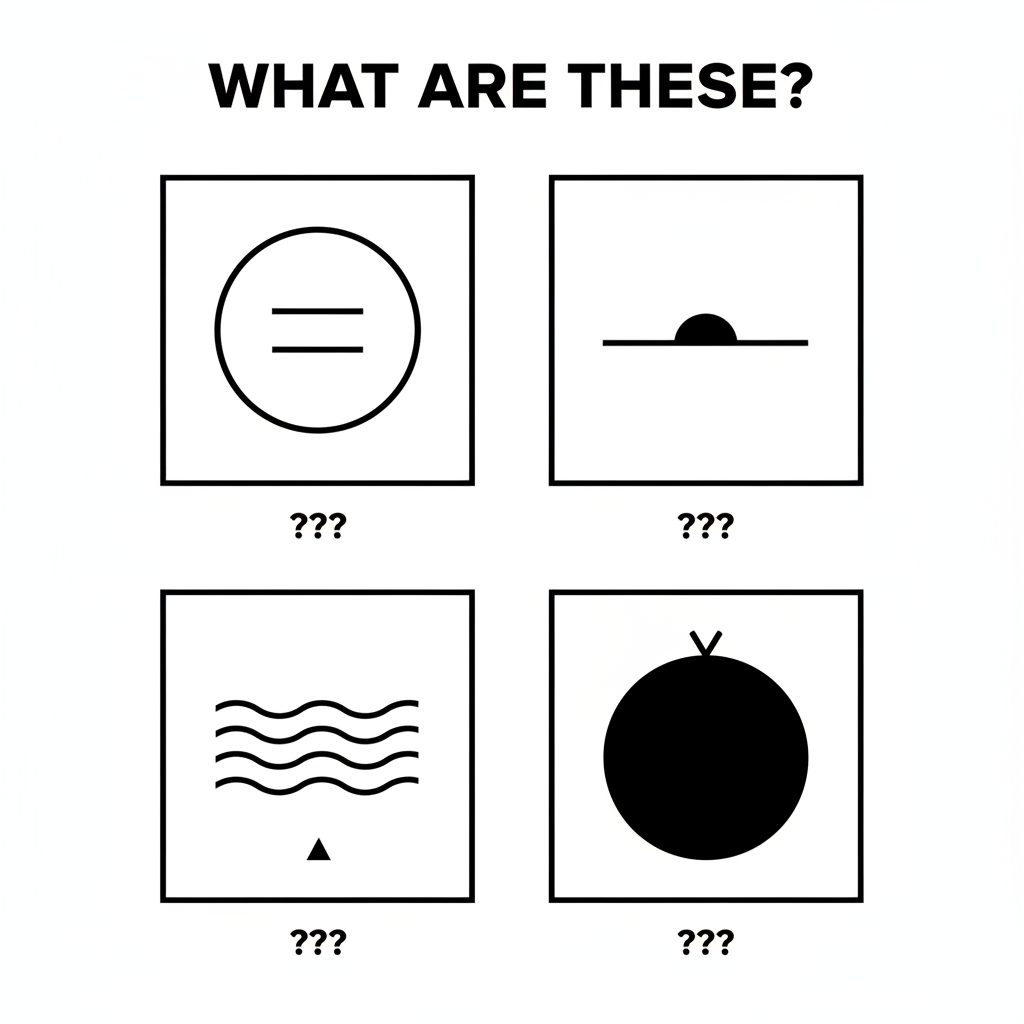
Then reveal the surprising captions:
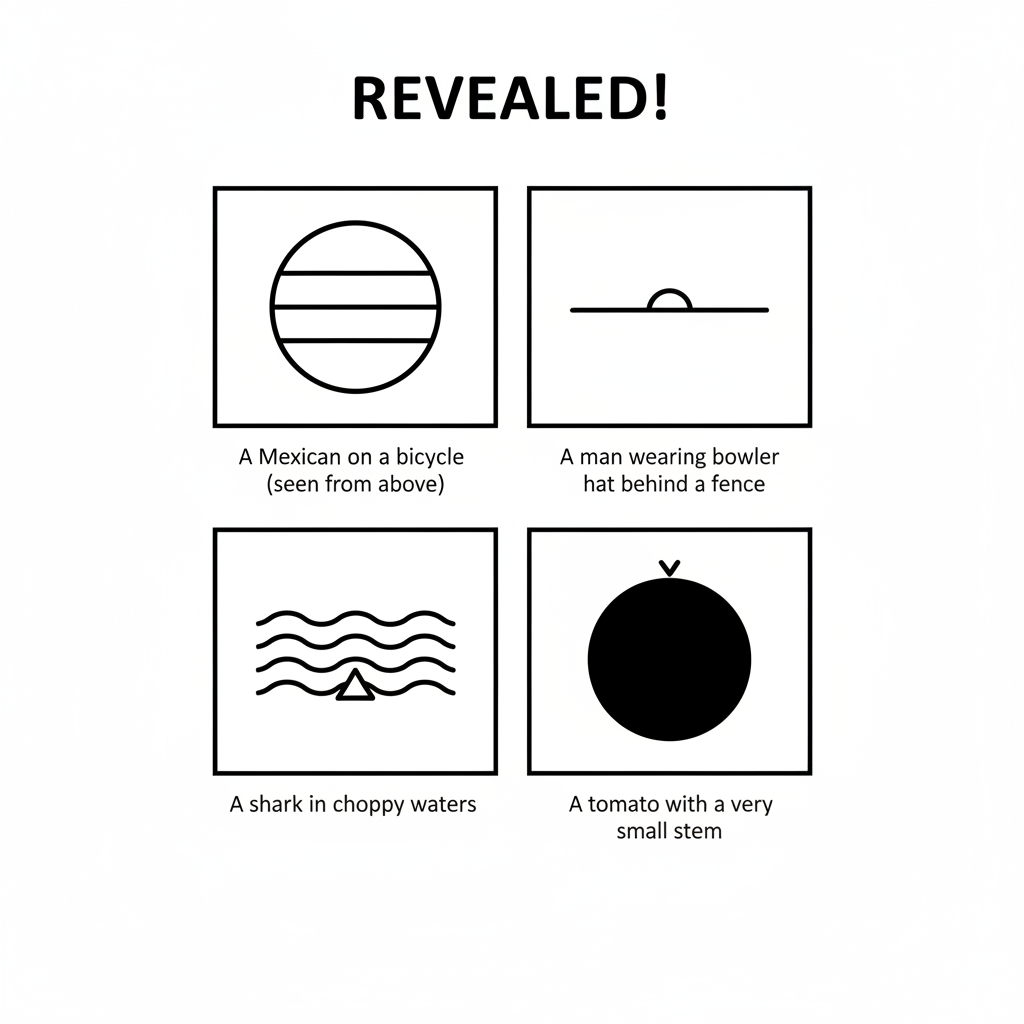
At a Glance
- Time: 3-5 minutes
- Prep: Minimal (whiteboard drawings or slides with simple geometric shapes)
- Group: Whole class (guess + create)
- Setting: In-person, hybrid, or online
- Subjects: Universal (especially effective for creativity, communication, design thinking, lateral thinking)
- Energy: High (the captions are often hilarious)
Purpose
Demonstrate that whoever controls the frame (the caption) controls how the data (the drawing) is perceived. A Droodle — a portmanteau of "doodle," "drawing," and "riddle" invented by Roger Price in the 1950s — is a minimalist square containing abstract geometric shapes that are meaningless until a specific caption reframes them. The caption shifts your mental camera angle, scale, and narrative so violently that abstract geometry instantly becomes a vivid scene. This is The X Activity's creative cousin: same principle of context-creating-meaning, but with humor and narrative imagination.
How It Works
Step-by-step instructions:
- DRAW THE DROODLE (10 seconds) — Inside a square, draw three parallel vertical lines crossed by jagged horizontal zig-zags. Show it to the audience. Ask: "What is this?"
- COLLECT GUESSES (30 seconds) — A fence? A textile pattern? A ruined building? An EKG reading? Accept all guesses without confirming.
- THE CAPTION (10 seconds) — Reveal Roger Price's caption: "A bug walking on a waffle." The room erupts. Suddenly the mental camera zooms to extreme micro-scale: the vertical lines are waffle grooves, the zig-zags are tiny bug legs navigating the texture.
- ROUND TWO (60 seconds) — Show a new abstract drawing: a circle with two horizontal lines protruding from each side. Guesses: a face? A clock? An emoji? Reveal: "A Mexican on a bicycle, viewed from above." The circle = sombrero, the lines = handlebars. The perspective violently shifts to a bird's-eye view.
- CREATE YOUR OWN (60 seconds) — Show a new unlabeled Droodle. Ask the room to invent at least two different captions for the same image. This switches from consumption to creation.
- THE LESSON (30 seconds) — "The drawings were identical throughout. The only thing that changed was the caption — the FRAME. The caption told your brain what scale to use, what angle to view from, and what story to construct. In communication, leadership, and AI — whoever provides the frame determines what people see."
What to Say
Opening: (Draw the Droodle.) "What is this? Any guesses?"
After the caption: "A bug walking on a waffle! (Let the laughter land.) Now look at it again. Can you see the waffle? Can you see the little bug? Your brain just zoomed from a bird's-eye landscape down to the surface of a breakfast food. The drawing didn't change. Your PERSPECTIVE did."
AI connection: "When you prompt AI, you're providing the caption for the Droodle. A vague prompt gives AI no perspective — it generates something generic. A specific, framed prompt tells AI exactly what angle, scale, and narrative you want. The quality of the AI output depends on the quality of YOUR caption."
Why It Works
Created by comedy writer Roger Price in 1953, Droodles demonstrate that linguistic framing determines visual perception. The caption doesn't add visual information — it adds a narrative framework that forces the brain to reorganize abstract shapes into a specific scene.
The power of Droodles lies in their manipulation of spatial reasoning: the caption determines whether you view the image from above, below, close-up, far away, or from an impossible internal vantage point. This proves that meaning construction is an active, imaginative process — not passive reception.
Generating alternative captions for the same Droodle is an exceptional exercise in cognitive flexibility and breaking functional fixedness. It requires fluidly shifting between macro and micro perspectives, testing lateral hypotheses, and resisting the anchoring effect of the first caption heard.
Reference: Price, R. (1953). Droodles. Simon & Schuster.
Teacher Tip
The creation round is essential — don't skip it. When students invent their own captions, they shift from spectators to practitioners. The cognitive work of GENERATING a frame is far more demanding than receiving one, and it's where the deepest learning happens. Also: the funnier the caption, the better it sticks. Encourage absurdity.
Variations
Classic Droodles
| Drawing | Caption | Perspective Shift |
|---|---|---|
| Flat horizontal line with small semi-circle below | "Piccolo player as seen from inside the piccolo" | Impossible internal vantage point |
| Square with small stick figure in corner, arrow pointing left | "Man in a mailbox signaling for a left turn" | Absurd narrative logic |
| Two large domes with small shape between them | "Elephant taking a sunbath" | Ground-level massive scale |
For Different Subjects
- Design Thinking: Use Droodles as warm-ups for brainstorming sessions. "If you can find 5 different interpretations of 3 lines, you can find 5 different approaches to any design problem."
- Communication: "When you present data without a frame, your audience sees random lines. When you provide the story — the caption — they see exactly what you want them to see."
- AI Education: "AI generates the shapes. You provide the caption. Without your framing, AI output is abstract geometry."
For Different Ages
- Elementary (K-5): Draw simple shapes and let kids invent captions. Kids are naturally brilliant at Droodles because they haven't yet learned to be embarrassed by creative answers.
- College/Adult: Challenge them to create Droodles that illustrate a concept from their field. A biology student might draw a Droodle whose caption is "A cell dividing, as seen by the ribosome."
Online Adaptation
Display a Droodle via screen share. "Type your caption in chat — be creative!" The chat fills with wildly different interpretations. Then reveal Price's original caption. Award "most creative" to someone whose caption was completely different but equally valid.
Extension Ideas
- Deepen: Have students create Droodles as visual metaphors for abstract concepts they're learning. "Draw a Droodle that represents 'confirmation bias' or 'supply and demand.' Write the caption."
- Connect: Pair with The X Activity (001) — both show context creating meaning, but The X Activity uses symbols and Droodles use narrative framing. Together they prove the principle works across every modality.
Related Activities: The X Activity, Dallenbach's Cow, Visual Thinking Strategies