
Four Voices — Concept Cartoon
A concept cartoon: four students observe the same phenomenon but offer competing explanations:
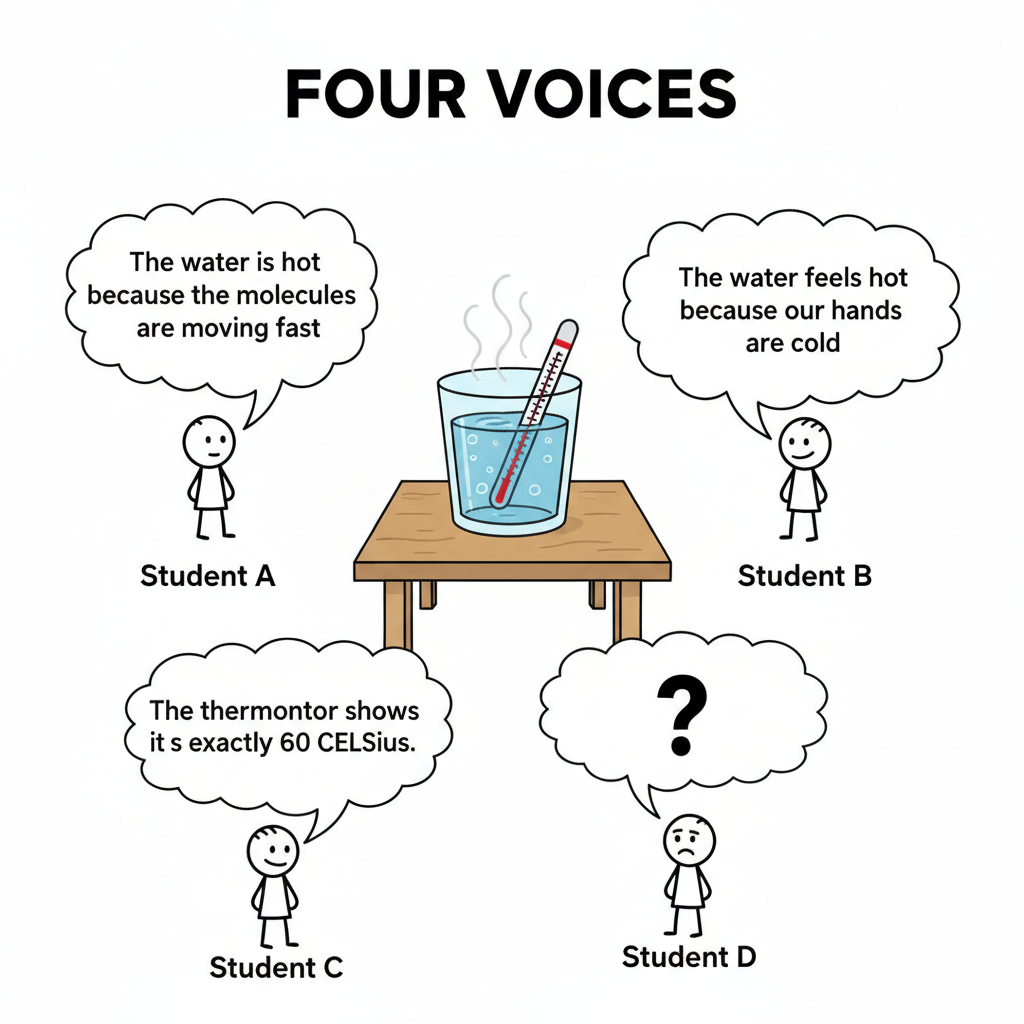
At a Glance
- Time: 3-5 minutes
- Prep: Minimal (slide with 3-4 speech bubbles around one phenomenon)
- Group: Whole class (vote, discuss, justify)
- Setting: In-person, hybrid, or online
- Subjects: Universal (especially effective for science, ethics, policy, education)
- Energy: Medium
Purpose
Present 3-4 plausible explanations for one phenomenon and ask: "Which voice is strongest right now?" and "What evidence would settle it?" Unlike activities with one right answer, this forces the audience to evaluate competing arguments on their merit, identify missing assumptions, and think about what evidence WOULD be needed — not just what they believe. Particularly effective with high-achieving groups because the alternatives are genuinely plausible, checking overconfidence.
How It Works
Step-by-step instructions:
- PRESENT THE PHENOMENON (10 seconds) — Describe a situation or observation. For example: "After introducing a new teaching method, students in Mrs. Chen's class became notably quieter."
- SHOW FOUR VOICES (20 seconds) — Display 3-4 speech bubbles, each offering a plausible explanation:
- Voice A: "Students were quiet because they were disengaged."
- Voice B: "Students were quiet because they were thinking deeply."
- Voice C: "Students were quiet because the instructions were unclear."
- Voice D: "Students were quiet because prior knowledge was missing."
- VOTE (15 seconds) — "Which voice is strongest RIGHT NOW? Hands up for A. B. C. D."
- JUSTIFY (60 seconds) — "You voted for B — what evidence would you need to confirm B is right? What evidence would DISPROVE B?" Repeat for 2-3 voices.
- THE BLANK BUBBLE (15 seconds) — Show a fifth bubble labeled: "Missing View: ___". Ask: "What perspective is missing? What explanation haven't we considered?"
- THE LESSON (30 seconds) — "Same observation. Four plausible explanations. You picked one — but on what evidence? Most of us vote based on which explanation FEELS right, not which one has the most support. The question isn't 'which do you believe?' It's 'which would you test first, and how?'"
What to Say
Opening: "Mrs. Chen's students got quieter after the new teaching method. Four people have theories about why. Which one is strongest?"
After voting: "Interesting. Most of you picked B — they're thinking deeply. That's reassuring. But what's your evidence? How would you CHECK? And here's the harder question: what evidence would prove B WRONG?"
The blank bubble: "What are we all missing? What explanation did none of these voices offer?" (Often: cultural factors, assessment pressure, time of day, specific student dynamics...)
AI connection: "When you ask AI to explain something, it gives you ONE voice — usually the most commonly written perspective. But there are always other voices, other explanations. Your job is to generate the competing voices yourself and ask: which one has the evidence?"
Why It Works
Based on the concept cartoon methodology developed by Naylor and Keogh (2000), this format has specific research-backed strengths: it presents plausible alternatives, lowers social risk (you're choosing someone else's argument, not creating your own), generates more dialogue, challenges misconceptions effectively, and increases motivation and engagement.
The "missing view" bubble is particularly powerful — it teaches that the best explanation might not be among the options presented. This combats the anchoring effect of multiple-choice thinking, where people assume the answer must be one of the listed options.
Research basis: Naylor, S., & Keogh, B. (2000). Concept Cartoons in Science Education. Millgate House. | See also: ASE (Association for Science Education) reviews.
Teacher Tip
All voices must be genuinely plausible. If one is obviously silly, the audience dismisses it and the exercise becomes trivial. The power comes from genuinely not knowing which voice is correct — which means YOU shouldn't reveal the "right" answer either. In complex real-world situations, there often ISN'T a single right answer, and honoring that ambiguity is part of the lesson.
Variations
Example Scenarios
| Phenomenon | Voice A | Voice B | Voice C | Voice D |
|---|---|---|---|---|
| Student test scores dropped | Teaching was poor | Test was harder | Students didn't study | Content was taught too fast |
| A team project failed | Poor leadership | Unclear goals | Wrong team composition | Insufficient time |
| AI wrote a flawed essay | Prompt was vague | AI hallucinated | Training data was biased | The topic was too nuanced |
For Different Subjects
- Science: Show an unexpected experimental result. Four voices propose different hypotheses. "Which would you test first?"
- Ethics: Present a moral dilemma. Four ethical frameworks give different answers. "Which framework is most convincing here?"
- Education/PD: "A student consistently underperforms." Four voices: learning disability, motivation, home factors, teaching mismatch.
- AI Education: "AI generated misinformation in a student's essay." Four voices propose different root causes.
For Different Ages
- Elementary (K-5): Use simple scenarios: "The plant died. Why?" with picture bubbles.
- College/Adult: Use complex, domain-specific scenarios with nuanced competing explanations.
Online Adaptation
Display the four voices. Use a poll for the initial vote (Zoom poll, Google Forms, chat). Then facilitate discussion: "You voted C — type in chat what evidence you'd need." The structured format works particularly well online because every voice gets equal visual weight.
Extension Ideas
- Deepen: After discussion, have students write a "5th voice" — their own explanation that synthesizes elements of the others. This moves from analysis to synthesis.
- Connect: Pair with Hidden Rule (024) — Four Voices evaluates competing hypotheses; Hidden Rule builds a definition from examples. Both require evidence-based reasoning under ambiguity.
Related Activities: Which One Doesn't Belong, Hidden Assumption, Best Wrong Answer