
The B or 13 — Context Determines Category
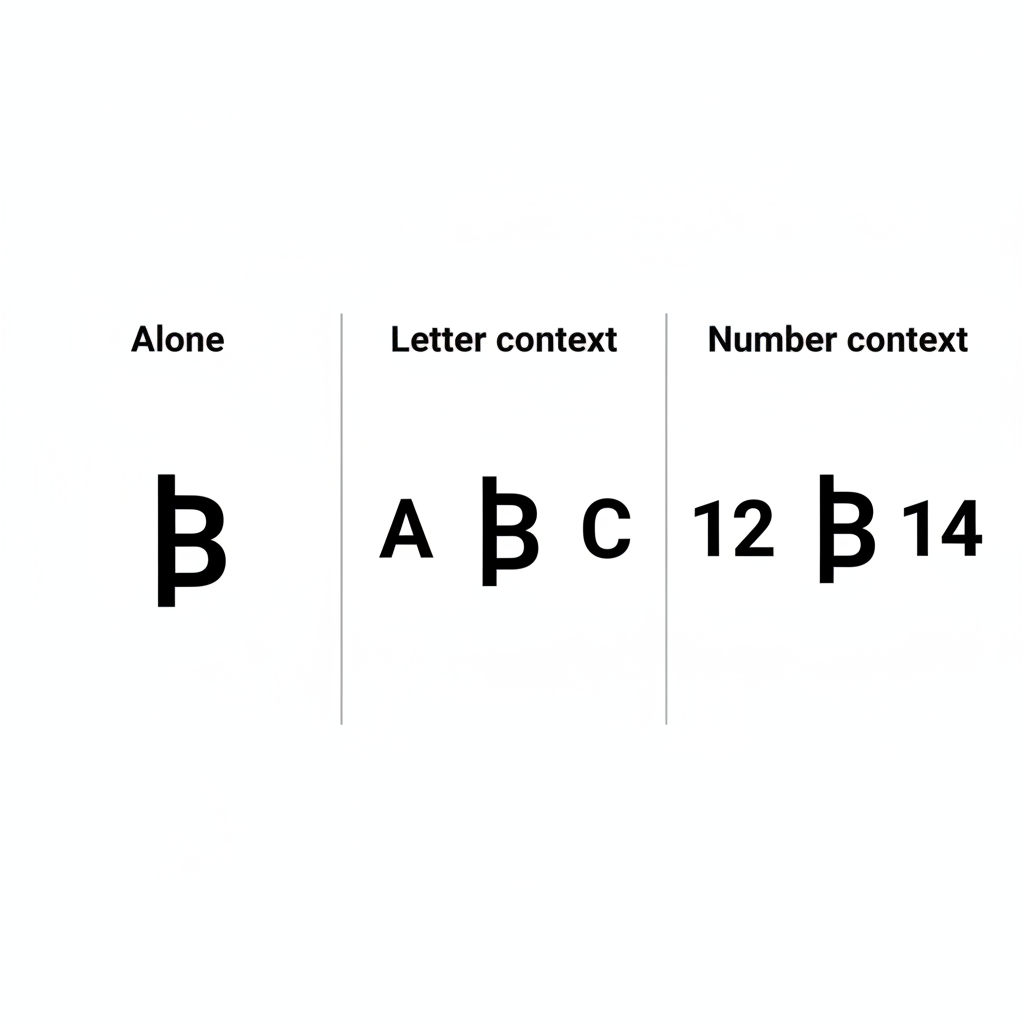
The same symbol changes meaning depending on its neighbors:
At a Glance
- Time: 2-3 minutes
- Prep: Minimal (whiteboard or slide with an ambiguous character)
- Group: Whole class (call-and-response)
- Setting: In-person, hybrid, or online
- Subjects: Universal (especially effective for psychology, data science, AI education)
- Energy: Medium
Purpose
Demonstrate that identical visual information gets categorized differently depending on what surrounds it. An ambiguous character that sits between the letter "B" and the number "13" is read as one or the other depending solely on its neighbors. This is The X Activity's closest cousin — same mechanic, different modality — and it proves that context doesn't just influence interpretation, it determines the entire category system we apply to raw data.
How It Works
Step-by-step instructions:
- DRAW THE AMBIGUOUS CHARACTER (10 seconds) — Write a character on the board that sits between "B" and "13": a vertical line with two bumps on the right, but with the bumps slightly detached from the vertical stroke so they could be read as a "1" next to a "3." Show it alone and ask: "What is this?"
- THE SPLIT (20 seconds) — Some say "B," some say "13." Both are defensible. Don't confirm either.
- CONTEXT 1 — LETTERS (15 seconds) — Write A to the left and C to the right: A _ C. Ask: "What is it now?" The entire room reads it as B. The alphabetical sequence forces the letter schema.
- CONTEXT 2 — NUMBERS (15 seconds) — Erase A and C. Write 12 to the left and 14 to the right: 12 _ 14. Ask: "And now?" Everyone reads it as 13. The numerical sequence forces the number schema.
- THE LESSON (30 seconds) — "The character didn't change. Not a single pixel. But when I put it between letters, you saw a letter. When I put it between numbers, you saw a number. Your brain didn't analyze the character — it analyzed the CONTEXT and assigned a category before you even started thinking."
What to Say
Opening: (Draw the ambiguous character.) "Quick — what is this? Shout it out."
After the split: "Interesting. Some of you see a B. Some see 13. You're looking at the same thing. Let's see if I can settle this."
After A _ C: "B, right? Obviously B. Nobody sees 13 anymore. What changed? I didn't touch the middle character."
After 12 _ 14: "Now it's obviously 13. The same character. Two completely different identities. Your brain didn't decide what the character IS — it decided what category to PUT it in based on the neighbors."
AI connection: "This is how AI classification works too. AI models don't recognize objects in isolation — they use surrounding context to assign categories. And just like your brain, they can be tricked by context. The same input, different context, different classification. If that's true for a letter on a whiteboard, imagine what it means for data, news headlines, or student performance metrics."
Why It Works
This activity is based on the classic Bruner and Minturn experiment (1955), which demonstrated that perceptual set — the readiness to perceive stimuli in a particular way based on expectations — determines categorical judgment. Participants shown the ambiguous B/13 character in an alphabetical sequence universally reported seeing "B," while those shown it in a numerical sequence universally reported "13."
The effect is not a choice — it's automatic. The brain doesn't deliberate between letter and number; the context activates one schema and suppresses the other before conscious processing begins. This makes it a perfect demonstration of top-down processing: expectations shape perception, not the other way around.
Research Citation: Bruner, J.S., & Minturn, A.L. (1955). Perceptual identification and perceptual organization. Journal of General Psychology, 53, 21-28.
Teacher Tip
The ambiguous character is key. Practice drawing it beforehand. The vertical stroke should be clear, but the two bumps on the right should be slightly detached — close enough to read as B, far enough to read as 1-3. If it's too clearly a B or too clearly a 13, the initial ambiguity doesn't land. Test it on a colleague first.
Variations
For Different Subjects
- Data Science: "When a machine learning model classifies an image, it uses surrounding pixels as context — just like you used surrounding letters. Change the context, change the classification. This is why adversarial attacks on AI work."
- Language Arts: Connect to how the same word changes part of speech based on sentence context. "Record" (noun: a vinyl record) vs. "record" (verb: to record a song). Same letters, different category.
- Math: "Is 0 a positive number, a negative number, or neither? The answer depends on the mathematical context and convention system."
- Psychology: Full debrief on perceptual set, priming, and top-down processing. "Your brain decided the answer before you 'thought' about it."
For Different Ages
- Elementary (K-5): Draw a circle. Is it the letter O, the number 0, a ball, or the sun? Put it in different contexts to show each meaning.
- Middle/High School (6-12): Full B/13 version works perfectly.
- College/Adult: Add the Bruner & Minturn research context. Discuss implications for diagnostic categories in medicine, law, and AI.
Online Adaptation
Tools Needed: Slide deck or whiteboard app
Instructions:
- Show the ambiguous character alone. "Type in chat: B or 13?"
- Show it between A and C. "Now what? Type again."
- Show it between 12 and 14. "And now?"
- The chat log documents the instant switch — screenshot it for the debrief.
Troubleshooting
Challenge: Everyone sees the same thing from the start. Solution: Your character isn't ambiguous enough. Adjust the gap between the vertical stroke and the bumps. If everyone says "B," make the bumps more detached. If everyone says "13," bring them closer.
Challenge: Someone insists "It's still a B even between 12 and 14." Solution: "That's interesting — you're actively resisting the context. That takes effort. Most brains surrender to context automatically. What you're doing is deliberate System 2 override of System 1. That's exactly the skill we're trying to build."
Extension Ideas
- Deepen: Show how the same data point (e.g., "75%") is categorized differently depending on context: 75% test score (good or bad? depends on the class average), 75% survival rate (good or bad? depends on the disease), 75% approval rating (high or low? depends on the country).
- Connect: Pair with The X Activity (001) to create a powerful one-two punch: first symbols change meaning, then categories change entirely.
Related Activities: The X Activity, The Number Without Context, Graph Without Axes