
Sentence Without Punctuation
Same words. Opposite meanings. Only punctuation changes:
At a Glance
- Time: 2-3 minutes
- Prep: None (whiteboard or slide)
- Group: Whole class (read aloud, then compare)
- Setting: In-person, hybrid, or online
- Subjects: Universal (especially effective for language arts, philosophy, law, communication)
- Energy: Medium
Purpose
Demonstrate that punctuation is not decoration — it IS meaning. The same string of words, without changing a single letter, can express diametrically opposite ideas depending solely on where you place a comma or colon. This is the linguistic twin of The X Activity: same raw material, different context, opposite meaning.
How It Works
Step-by-step instructions:
-
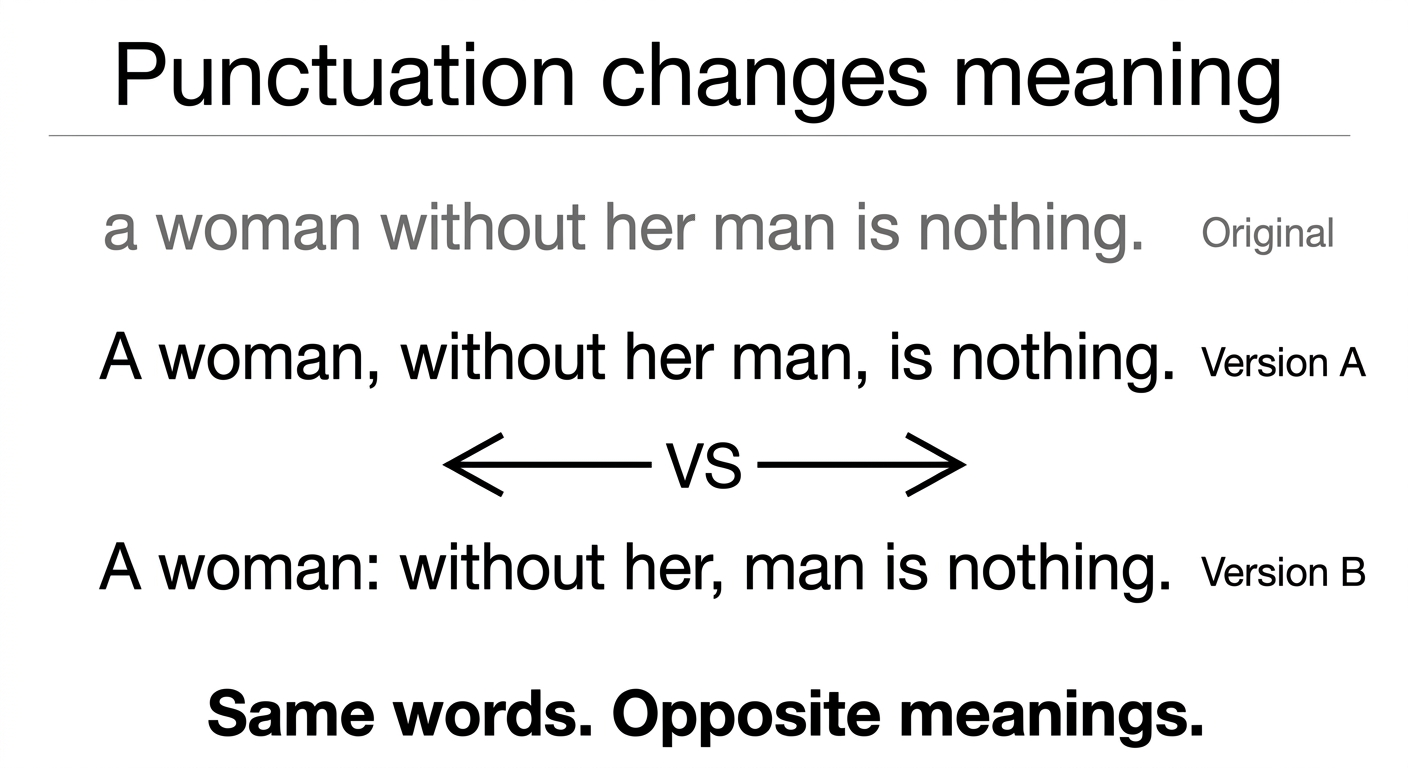
DISPLAY THE SENTENCE (10 seconds) — Write on the board with zero punctuation, all lowercase:
a woman without her man is nothing
Ask: "What does this sentence mean?" Let the room interpret it.
-
VERSION ONE (15 seconds) — Write it with punctuation:
A woman, without her man, is nothing.
This reads as: a woman is nothing without her man. A dependent, diminished reading.
-
VERSION TWO (15 seconds) — Write the same words with different punctuation:
A woman: without her, man is nothing.
This reads as: without the woman, MAN is nothing. The exact opposite meaning.
-
THE LESSON (30 seconds) — "Same words. Same letters. Same order. One comma changes the sentence from 'a woman needs a man' to 'a man needs a woman.' The punctuation didn't add words — it added MEANING. A tiny piece of context flipped the entire message."
What to Say
Opening: "Read this sentence." (Display unpunctuated version.) "What does it mean?"
After Version One: "Okay, this is one reading. Clear enough. But watch this..."
After Version Two: "Same seven words. Completely opposite meaning. The only thing that changed was a comma and a colon. Two tiny marks on a page reversed the entire point."
AI connection: "When AI generates text, it produces grammatically fluent sentences. But fluency isn't the same as intended meaning. A misplaced comma, a missing qualifier, a subtle word order change — and the AI says the opposite of what you needed. Punctuation is not optional. It's structural."
Why It Works
This exercise demonstrates syntactic ambiguity — sentences that are grammatically valid under multiple parse structures. The human brain resolves ambiguity using context, tone, and cultural expectation. Without punctuation, the sentence is genuinely ambiguous; both readings are syntactically valid. The reveal shows that the "obvious" reading was never the only reading — it was just the one your assumptions selected.
Linguist Noam Chomsky's work on surface structure vs. deep structure is directly relevant: the surface form (the words) is identical, but the deep structure (the meaning) is entirely different.
Teacher Tip
Let the room commit to one reading before showing the two versions. The surprise is bigger when people have publicly agreed on a meaning and then see it reverse. If you show both versions immediately, the exercise becomes a grammar lesson. If you let them commit first, it becomes a perception lesson.
Variations
Extended Examples
| Raw Sentence | Punctuated Version A | Punctuated Version B |
|---|---|---|
| let's eat grandma | Let's eat, Grandma! | Let's eat Grandma! |
| i like cooking my family and my pets | I like cooking, my family, and my pets. | I like cooking my family and my pets. |
| the man saw the woman with the telescope | The man saw the woman [who had] the telescope. | The man saw the woman [using] the telescope. |
The third example introduces structural ambiguity (who has the telescope?) — excellent for more advanced audiences.
For Different Subjects
- Law: "In legal contracts, a single comma has decided million-dollar lawsuits. The 'Oxford comma case' (O'Connor v. Oakhurst Dairy, 2017) turned on whether a missing comma changed the scope of an overtime exemption."
- AI Education: "AI doesn't understand intended meaning — it generates the most statistically likely next token. Whether the output means Version A or Version B is something only a human reader can evaluate."
For Different Ages
- Elementary (K-5): Use "Let's eat Grandma" — kids find it hilarious. The humor makes the lesson stick.
- College/Adult: Use the structural ambiguity example ("the man saw the woman with the telescope") and connect to legal, diplomatic, or AI-generated text.
Online Adaptation
Show the unpunctuated sentence via screen share. Ask participants to type their interpretation in chat. Then reveal both punctuated versions. The chat record shows which reading dominated — and who saw the alternative.
Troubleshooting
Challenge: Everyone sees both readings immediately. Solution: "Good — you're linguistically sophisticated. But most people default to one reading. The point isn't that you're clever — it's that the sentence genuinely supports BOTH meanings, and the only thing that determines which one you get is a tiny piece of punctuation."
Extension Ideas
- Deepen: Show an AI-generated paragraph where a single comma changes the meaning of a key sentence. Ask: "Which version did the AI intend?" (Trick question — AI doesn't intend anything.)
- Connect: Pair with Statement Stress (011) to show that spoken language adds meaning through emphasis, while written language adds meaning through punctuation.
Related Activities: Statement Stress, The X Activity, The Word That Is Everything