
How Many Squares? — Hidden Complexity
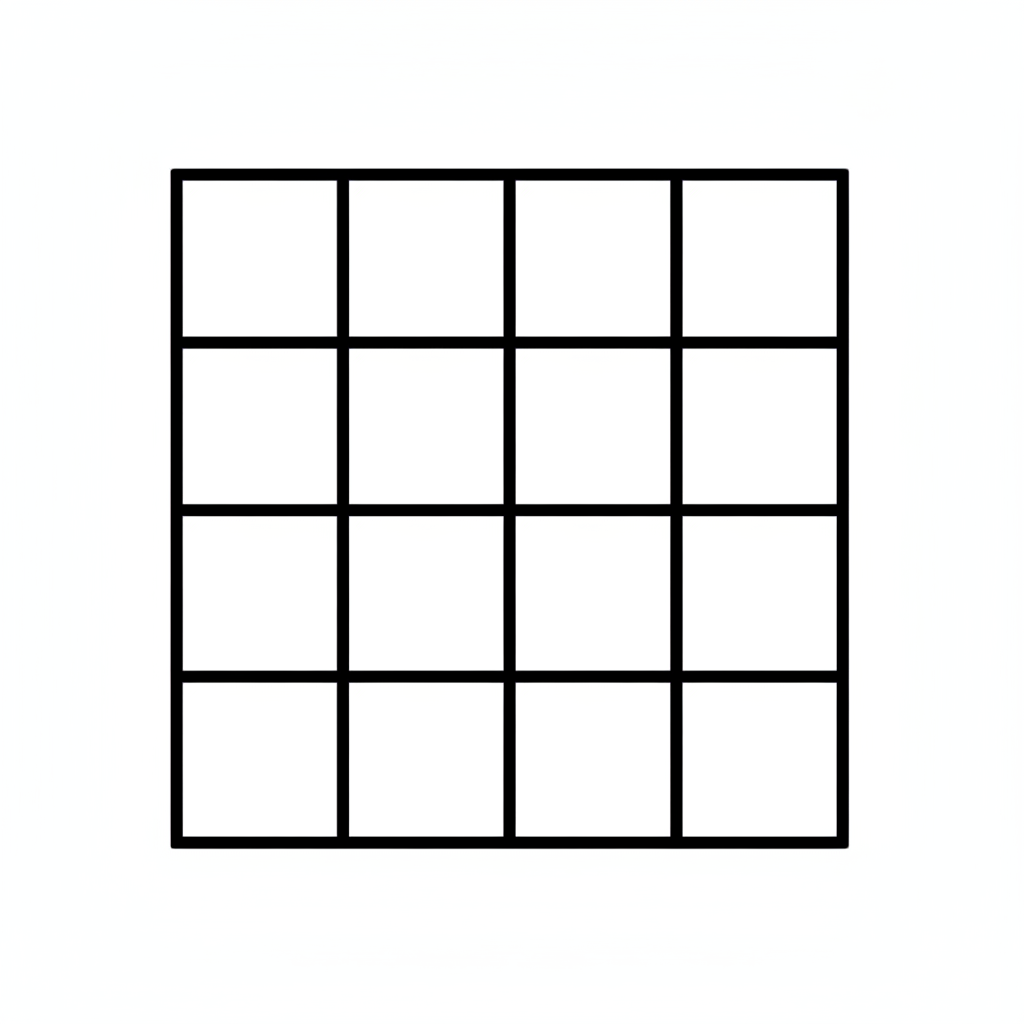
Display this grid and ask: "How many squares can you count?"
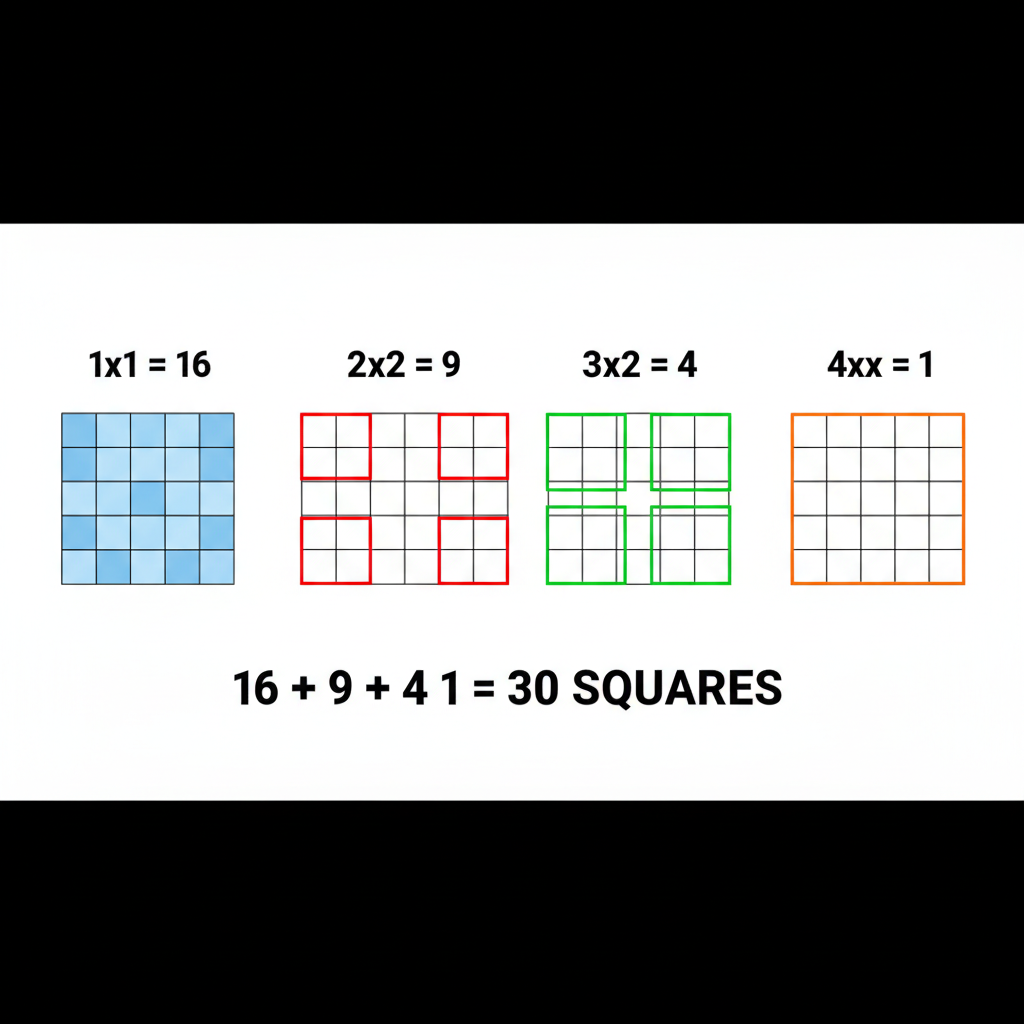
Then reveal the answer — squares at every size:
At a Glance
- Time: 3-4 minutes
- Prep: None (whiteboard or slide with a 4x4 grid)
- Group: Whole class (individual count, then progressive reveal)
- Setting: In-person, hybrid, or online
- Subjects: Universal (especially effective for math, AI education, systems thinking)
- Energy: Medium
Purpose
Demonstrate that the obvious answer is almost never the complete answer — and that deeper complexity hides inside apparent simplicity. When shown a 4x4 grid, most people immediately count 16 small squares and stop. But through progressive revelation, the count nearly doubles as 2x2, 3x3, and 4x4 squares emerge. This mirrors the X Activity's DNA perfectly: same visual, escalating context, expanding meaning. The lesson applies directly to AI literacy: when you accept AI's first answer, you're seeing the 16 and missing the other 14.
How It Works
Step-by-step instructions:
- DRAW THE GRID (10 seconds) — Draw a simple 4x4 grid on the board (16 small unit squares, like a larger tic-tac-toe board). Clean, clear lines.
- THE QUESTION (10 seconds) — Ask: "How many squares do you see?" Let them count silently for 10 seconds.
- THE OBVIOUS ANSWER (15 seconds) — "How many? Raise your hand if you got 16." Most hands go up. Write 16 on the board. "Anyone get more?" A few might say 17 or 20.
- PROGRESSIVE REVELATION — Layer 1 (20 seconds) — "But wait..." Trace a 2x2 square within the grid with your finger or a colored marker. "Is this a square?" Yes. "How many 2x2 squares can you find in this grid?" Let them think... the answer is 9. (A 2x2 square can start in any of 3 rows × 3 columns.) Write: 16 + 9 = 25.
- PROGRESSIVE REVELATION — Layer 2 (20 seconds) — Trace a 3x3 square. "How many of these?" The answer is 4 (2 rows × 2 columns of starting positions). Write: 25 + 4 = 29.
- PROGRESSIVE REVELATION — Layer 3 (10 seconds) — Trace the entire 4x4 outer border. "And this one?" That's 1 big square. Write: 29 + 1 = 30.
- THE LESSON (30 seconds) — "You started at 16 and the real answer is 30 — nearly double. The extra 14 squares were hiding in plain sight. You stopped at the first layer because the obvious answer felt complete. This is what happens when we accept AI's first answer — we get the 16, and miss the other 14."
What to Say
Opening: "Simple question." (Draw the grid.) "How many squares? Count them. You have 10 seconds."
After the first count: "16? Yeah, that's what most people get. And it's... not wrong. But it's not complete. Watch."
During progressive revelation: (Trace the first 2x2 square.) "Is this a square? Yes. How many of these exist? (Let them count.) Nine. So we're already at 25." (Trace a 3x3 square.) "What about this? Four of these. Now we're at 29." (Trace the full grid border.) "And the whole thing? That's one more. Thirty."
The lesson: "You looked at this grid and saw the obvious answer — 16. And you were ready to stop there because it felt complete. But the real answer was almost double. The complexity was hiding inside the simplicity. This is what happens with AI: it gives you the 16 — the surface answer, the obvious pattern. Your job is to keep looking until you find the 30."
AI connection: "When students use AI for research, they get the first-layer answer. Teaching them to probe deeper — to ask follow-up questions, to look for overlapping patterns, to question completeness — is OUR job as educators."
Why It Works
This activity leverages hierarchical pattern recognition — the brain's tendency to see the most granular units first and stop there, rather than recognizing patterns at multiple scales simultaneously. It's a visual metaphor for cognitive depth: surface-level analysis yields surface-level answers.
The progressive revelation mirrors the X Activity's structure: same visual, new context reveals new meaning. Each layer of squares was always there — the audience just wasn't looking for them. This is the perfect metaphor for the difference between shallow and deep analysis.
The math itself is satisfying: 1² + 2² + 3² + 4² = 1 + 4 + 9 + 16 = 30. For a general n×n grid, the total number of squares is n(n+1)(2n+1)/6. This formula-reveal can add an extra "aha" for math-oriented audiences.
Research basis: Gestalt psychology's principles of figure-ground organization and perceptual grouping explain why we see the smallest units first and must actively search for larger patterns.
Teacher Tip
Draw the grid LARGE — fill the entire whiteboard section. This makes it easy for everyone to see and makes the 2x2, 3x3, and 4x4 squares visually obvious when you trace them. If the grid is too small, the layered squares are hard to distinguish and the progressive revelation loses its impact. Also: use a different color marker for each layer of squares to make the visual distinction clear.
Variations
For Different Subjects
- Math: After the activity, challenge students to find the formula. "How many squares in a 5x5 grid? 6x6? Can you generalize?" (1² + 2² + ... + n² = n(n+1)(2n+1)/6.) This connects combinatorics to visual spatial reasoning.
- Science: "This grid is like an ecosystem. If you only count the species you can see (the 16), you miss all the relationships between them (the 14 hidden squares). Systems thinking means seeing the connections, not just the components."
- Literature: "A story has the obvious plot (the 16 squares) and the underlying themes, motifs, and subtext (the hidden squares). A shallow reading gives you 16. A deep reading gives you 30."
- AI Education: "When you ask AI 'what are the causes of World War I?' you get the 16 small squares — assassination of Franz Ferdinand, alliance systems, nationalism. But the complex, overlapping causes — the hidden 2x2 and 3x3 squares — require deeper investigation that AI's first answer won't provide."
- Project Management: "The tasks you can see (the 16) are always fewer than the tasks that actually exist (the 30). Dependencies, edge cases, and integration challenges are the hidden squares."
For Different Settings
- Large Audience (50+): Works perfectly. Project the grid large. Use colored overlays to highlight each layer.
- Small Class (5-15): Give each student a printed 4x4 grid and colored pencils. Have them find and color-code all 30 squares in pairs before the class reveal.
- Workshop/PD: After the reveal, ask: "In your current project or initiative, what are the 'hidden squares' — the complexity you haven't yet accounted for?"
For Different Ages
- Elementary (K-5): Use a 3x3 grid instead (simpler math). Total: 1 + 4 + 9 = 14 squares. Still surprising when they start at 9.
- Middle/High School (6-12): Full 4x4 version. Add the mathematical formula challenge.
- College/Adult: Full version plus connection to professional blind spots. "Where in your work are you seeing only the 16?"
Grid Size Scaling
| Grid | Small | 2x2 | 3x3 | 4x4 | 5x5 | Total |
|---|---|---|---|---|---|---|
| 3x3 | 9 | 4 | 1 | — | — | 14 |
| 4x4 | 16 | 9 | 4 | 1 | — | 30 |
| 5x5 | 25 | 16 | 9 | 4 | 1 | 55 |
Online Adaptation
Tools Needed: Screen share with grid image, annotation tools
Setup: Display a clean 4x4 grid via screen share.
Instructions:
- Show the grid. "Type your count in the chat. Don't overthink it."
- Watch the chat fill with "16" (and a few other numbers).
- Use annotation tools or pre-made overlay slides to trace each layer of squares.
- After the reveal, ask: "Who said 30 in the chat?" Screenshot the chat as evidence.
Pro Tip: Use a drawing tool to trace each hidden square in a different color on screen. The visual of red 1x1s, blue 2x2s, green 3x3s, and yellow 4x4 makes the layered complexity vivid.
Troubleshooting
Challenge: Someone immediately says 30. Solution: "Impressive! How did you get that?" They'll explain their method — which becomes a teaching moment about systematic analysis vs. surface scanning. "Most of the room saw 16 because they stopped at the first layer. What strategy did you use to find all 30?"
Challenge: Students get confused counting the 2x2 squares and argue about the number. Solution: Count them together systematically. "Start in the top-left corner — there's one 2x2 square. Slide it right — there's another. Slide again — that's three. Now move down to the second row..." Walk through the 3x3 grid of starting positions for the 2x2 squares.
Challenge: "But you said 'squares,' not 'all sizes of squares.'" Solution: "Exactly. I said 'how many squares do you see.' A 2x2 square IS a square. A 3x3 square IS a square. You made an assumption about what I meant — and that assumption limited what you saw. Where else do assumptions limit what you see?"
Extension Ideas
- Deepen: After the grid exercise, show an AI response to a complex question. Ask: "Is this a '16-squares' answer or a '30-squares' answer? What layers of complexity is it missing?" Have students identify the "hidden squares" in the AI's response.
- Connect: Challenge students to find "hidden squares" in a topic they're studying. "What's the obvious surface-level understanding? What are the deeper, overlapping patterns?"
- Follow-up: Start a class habit: when AI gives an answer, always ask at least 3 follow-up questions to find the "hidden squares." Track how often the follow-up questions reveal important information the initial answer missed.
Related Activities: The X Activity, Confirmation Bias Trap, Invisible Gorilla