
Hidden Rule — The Yes/No Wall
At a Glance
- Time: 3-5 minutes
- Prep: None (whiteboard with two columns)
- Group: Whole class (inductive reasoning)
- Setting: In-person, hybrid, or online
- Subjects: Universal (especially effective for science, research methods, logic)
- Energy: High (competitive and engaging)
Purpose
Build a concept definition from examples and non-examples — the same way real scientific thinking works. Two columns (YES and NO) are filled one example at a time. The audience must infer the hidden rule by analyzing what the YES examples share and what the NO examples lack. This teaches necessary vs. sufficient conditions, concept boundaries, and the critical skill of using non-examples (not just examples) to define a concept precisely.
How It Works
Step-by-step instructions:
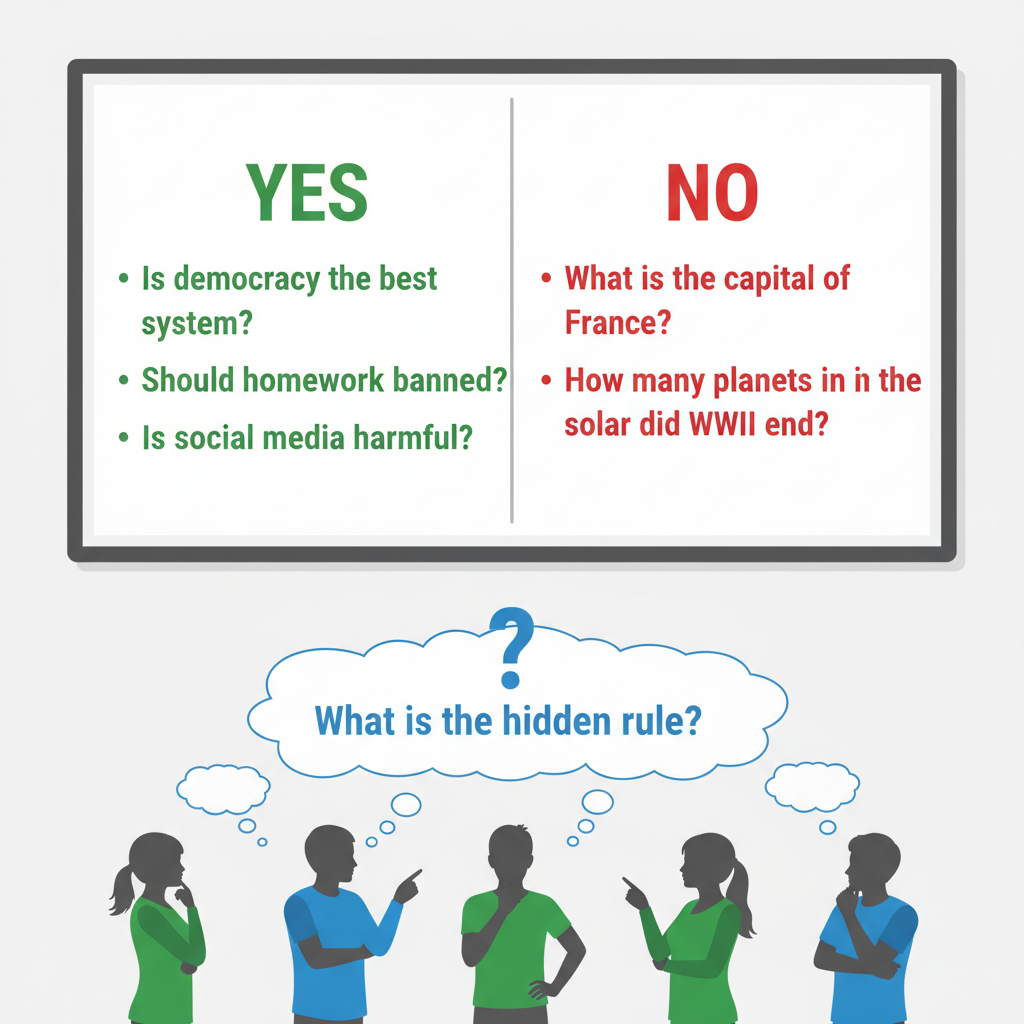
- DRAW TWO COLUMNS (5 seconds) — Label them YES and NO on the board.
- ADD EXAMPLES ONE BY ONE (2 minutes) — Place examples in each column, one at a time. After each addition, ask: "What's the rule?" Vary surface features to prevent superficial categorization:
- YES: "Is homework always bad?" / NO: "What is the capital of France?"
- YES: "Should schools ban phones?" / NO: "Define photosynthesis."
- YES: "Is AI making us lazy?" / NO: "List three types of rock." (Hidden rule: the YES column contains debatable questions; the NO column contains factual ones.)
- LET HYPOTHESES FORM (30 seconds) — The room will start generating hypotheses. Some will be wrong (too broad or too narrow). Continue adding examples that break incorrect hypotheses.
- THE BORDERLINE CASE (30 seconds) — Add a case that sits on the boundary: "Is climate change real?" Ask: "Which column?" This forces them to sharpen their definition — is it debatable in principle, or is the audience split on what counts as debatable?
- THE LESSON (30 seconds) — "You just built a definition from data — inductively, from examples, the way science works. The non-examples were as important as the examples. You couldn't define 'debatable question' without seeing what ISN'T one."
What to Say
Opening: "I have a rule. I'll show you examples that follow my rule (YES) and examples that don't (NO). Your job: figure out the rule."
After each addition: "Does this help? Changed your theory?"
After the borderline case: "This one is tricky. Is 'Is climate change real?' debatable? Some of you say yes (it's debated in public), some say no (the science is settled). Your disagreement about this borderline case IS the lesson — defining a concept precisely requires wrestling with edge cases."
AI connection: "When you ask AI to evaluate whether something is 'appropriate' or 'good' or 'valid,' AI needs a definition. But definitions have fuzzy boundaries. If YOU can't agree on the borderline cases, how can AI? The quality of AI classification depends on the precision of the concept you're asking it to apply."
Why It Works
Research on examples and non-examples (Deans for Impact, drawing on cognitive science) shows that varied examples help learners see deep structure, while contrasting non-examples reveal concept boundaries and reduce overgeneralizing. The YES column shows what a concept IS; the NO column shows what it ISN'T. Both are necessary for a precise definition.
This mirrors inductive reasoning in science: hypotheses are formed from observed patterns, tested against new data, and refined through counterexamples.
Research basis: Deans for Impact (2015). The Science of Learning. | Tennyson, R.D. & Park, O. (1980). The teaching of concepts: A review of instructional design literature. Review of Educational Research, 50(1), 55-70.
Teacher Tip
The rule must be non-obvious. If the YES/NO distinction is visible from the first two examples, the exercise is too easy. Vary surface features aggressively — if the rule is about sentence structure, make the topics wildly different so they can't use topic as a shortcut.
Variations
Strong Use Cases
| Domain | YES Column | NO Column | Hidden Rule |
|---|---|---|---|
| Research | Hypothesis-driven questions | Factual lookup questions | Testable vs. non-testable |
| Writing | Paraphrased sources | Plagiarized passages | Proper attribution vs. copying |
| History | Primary sources | Secondary sources | Created during event vs. after |
| Statistics | Causal claims | Correlational claims | Cause vs. association |
Best Closing Move
Always end with a borderline case after the room feels settled. "Which column does THIS go in, and why?" The borderline case is where the real thinking happens.
For Different Ages
- Elementary (K-5): Sort animals (YES: mammals, NO: not mammals). Add a platypus. Watch the chaos.
- College/Adult: Use disciplinary concepts where boundaries are genuinely contested.
Online Adaptation
Use a shared Google Doc or slide with two columns. Add examples live. Participants type their rule hypothesis in chat after each addition. The chat becomes a real-time hypothesis tracker.
Extension Ideas
- Deepen: After revealing the rule, ask students to CREATE their own Yes/No walls for a concept they're studying. Designing the non-examples requires deeper understanding than identifying the examples.
- Connect: Pair with Confirmation Bias Trap (006) — the Yes/No Wall teaches inductive reasoning from evidence. The 2-4-6 task shows how people fail at it when they only test confirming examples.
Related Activities: Confirmation Bias Trap, Which One Doesn't Belong, Precision Ladder