
Sound of Silence — Hidden Agency
At a Glance
- Time: 2-3 minutes
- Prep: None (whiteboard or slide)
- Group: Whole class (compare three sentences)
- Setting: In-person, hybrid, or online
- Subjects: Universal (especially effective for journalism, law, politics, media literacy)
- Energy: Medium
Purpose
Demonstrate that what is LEFT OUT of a sentence shapes its meaning as powerfully as what is included. By rewriting the same event three ways — active voice, passive voice, and agentless passive — the activity shows how language can spotlight or hide who did what. A critical reading skill for evaluating news, official statements, corporate communications, and AI-generated text.
How It Works
Step-by-step instructions:
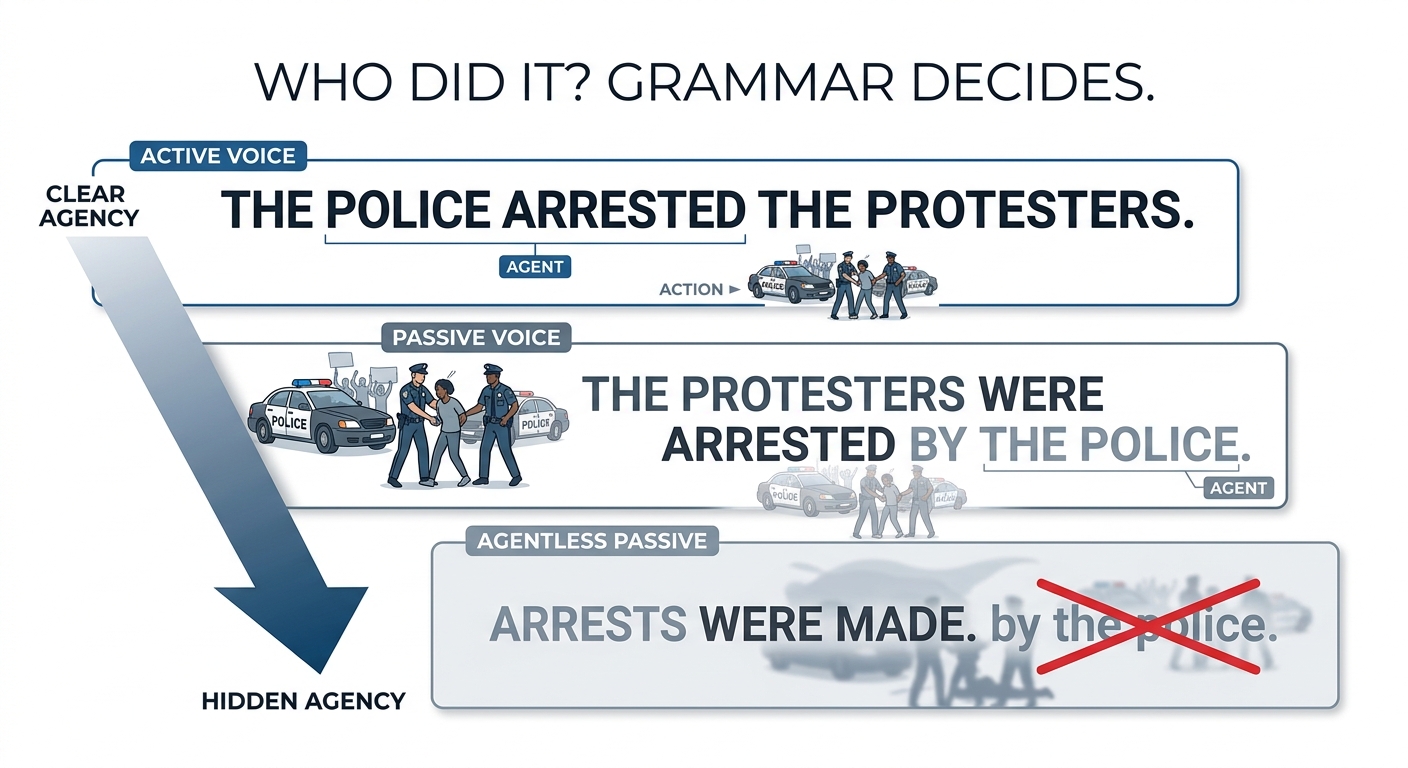
- SENTENCE 1 — ACTIVE (10 seconds) — Write: "The police arrested the protesters." Ask: "What picture does this create? Who is doing the action?"
- SENTENCE 2 — PASSIVE (10 seconds) — Write below it: "The protesters were arrested by the police." Ask: "What changed? Same event, same actors — what shifted?" The focus moved from police-as-agents to protesters-as-subjects.
- SENTENCE 3 — AGENTLESS (10 seconds) — Write: "Arrests were made." Ask: "What DISAPPEARED?" Both the police AND the protesters vanished. The action exists without any agent.
- THE QUESTION (20 seconds) — "Why would a newspaper, a government, or a corporation choose this version? What does hiding the agent accomplish?"
- THE LESSON (30 seconds) — "Active voice names the doer. Passive voice shifts focus away from the doer. Agentless passive erases the doer entirely. These are not grammar choices — they are political choices. Every sentence in every report, every news article, and every AI-generated summary makes this choice. Your job is to ask: who disappeared?"
What to Say
Opening: "I'm going to write the same event three ways. Watch what changes."
After the three versions: "Same event. Three sentences. In the first, the police are the main characters. In the second, the protesters are. In the third, nobody is — the action happens in a vacuum. 'Arrests were made' could have been done by police, by military, by anyone. And THAT is the point."
AI connection: "When AI summarizes events, it often defaults to passive constructions: 'mistakes were made,' 'problems were identified,' 'changes were implemented.' These sentences hide who is responsible. When reading AI output, always ask: who did this? If the sentence doesn't tell you, that's information you need to find."
Why It Works
This exercise demonstrates agentive framing — how grammatical choices determine who is perceived as responsible for an action. In media studies and critical discourse analysis, the shift from active to passive to agentless passive is one of the primary tools for managing attribution of responsibility.
George Orwell wrote about this in "Politics and the English Language" (1946): passive constructions enable vagueness, obscure responsibility, and create distance between actor and action. "Mistakes were made" is the political passive par excellence.
Teacher Tip
Use a real headline for maximum impact. Find a news headline using agentless passive ("shots were fired," "civilians were killed") and ask: "Who is missing from this sentence? Why?" The real-world application makes the grammar lesson unforgettable.
Variations
For Different Subjects
- Journalism: Compare how the same event is reported by different outlets. Does one use active voice (naming the agent) while another uses passive?
- History: "Columbus discovered America" vs. "America was discovered" vs. "Discovery occurred." Who appears and disappears in each version? What does that imply?
- Science: "The experiment showed..." vs. "It was shown that..." vs. "Results indicate..." Science writing conventions often favor passive voice — what does that hide?
- Law: "The defendant struck the victim" vs. "The victim was struck" vs. "An injury occurred." Legal framing directly determines perceived culpability.
For Different Ages
- Elementary (K-5): "The cat broke the vase" vs. "The vase was broken" vs. "The vase broke." Ask: "Where did the cat go?"
- College/Adult: Full version with media analysis and political implications.
Online Adaptation
Display the three sentences side by side via screen share. Ask: "Type in chat: which version would a government spokesperson choose? Why?" The chat discussion reveals sophisticated understanding of political language.
Extension Ideas
- Deepen: Give students an AI-generated summary of a historical event. Ask them to identify every passive construction and rewrite it in active voice. "Who did the AI hide? Was it accidental or structural?"
- Connect: Pair with Hidden Assumption (022) — one shows how grammar hides agency, the other shows how questions hide assumptions. Together they build comprehensive critical language analysis.
Related Activities: Hidden Assumption, Graph Without Axes, Statement Stress