
Dallenbach's Cow — Visual One-Shot Learning
The core concept: once you see it, you can never unsee it.
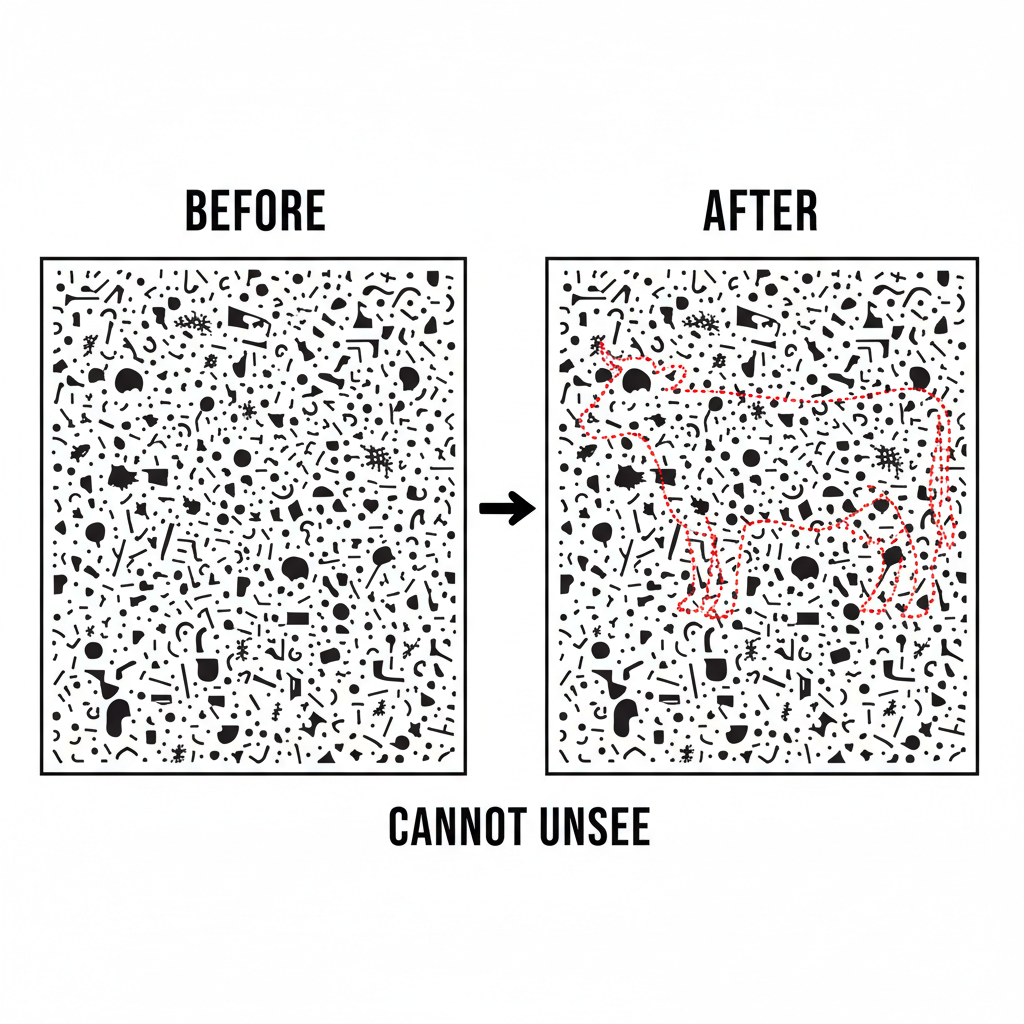
Where to find the classic image: Search for "R.C. James Dalmatian hidden figure" or "Dallenbach's Cow" — these famous two-tone images are widely available in psychology textbooks and educational resources. The original R.C. James photograph (1970) shows a Dalmatian dog sniffing the ground near a tree, hidden within abstract black-and-white splotches.
At a Glance
- Time: 2-3 minutes
- Prep: Minimal (slides with degraded image + clear outline version)
- Group: Whole class (observe, struggle, then reveal)
- Setting: In-person or hybrid (requires large projected image)
- Subjects: Universal (especially effective for psychology, leadership, change management)
- Energy: High (the "aha!" moment is electric)
Purpose
Demonstrate the concept of irreversible paradigm shifts. A heavily degraded black-and-white image appears as random splotches until the hidden figure is revealed — after which it can NEVER be unseen. Unlike the Duck-Rabbit where you can switch between interpretations, this is a one-way cognitive threshold. Once your brain sees the cow (or Dalmatian), the perception is permanently altered. This powerfully illustrates that learning changes the fundamental machinery of perception, and that once you see something, you cannot return to innocence.
How It Works
Step-by-step instructions:
- SHOW THE DEGRADED IMAGE (10 seconds) — Project Dallenbach's Cow or James's Dalmatian (a high-contrast, heavily degraded black-and-white image). Don't explain what it is. The image appears as random black and white splotches.
- ASK AND WAIT (30 seconds) — "Raise your hand if you can clearly identify the animal hidden in this picture." Initially, very few hands go up. Let the mild frustration build as eyes dart across the screen trying to find structure in chaos.
- THE REVEAL (10 seconds) — Switch to a slide showing the same image with the animal's outline highlighted in color, or show the original undegraded photograph. The audience immediately sees the animal.
- THE PARADIGM SHIFT (15 seconds) — Switch back to the original unmarked, degraded image. Ask: "Who can see it NOW?" Every hand goes up instantly. The random splotches have permanently organized into the animal.
- THE LESSON (30 seconds) — "You can never look at this image and see random splotches again. Your brain has permanently rewired how it processes this specific pattern. That is what a paradigm shift IS — not a preference change, not a mood change, but a permanent alteration of perception. Once you see it, you cannot unsee it."
What to Say
Opening: "Look at this image carefully. There's a specific animal hiding in these black and white shapes. Can you find it?"
During the struggle: (Let them struggle for 20-30 seconds. The tension builds the payoff.)
After the reveal: "See it? Now..." (Switch back to the original.) "Can you UN-see it? Can you go back to seeing random splotches?" (They can't.) "That's a paradigm shift. Your perception has been permanently altered."
Leadership connection: "When you're leading a team through change — a new system, a new strategy, a new way of thinking — they are staring at the ink splotches. They literally cannot see what you see. Expressing frustration that the vision is 'obvious' is like being frustrated that someone can't find the cow. Your job is to outline the figure for them. Once they see it, they'll never unsee it."
AI connection: "This is also how learning to spot AI-generated content works. Once someone shows you the patterns — the too-perfect transitions, the confident but unsourced claims, the formulaic structure — you can never unsee them. You've permanently changed how you read."
Why It Works
This activity demonstrates Gestalt emergence — the brain's ability to suddenly organize fragmentary visual data into a coherent whole. The shift from "random noise" to "cow" is not gradual; it's sudden and complete. Perceptual psychologist Karl Dallenbach (1951) and Ronald C. James (1970) used these images to study visual one-shot learning — the phenomenon where a single exposure to the correct interpretation permanently changes perception.
The neurological mechanism involves prediction error minimization: once the brain has a template (cow/Dalmatian), it forcefully imposes this template on the sensory input, and the prediction error drops dramatically. The "aha!" moment is the brain resolving a massive prediction error all at once.
Crucially, the learning is irreversible. Unlike bistable images (duck-rabbit), which toggle between two stable states, Dallenbach's images cross a one-way threshold. This makes them uniquely powerful for teaching about paradigm shifts, change management, and the permanent nature of genuine learning.
Research basis: Dallenbach, K.M. (1951). A puzzle-picture with a new principle of concealment. American Journal of Psychology, 64, 431-433. | Gregory, R.L. (1970). The Intelligent Eye.
Teacher Tip
Use the HIGHEST resolution version of the image you can find, projected as large as possible. The degraded image needs to be genuinely ambiguous at first glance. If the image is too small or low-quality, people might see the animal immediately (defeating the purpose) or never find it (creating frustration without payoff). Test the image from the back of the room before the session.
Variations
Alternative Images
- James's Dalmatian — A Dalmatian dog sniffing the ground in a spotted, shadowy scene. Perhaps the most famous example.
- Mooney Faces — High-contrast two-tone faces that are unrecognizable until the original photograph is shown.
- Hidden animal puzzles — Various degraded nature photographs where animals are camouflaged.
For Different Subjects
- Psychology: Full debrief on bottom-up vs. top-down processing, Gestalt principles, and the role of expectation in visual perception.
- Change Management: "When employees resist a new strategy, they're looking at ink splotches. They can't see the vision. You must outline the figure. Once they see it, resistance transforms into clarity."
- Medical Education: This exercise is used to simulate aspects of Cortical Visual Impairment (CVI), helping healthcare providers understand the latency and complexity challenges faced by patients.
- AI Education: "AI 'sees' images through pattern matching. When the patterns are degraded or ambiguous, AI struggles — just like you did. Understanding HOW perception works helps you understand both human and artificial cognition."
For Different Ages
- Elementary (K-5): Use simpler hidden picture puzzles where animals are camouflaged in nature scenes.
- College/Adult: Full version with the irreversibility discussion and its implications for learning, leadership, and epistemology.
Online Adaptation
Share the degraded image via screen share at maximum resolution. "Type in chat if you can identify the animal." Wait 30 seconds (the chat will show confusion). Then share the revealed version. Switch back to the original. "Can you see it now? Type YES or NO." The instant flood of "YES" demonstrates the permanent shift.
Troubleshooting
Challenge: Too many people see the animal immediately (image too easy or audience has seen it before). Solution: If they've seen the specific image, use a different degraded image. If it's too easy, find a more heavily degraded version.
Challenge: Someone still can't see the animal after the reveal. Solution: Use a colored outline overlay that traces the animal directly on the degraded image. Rotate the slide slowly while pointing. Once they finally see it, ask: "How does it feel to suddenly see what was always there?" That experience IS the lesson.
Extension Ideas
- Deepen: Show a series of increasingly degraded images and ask: "At what point does the pattern become unrecognizable?" This builds understanding of signal-to-noise ratio and the threshold of perception.
- Connect: Pair with the Duck-Rabbit (003) for a powerful contrast: the Duck-Rabbit is reversible (you can toggle between interpretations). Dallenbach's Cow is irreversible (once seen, never unseen). "Some paradigm shifts are choices. Others are permanent. Learning is permanent."
Related Activities: Duck-Rabbit, Droodles, Laundry Paragraph