
The Laundry Paragraph — Schema Activation
At a Glance
- Time: 3-4 minutes
- Prep: Minimal (one slide with a paragraph, no title)
- Group: Whole class (read, recall, then reveal)
- Setting: In-person, hybrid, or online
- Subjects: Universal (especially effective for psychology, education, AI, communication)
- Energy: Medium
Purpose
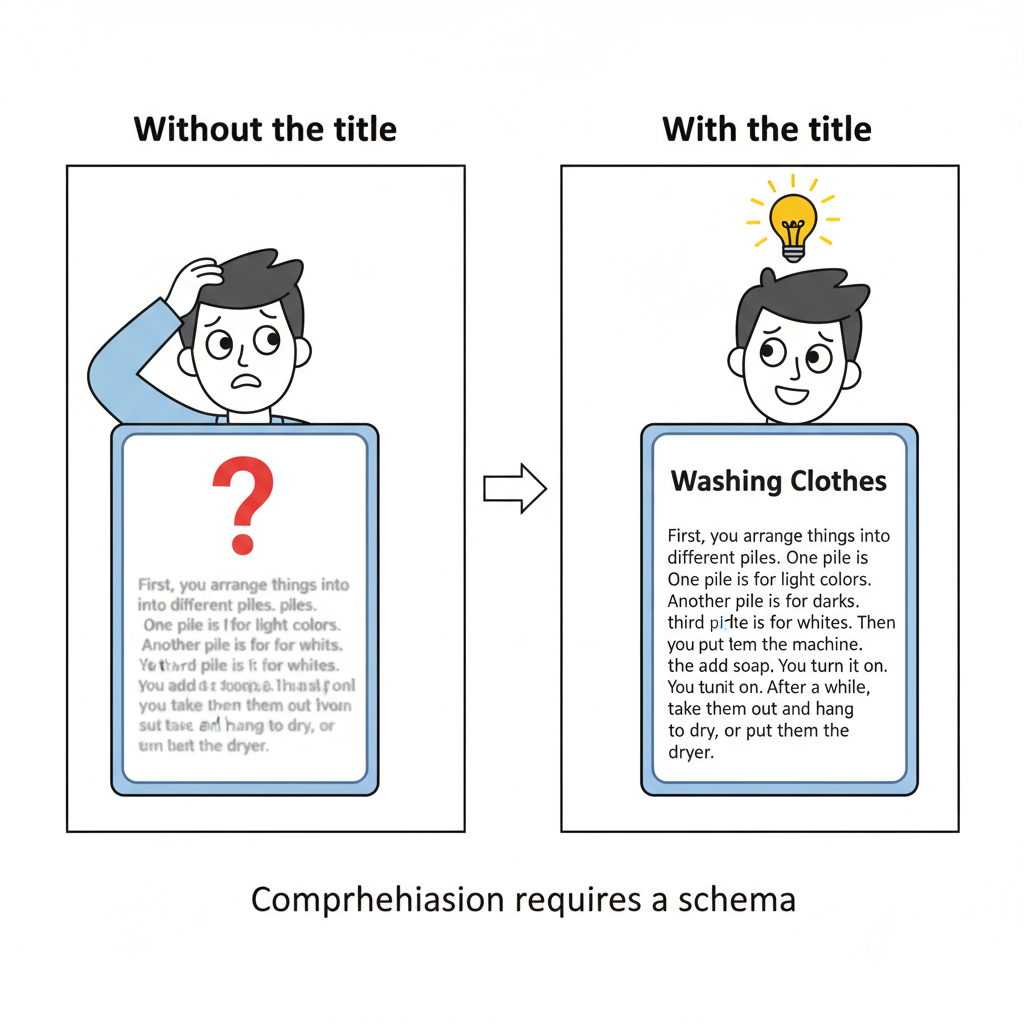
Demonstrate that comprehension requires a schema — a mental framework — before content arrives. A perfectly grammatical paragraph about doing laundry is utterly incomprehensible without the title. The moment you add the two-word title "Washing Clothes," every sentence snaps into focus. This proves that context must precede content for the brain to encode information — and that "clear writing" is only clear when the reader has the right framework.
How It Works
Step-by-step instructions:
-
DISPLAY THE PARAGRAPH (10 seconds) — Show this text with NO title, NO preamble, NO imagery:
"The procedure is actually quite simple. First you arrange things into different groups. Of course, one pile may be sufficient depending on how much there is to do. If you have to go somewhere else due to lack of facilities that is the next step, otherwise you are pretty well set. It is important not to overdo things. That is, it is better to do too few things at once than too many. In the short run this may not seem important but complications can easily arise. A mistake can be expensive as well. At first the whole procedure will seem complicated."
-
READ AND RECALL (45 seconds) — Ask the audience to read silently and try to understand and remember the key points. After 30 seconds, hide the slide. Ask: "What was this about? Can anyone explain it?"
-
THE STRUGGLE (30 seconds) — Most will recall fragments — "different groups," "expensive mistake," "complications" — but nobody can articulate what the paragraph is actually describing. Some will guess: a scientific procedure? Moving house? Cooking?
-
THE REVEAL (10 seconds) — Show the paragraph again, but this time add a title at the top: Washing Clothes.
-
THE TRANSFORMATION (30 seconds) — Ask them to read it again. "Different groups" = sorting lights and darks. "Lack of facilities" = going to a laundromat. "Expensive mistake" = shrinking a wool sweater. Every sentence instantly resolves. The room goes from confusion to complete clarity in seconds.
-
THE LESSON (30 seconds) — "The paragraph didn't change. Every word is the same. What changed is that you now have a SCHEMA — a mental framework — to organize the information. Without the title, your brain had no filing cabinet. With it, every sentence has a home."
What to Say
Opening: "Read this paragraph carefully. Try to understand it and remember it. You have 30 seconds."
After hiding the slide: "What was it about? (Take a few answers.) Not sure? You read every word. The grammar was perfect. The vocabulary was simple. Why can't you explain what it means?"
After the reveal: "'Washing Clothes.' Read it again. (Pause.) See how every sentence just clicked? 'Arrange things into different groups' — that's sorting laundry. 'A mistake can be expensive' — that's the wool sweater you accidentally washed on hot. Nothing in the text changed. Your BRAIN changed because it now has a framework to organize the information."
AI connection: "This is why prompt engineering matters. When you ask AI a question without context — without a 'title' for what you want — you get a response that's grammatically perfect but semantically unfocused. The AI's output is the paragraph without the title. YOUR context is the title. Provide it first."
Why It Works
This activity replicates the classic Bransford and Johnson (1972) experiment, one of the foundational studies in cognitive psychology. They showed that comprehension and recall are dramatically improved when contextual information precedes the content, compared to providing context afterward or not at all.
The key finding: providing the title AFTER reading helped minimally. The schema must be activated BEFORE encoding for it to organize incoming information effectively. This proves that comprehension is not passive absorption — it's active construction that requires a pre-existing framework.
Research Citation: Bransford, J.D., & Johnson, M.K. (1972). Contextual prerequisites for understanding: Some investigations of comprehension and recall. Journal of Verbal Learning and Verbal Behavior, 11(6), 717-726.
Teacher Tip
Do NOT show the title first. The entire power of this activity depends on the audience experiencing genuine confusion with the untitled paragraph. If even one person calls out "It's about laundry!" before the reveal, the experience collapses. Keep the reveal moment tight: hide the slide, discuss confusion, then reveal with the title added. The contrast between confusion and clarity IS the lesson.
Variations
Alternative Paragraphs
Bransford and Johnson used several ambiguous paragraphs. Another famous one describes what sounds like a surreal sci-fi scenario but is actually about playing a guitar/serenade from a distance using a microphone suspended by balloons.
You can also create your own: describe any common activity (making coffee, parallel parking, brushing teeth) using only abstract, category-level language without naming the activity. Test it on a colleague — if they can't guess, it works.
For Different Subjects
- Education/PD: "This is why learning objectives matter. When students walk into class without knowing the topic, they're reading the paragraph without the title. A clear learning objective IS the title. It activates the schema before content arrives."
- Business: "When a CEO announces strategy without first explaining the 'why,' every employee reads a different paragraph. Providing context before content is not optional — it's neurological necessity."
- AI Education: "Prompting AI is titling the paragraph. A vague prompt produces a vague response — not because AI is bad, but because you didn't provide the schema."
- Science: "This is why theory before experiment matters. A theoretical framework organizes observations. Without it, data is noise."
For Different Ages
- Elementary (K-5): Read a story description aloud: "First you get the stuff ready. You put it on the thing. Then you add the other stuff on top. You put more stuff on top of that. Then you put it in the hot thing for a while." (It's a sandwich or pizza.) Kids love guessing.
- College/Adult: Full Bransford & Johnson version with the academic context and implications for knowledge transfer and curriculum design.
Online Adaptation
Display the untitled paragraph via screen share. After 30 seconds, ask: "Type in chat what this is about." The chat will show wildly divergent guesses. Then reveal the title and ask everyone to re-read. Follow up in chat: "Does it make sense now?" The collective "ohhhh" in chat is the online equivalent of the classroom gasp.
Troubleshooting
Challenge: Someone guesses "laundry" before the reveal. Solution: If it happens early, pivot: "Interesting guess! Let's see if anyone else agrees." If most disagree, proceed with the reveal. If the guess catches on, acknowledge it and still do the reveal formally — the experience of re-reading with the title is still powerful even if some guessed correctly.
Challenge: Audience says "The paragraph was just poorly written." Solution: "Actually, it's perfectly grammatical and uses simple vocabulary. It feels confusing not because it's badly written, but because YOU don't have the schema. The writing is fine. The context is missing. And that's the point — 'clear writing' is only clear when the reader has the right framework."
Extension Ideas
- Deepen: Have students write their own "laundry paragraphs" — describe a common activity using only abstract language. Swap with a partner. Can they guess? This builds metacognitive awareness of how much we rely on context.
- Connect: Pair with The X Activity (001) for a powerful combination: "Two crossing lines need context to become meaningful. An entire paragraph needs context too. If this is true at every scale — symbols, words, paragraphs — what does that mean for how we teach, lead, and communicate?"
Related Activities: The X Activity, Dallenbach's Cow, The Tapping Experiment