
Half a Case — Predict the Outcome
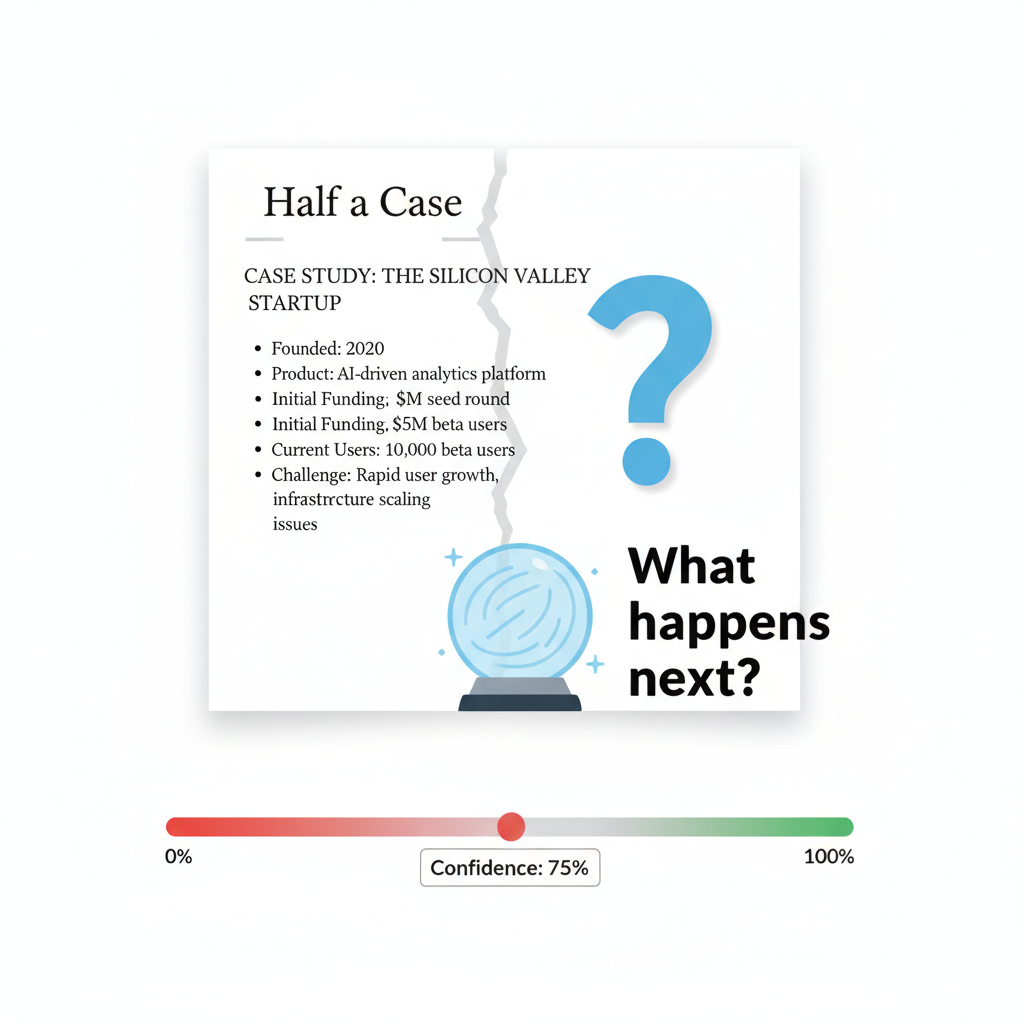
At a Glance
- Time: 3-5 minutes
- Prep: Minimal (a case study, story, experiment, or demo prepared to stop halfway)
- Group: Whole class (predict + compare)
- Setting: In-person, hybrid, or online
- Subjects: Universal (especially effective for science, history, law, medicine)
- Energy: High (the reveal creates strong reactions)
Purpose
Stop a case study, experiment, proof, demo, or story exactly at the midpoint and ask the audience to predict what happens next — plus rate their confidence. Then reveal the actual outcome. The gap between prediction and reality exposes hidden assumptions and builds the habit of revising mental models when surprised. Research shows that making a prediction changes how people process the answer, especially when the outcome surprises them.
How It Works
Step-by-step instructions:
- SET UP THE CASE (30 seconds) — Present the first half of a case study, historical event, experiment, or story. Include enough detail to form a reasonable prediction, but stop at the decision point or turning point.
- PREDICT (30 seconds) — "What happens next? Write down your prediction AND your confidence level: 1 (wild guess) to 5 (certain)."
- SHARE (30 seconds) — "Hands up: who predicted outcome A? B? C? And how confident were you?" Map the predictions on the board.
- THE REVEAL (30 seconds) — Show the actual outcome. If it matches most predictions, ask: "What made this predictable?" If it surprises, ask: "What assumption misled you?"
- THE DEBRIEF (60 seconds) — "Look at your confidence rating. If you were at 4 or 5 and got it wrong, that overconfidence is data. It tells you something about which assumptions you're treating as facts. The point of prediction isn't to be right — it's to make your assumptions visible so you can examine them."
What to Say
Opening: "I'm going to tell you half a story. Then you're going to predict the ending. And you're going to tell me how SURE you are."
After the reveal: "Most of you predicted [X]. The actual outcome was [Y]. What assumption led you astray? (Let them articulate.) Good — you assumed [Z] because it felt obvious. But 'obvious' is just another word for 'unexamined assumption.'"
AI connection: "When AI predicts outcomes — in medicine, in finance, in law — it's doing exactly what you just did: using patterns from past cases to project forward. And it's wrong for the same reasons you were: hidden assumptions, missing context, and overconfidence in patterns that don't always hold."
Why It Works
Prediction research demonstrates that making a prediction changes how people process the subsequent answer (Brod, Hasselhorn, & Bunge, 2018). When the outcome is surprising, the prediction-error signal strengthens encoding of the correct information. This means that being WRONG (after committing to a prediction) actually produces better learning than passively receiving the correct answer.
Productive failure research (Kapur, 2008) supports the same principle: a brief attempt before explanation deepens understanding because the struggle creates cognitive structures that the explanation then fills.
Research basis: Brod, G., et al. (2018). When generating a prediction boosts learning. Psychonomic Bulletin & Review, 25, 2061-2067. | Kapur, M. (2008). Productive failure. Cognition and Instruction, 26(3), 379-424.
Teacher Tip
Ask for TWO possible outcomes before the reveal, not just one. The first prediction is often the most obvious/intuitive answer. The second prediction forces deeper thinking and often surfaces the actual outcome. It also protects against overconfidence — if you have two predictions, you're acknowledging uncertainty.
Variations
Strong Use Cases
| Domain | Half-Case Setup | Surprising Outcome |
|---|---|---|
| Science | Describe an experiment setup and hypothesis | The data showed the opposite |
| History | Describe the situation before a key decision | The leader made the unexpected choice |
| Law | Present the case facts and arguments | The court ruled against expectations |
| Education | Describe a teaching intervention's design | Student outcomes were counterintuitive |
| Business | Present a company's strategy and market conditions | The company failed/succeeded against predictions |
For Different Subjects
- Science: Stop a demonstration halfway. "What will happen when I add this chemical?" Predict, then observe.
- History: "It's 1941. Japan is considering targets. Predict their strategy." The choice of Pearl Harbor surprises because it seems strategically irrational without deeper context.
- Literature: Stop a story at the turning point. "How does this end?" Compare predictions to the author's actual resolution.
For Different Ages
- Elementary (K-5): Stop a read-aloud story at the climax. "What happens next? Draw your prediction!"
- College/Adult: Use real-world case studies with counterintuitive outcomes.
Online Adaptation
Present the half-case via screen share. Use a poll for predictions and confidence ratings. After the reveal, show the poll results next to the actual outcome. The documented overconfidence is powerful visual evidence.
Extension Ideas
- Deepen: Track prediction accuracy across a semester. Do students get better at calibrating their confidence? The goal isn't 100% prediction accuracy — it's improved calibration (when you say 4/5 confidence, you should be right about 80% of the time).
- Connect: Pair with Confirmation Bias Trap (006) — prediction failures often stem from the same confirmation bias: we predict the outcome that confirms our existing model and fail to consider alternatives.
Related Activities: Confirmation Bias Trap, Four Voices, How Many Squares